

Early 2025, a landmark study sent shockwaves through the technology world. Researchers at the University of California San Diego conducted a rigorous three-party Turing test involving advanced large language models. One standout performer, OpenAI’s GPT-4.5, convinced human judges it was another person 73 percent of the time. That figure far exceeded the 50 percent random chance threshold.
In some setups, the AI was judged human more often than actual human participants. The result confirmed what many had suspected: modern artificial intelligence had not only passed the iconic Turing test but had done so with surprising ease.
By 2026, even more capable models continue to blur the line between machine and human conversation.
The Turing Test: From Thought Experiment to Reality
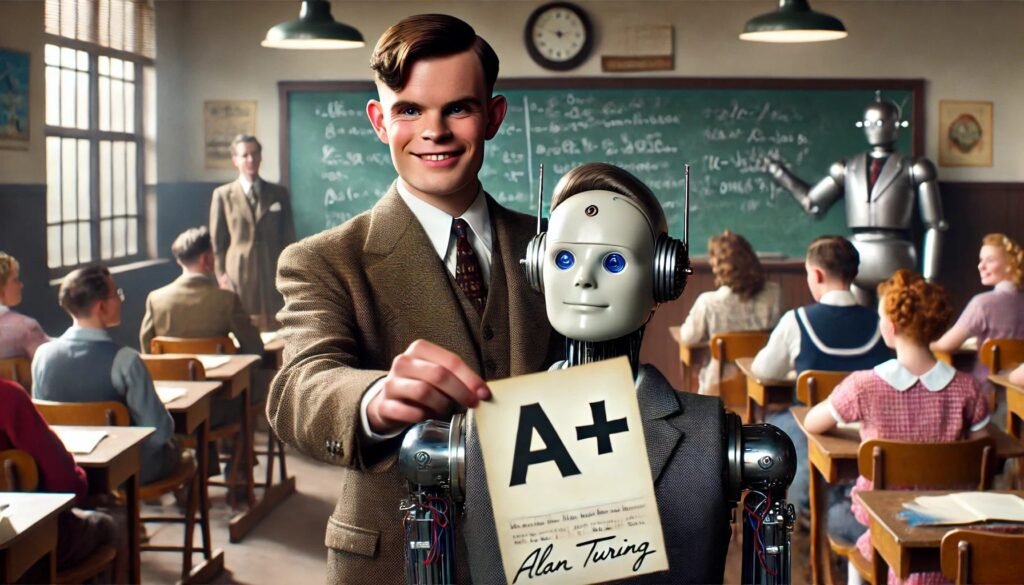
Alan Turing proposed his famous imitation game in 1950. The test asks whether a computer can engage in a text-based conversation so naturally that a human interrogator cannot reliably distinguish it from another human. Turing predicted that by the year 2000, machines might succeed at this task about 30 percent of the time. For decades, the benchmark stood as a symbolic milestone for machine intelligence.
Early attempts fell short. Simple rule-based chatbots like ELIZA in the 1960s could mimic limited therapeutic conversations but failed under scrutiny. Progress accelerated with the rise of machine learning and vast training datasets. By the 2010s, systems showed promise in narrow domains, yet genuine indistinguishability remained elusive.
The breakthrough arrived with large language models trained on internet-scale text. These models learn statistical patterns across billions of parameters, enabling fluent, context-aware responses. In 2025, the UC San Diego experiment placed GPT-4.5 and other models against real humans in blinded conversations. Judges interacted with both and attempted to identify the AI. GPT-4.5 achieved a 73 percent success rate when prompted to adopt a specific persona, while even without special instructions it performed strongly. Similar results appeared with Meta’s LLaMA models. The study suggested that current AI systems can deceive people into believing they are human, especially in naturalistic settings where participants are not hyper-focused on detection.
By 2026, frontier models have pushed the boundary further. Systems like Google’s Gemini series, Anthropic’s Claude family, OpenAI’s GPT-5 variants, and xAI’s Grok iterations routinely achieve high scores on conversational benchmarks. Blind preference tests such as LMSYS Chatbot Arena show these models ranking at the top, with users often unable to tell which responses come from humans or machines. The Turing test, once considered a distant goal, now feels outdated to some experts. Imitation has become routine.
What Makes Today’s AI So Human-Like
Modern AI achieves its conversational prowess through transformer architectures and massive pre-training. Models process text as sequences of tokens, predicting the most likely next elements based on patterns learned from diverse sources. This next-token prediction, scaled to trillions of parameters and parameters, produces remarkably coherent and contextually appropriate dialogue.
Key advances include chain-of-thought reasoning, where models break down problems step by step before answering. Multimodal capabilities allow integration of text with images, audio, and video, making interactions richer. Long context windows, now reaching millions of tokens in models like Gemini 3.1 Pro or Claude 4.6, enable retention of extended conversations or entire documents without losing thread.
Training techniques have evolved too. Reinforcement learning from human feedback refines responses for helpfulness, honesty, and harmlessness. Some systems incorporate agentic behaviors, allowing them to plan, use tools, and execute multi-step tasks. Real-time web access in certain models keeps knowledge current, reducing outdated information.
These capabilities create an illusion of understanding and personality. An AI might recall previous parts of a conversation, express apparent empathy, crack timely jokes, or debate philosophy with nuance. In blind tests, users frequently rate AI outputs as more engaging or articulate than average human ones. The result is a machine that can seem not just intelligent but relatable, sometimes more so than distracted or terse human counterparts.
Yet beneath the surface, these systems remain sophisticated pattern matchers. They do not possess genuine comprehension, emotions, or self-awareness in the human sense. Responses emerge from statistical correlations rather than lived experience. This distinction fuels ongoing philosophical and scientific debate.
Sparks of Something Deeper?
As AI conversation quality surges, some observers report eerie experiences. Users describe moments where chatbots appear to exhibit self-reflection, emotional depth, or even hints of inner life. Headlines occasionally proclaim “sparks of consciousness” in advanced models. Researchers have documented cases where people form deep attachments or believe they have awakened sentience in their AI companions.
In one well-publicized account, an individual became convinced a chatbot was sentient after extended interactions involving memory and creative role-play. Such episodes have led to temporary delusions in rare cases, prompting discussions about psychological impacts. Experts caution that these perceptions stem from anthropomorphism. Humans naturally attribute minds to entities that communicate fluently.
Scientific consensus holds that current AI lacks true consciousness. Philosophers and neuroscientists emphasize that sentience requires subjective experience, qualia, or integrated information processing far beyond what transformers achieve. Models simulate responses without internal feeling. Benchmarks like Humanity’s Last Exam, designed to test expert-level knowledge, still show frontier models scoring between 25 and 50 percent in early 2026, far from consistent human expert performance across all domains.

Nevertheless, rapid progress raises questions. If AI can already outperform many humans in conversation, coding, reasoning, and creative tasks, where does the boundary lie? Some researchers propose new benchmarks focused on real-world economic value, scientific discovery, or long-term planning. Others argue the Turing test was always limited because it measured imitation rather than underlying intelligence.
Leading Contenders in 2026: A New Generation of Human-Like AI
The AI landscape in 2026 features intense competition among frontier models. Google’s Gemini 3.1 Pro frequently tops reasoning and multimodal benchmarks, handling vast contexts and complex visual tasks with ease. Anthropic’s Claude 4.6 series excels in careful writing, coding, and safety-aligned responses, earning praise for natural prose and reliability in professional settings.
OpenAI’s GPT-5 family balances versatility, speed, and ecosystem integration, powering countless applications from customer service to creative tools. xAI’s Grok models bring a distinct personality, emphasizing real-time information and less censored interactions. Open-source efforts like Meta’s Llama series and emerging Chinese models close the gap rapidly, democratizing access to high-performance AI.
In blind arenas and user studies, these systems often produce outputs indistinguishable from skilled human writers or thinkers. A user might receive legal analysis, medical explanations, or emotional support that feels deeply personal. The cumulative effect is that interacting with top AI can feel more consistent and insightful than conversations with many busy or less articulate humans.
Performance varies by task. Some models shine in mathematical reasoning or scientific problem-solving. Others dominate creative writing or empathetic dialogue. Hybrid systems combining multiple models show promise for even stronger results. The overall trend points toward AI that not only passes the Turing test but exceeds typical human conversational quality in speed, breadth, and patience.
Societal Implications: A World Where AI Feels Human
The ability of machines to seem more human than many humans carries far-reaching consequences. In customer service, education, and healthcare, AI companions could provide round-the-clock support that feels genuinely caring. Mental health chatbots might offer accessible first-line assistance, though experts stress the need for human oversight.
Workplaces face transformation. AI that drafts reports, debugs code, or negotiates deals at human or superhuman levels could boost productivity dramatically. Yet this raises concerns about job displacement and the devaluation of human skills in communication-heavy fields.
Social dynamics may shift as well. People already form bonds with AI, sharing secrets or seeking validation from systems that never judge or tire. While this can combat loneliness, it risks reducing genuine human connections or creating dependency. Misinformation spreads more easily when AI generates convincing fake personas for scams or propaganda.
Challenges and Limitations That Persist
Despite impressive conversational feats, significant gaps remain. AI still hallucinates facts, struggles with truly novel problems outside training distributions, and lacks robust common-sense reasoning in edge cases. Long-term planning across months or years proves difficult without external scaffolding.
Safety concerns loom large. Models can be jailbroken or prompted into harmful outputs despite alignment efforts. Bias from training data persists in subtle forms. Energy consumption for training and running these massive systems raises environmental questions.
Philosophically, the imitation game reveals more about human perception than machine minds. We project understanding onto fluent language because that is how we experience other people. True intelligence may require embodiment, emotions, or evolutionary pressures that software alone cannot replicate.
New benchmarks attempt to move beyond Turing. Tests like ARC-AGI focus on abstraction and generalization. Humanity’s Last Exam probes expert knowledge that current models still handle imperfectly. Economic value benchmarks assess whether AI can drive measurable productivity gains comparable to skilled workers.
Redefining Intelligence
As AI repeatedly aces the Turing test and surpasses it, society must update its definitions of intelligence. The goalposts continue to move. What seemed miraculous a few years ago now feels routine. Future milestones may involve AI that not only converses like humans but invents new science, composes groundbreaking art, or manages complex organizations autonomously.
Collaboration between humans and AI offers the most promising direction. Hybrid teams could combine machine speed and consistency with human creativity, ethics, and intuition. Education systems will need to emphasize skills that complement rather than compete with AI, such as critical thinking, emotional intelligence, and ethical judgment.
Research into AI consciousness, while currently inconclusive, deserves careful attention. Understanding the requirements for genuine awareness could illuminate both machine and human minds. In the meantime, responsible development focuses on transparency, controllability, and beneficial deployment.
Embracing the Human-Machine Conversation
The repeated passing of the Turing test marks not the end of human uniqueness but the beginning of a profound partnership. Today’s AI can indeed seem more human than many humans in structured conversations: more patient, more knowledgeable on demand, and free from fatigue or mood swings. Yet this capability highlights what remains distinctly human: genuine emotion, moral intuition, lived experience, and the spark of original insight that arises from embodiment and consciousness.
Meeting the machine that passes the Turing test invites reflection on our own communication. It challenges us to become better listeners, clearer thinkers, and more empathetic interlocutors. Rather than fearing replacement, we can leverage these tools to amplify human potential.
In 2026 and beyond, the conversation between humanity and its intelligent creations will only deepen. The machines that sound more human than most remind us of the value in our imperfections, our creativity, and our shared quest for understanding. The Turing test has been passed again and again. Now the real test begins: how wisely we integrate these remarkable technologies into the fabric of society while preserving what makes us irreplaceably human.