

The world economy has not experienced a moment of genuine calm since the early days of the pandemic. Yet something sharper, more persistent, has taken hold in the opening months of 2026.
Conflicts that once felt contained now ripple outward with the force of oil tankers rerouted around strategic chokepoints and freight rates rising faster than anticipated. From the Strait of Hormuz to the lingering instability in the Red Sea, the global economy is absorbing shocks that resemble less the typical rhythms of the business cycle and more the familiar strains of wartime.
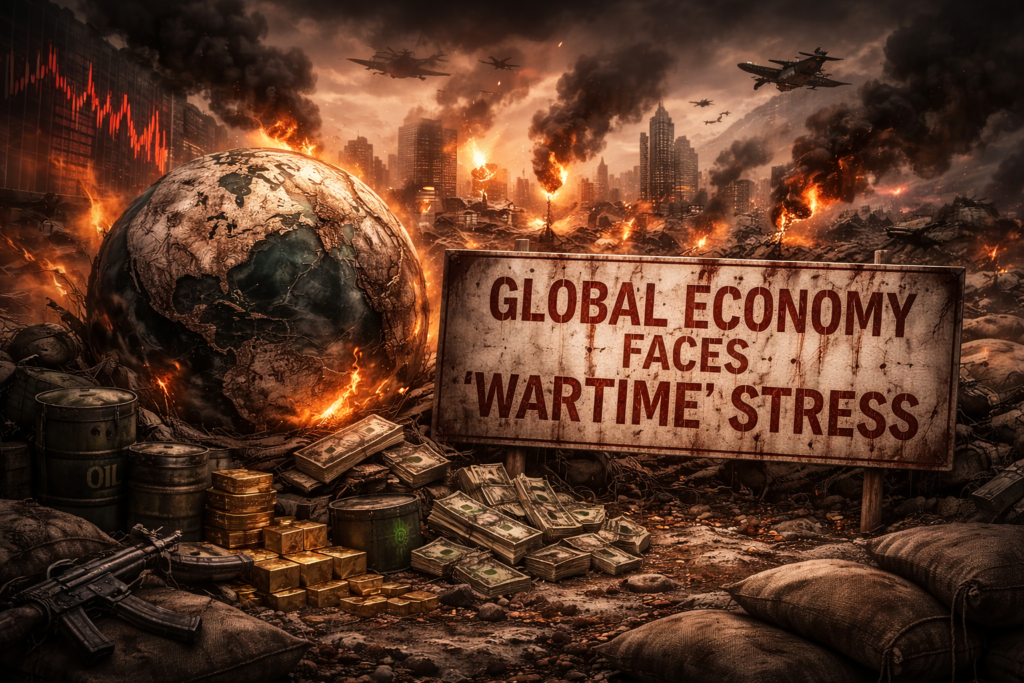
Supply chains are stretched thin, prices spike with little warning, and governments are channelling increasing resources into defense while households tighten their belts. It is not total war, but the stress is unmistakably wartime in character: fragmented trade flows, volatile energy markets, stubborn inflation, and a growing sense that security now takes precedence over efficiency.
Economists at the United Nations and the IMF have already revised down their growth expectations for the year. The UN projects global expansion slowing to 2.7 percent in 2026, well below the pre-pandemic average. The IMF, in its latest update, forecasts growth closer to 3.3 percent, while identifying geopolitical escalation as the single greatest downside risk. These figures are far from abstract.
They manifest in delayed shipments, higher grocery bills, and factories idled by missing components. What distinguishes this moment is that these shocks are arriving in a system already fatigued by years of tariffs, pandemic aftershocks, and the protracted war in Ukraine. Layer on renewed conflict in the Middle East, and the global picture shifts from manageable disruption to systemic strain.
Trade Routes Under Siege
Few images better capture the fragility of the current environment than empty berths along the Suez Canal or tankers idling off the coast of Yemen. Houthi threats, once intermittent, have intensified in response to the widening conflict in the Middle East. Even during temporary lulls, insurance premiums remain elevated, and many shipping operators opt for longer routes around Africa rather than risk exposure.
The consequences are immediate and costly. Journeys are extended by weeks, and billions in additional fuel expenses are ultimately passed on to consumers.
The economic arithmetic is stark. Diverting a single container vessel around the Cape of Good Hope can add roughly one million dollars in fuel costs to a round trip between Asia and Europe. Scaled across thousands of voyages, the cumulative drag on global trade is substantial. Egypt, heavily reliant on canal revenues, is already feeling the impact. Freight indices surged again in early 2026, echoing disruptions seen in 2024 and 2025, but now compounded by renewed uncertainty in the Gulf. Retailers that once championed just-in-time inventory models are quietly rebuilding buffers—raising warehousing costs and, ultimately, consumer prices.
The broader geoeconomic confrontation—recently highlighted by the World Economic Forum—extends well beyond shipping lanes. Tariffs, export controls, and capital restrictions have become normalized tools of economic statecraft. What began as targeted sanctions has evolved into a complex web of barriers fragmenting supply chains across critical sectors, from semiconductors to fertilizers.
For businesses, the shift is profound. Decades of optimization for cost and speed are giving way to a new emphasis on resilience and redundancy.
This transition is rational—indeed necessary—but it carries a measurable cost in the form of slower growth and structurally higher prices. Multilateral institutions that once played a stabilizing role now appear increasingly constrained. In boardrooms and finance ministries alike, the question is no longer whether to diversify away from risk, but how quickly it can be done—and at what cost.
Energy Markets in Turmoil
Few developments concentrate global attention as sharply as oil prices breaching the hundred-dollar threshold. The recent escalation involving the United States, Israel, and Iran has done precisely that. Brent crude surged by more than 30 percent in the early weeks of the conflict, briefly reaching levels not seen since the height of the 2022 Ukraine shock.
At the center of the tension lies the Strait of Hormuz, a critical artery through which roughly one-fifth of the world’s seaborne oil supply passes. Tanker traffic has slowed, insurance costs have surged, and markets are increasingly pricing in the risk of prolonged disruption.
The parallels with past oil crises are both uncomfortable and instructive. The embargo-driven shocks of the 1970s triggered prolonged stagflation, while the 2022 invasion of Ukraine sent European gas prices soaring and forced a rapid, costly search for alternatives.
Today’s surge arrives at a particularly vulnerable moment. Many economies have only recently begun to recover from earlier inflationary spikes. Central banks that had hoped to declare victory over price pressures now face renewed uncertainty. Even a short-lived disruption could add half a percentage point or more to global inflation, according to early estimates.
The burden, however, is uneven. Oil-importing economies across Asia and Europe feel the impact immediately through higher fuel and energy costs. Exporters such as Russia benefit from elevated prices, though sanctions and logistical constraints limit their upside.
Meanwhile, strategic petroleum reserves in the United States and allied nations have been tapped once again—providing short-term relief, but depleting buffers intended for more severe contingencies. The signal from markets is unequivocal: energy security has moved from the periphery to the core of economic policymaking.
Inflation’s Stubborn Return
For households, the effects of wartime economic stress are most visible at the checkout counter. Food prices, already elevated by earlier commodity cycles, are rising again as fertilizer costs track higher energy prices. Transportation and manufacturing inputs are following a similar trajectory.
In the United States, inflation forecasts for 2026 have been revised upward, with some analysts projecting averages near 4 percent should oil prices remain elevated. Across the G20, inflation could rise by more than a percentage point under adverse scenarios.
While wage growth in advanced economies has shown signs of recovery, renewed price pressures threaten to erode those gains. In emerging markets, the situation is more acute. Countries dependent on both fuel and food imports face a dual shock that can quickly escalate into social and political tension.
Central banks are left with few attractive options. Raising interest rates risks stalling already fragile recoveries, while holding steady increases the danger of unanchored inflation expectations.
The irony is striking. Just as easing supply chain constraints and moderating demand appeared to be guiding inflation downward, new external shocks have intervened. Policymakers who once spoke confidently of soft landings now emphasize resilience and caution.
For households managing everyday expenses, such language offers limited reassurance. The reality is more immediate and tangible: costs are rising again, and the drivers—though global in nature—are deeply felt at home.
Defense Spending and the New Fiscal Reality
One sector, however, is expanding rapidly. Global military expenditure reached 2.63 trillion dollars in 2025 and is projected to rise further in 2026. Europe has led the increase, driven by NATO commitments and the need to replenish depleted stockpiles. The Middle East and parts of Asia are following suit, citing immediate and evolving security threats.
In the United States, longstanding budget debates are giving way to renewed emphasis on defense, with proposals for expanded missile systems and procurement programs gaining traction.
This surge presents a complex trade-off. Increased defense spending supports employment across industries such as aerospace, shipbuilding, and advanced technology. At the same time, it diverts resources from critical long-term investments in infrastructure, education, and climate transition.
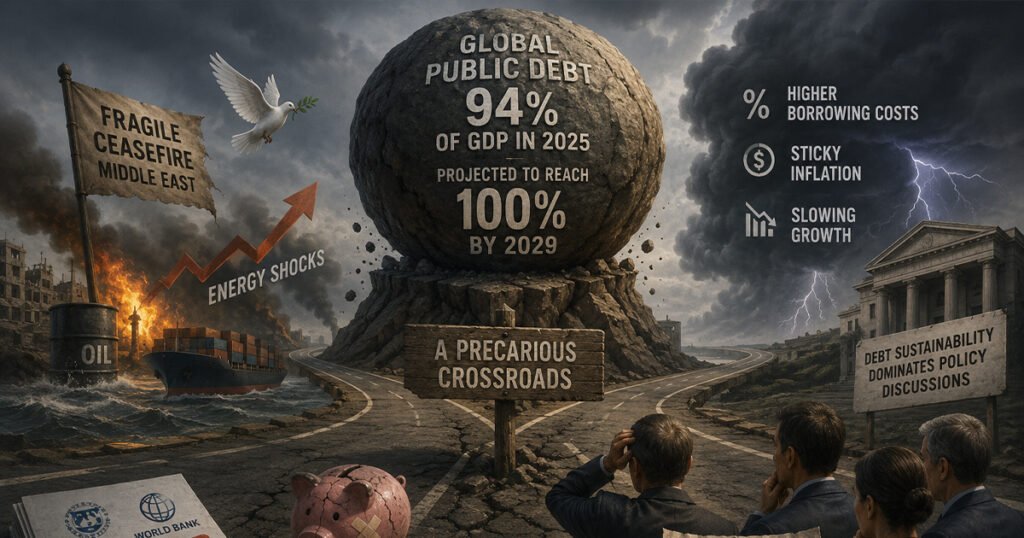
Governments financing these expenditures through borrowing face rising debt-servicing costs at a time when interest rates remain sensitive to inflation dynamics. The classic “guns versus butter” dilemma has re-emerged, albeit in a more complex and interconnected global context.
Private capital is already adjusting. Venture investment in defense and dual-use technologies has accelerated, particularly in Europe. Firms once focused exclusively on commercial markets are pivoting toward security-related applications.
While innovation spillovers may benefit the broader economy, the reallocation of capital and talent raises important questions about long-term growth trajectories. In an era defined by geoeconomic competition, security spending increasingly appears less discretionary and more structural. The fiscal consequences, however, will be long-lasting.
Diverging Fortunes Across Borders
The impact of these pressures is far from uniform. Commodity exporters with diversified trade relationships are better positioned to absorb higher energy prices than import-dependent economies.
China, contending with deflationary pressures domestically, faces the dual challenge of sustaining export growth amid weakening global demand. Meanwhile, emerging markets across Africa and Latin America—many still recovering from prior debt crises—are finding it increasingly difficult to attract capital, as investors demand higher compensation for geopolitical risk.
The K-shaped recovery that followed the pandemic is now entering a more complex phase. Advanced economies, supported by reserve currencies and deep financial systems, retain greater policy flexibility. Smaller economies face more constrained choices: protect households through subsidies and risk fiscal instability, or pass on rising costs and risk social unrest.
The IMF has warned that prolonged geopolitical tensions could deepen these divergences, leaving some economies with lasting structural damage.
Policy Tightrope and the Road Ahead
Policymakers are once again navigating a narrow path. Inflation must be contained without undermining growth. Defense priorities must be funded without triggering unsustainable debt dynamics. Trade must remain functional, even as nations pursue greater strategic autonomy.
At the same time, international coordination—once central to crisis response—is becoming more difficult to sustain in an increasingly fragmented global landscape. Institutions designed to foster cooperation now operate amid declining trust.
The baseline outlook remains one of modest, if fragile, growth. Continued investment in technology and the adaptability of the private sector offer a degree of resilience. Yet the margin for error is shrinking.
A prolonged disruption of key maritime routes, further escalation in Eastern Europe, or a sudden loss of confidence in sovereign debt markets could shift the global economy toward recession. Conversely, diplomatic breakthroughs or successful diversification of energy and supply chains could provide some relief.
In essence, the global economy is not collapsing—it is adjusting. Supply chains are being reconfigured, consumption patterns are evolving, and governments are reallocating resources in response to a more volatile environment.
The critical question is whether this resilience can endure sustained and overlapping shocks, or whether cumulative pressure will eventually force a more severe adjustment.
Across households and markets alike, a subtle but profound shift is underway. Efficiency alone is no longer sufficient. Security, redundancy, and strategic patience are emerging as the defining pillars of economic survival in an increasingly uncertain world.