

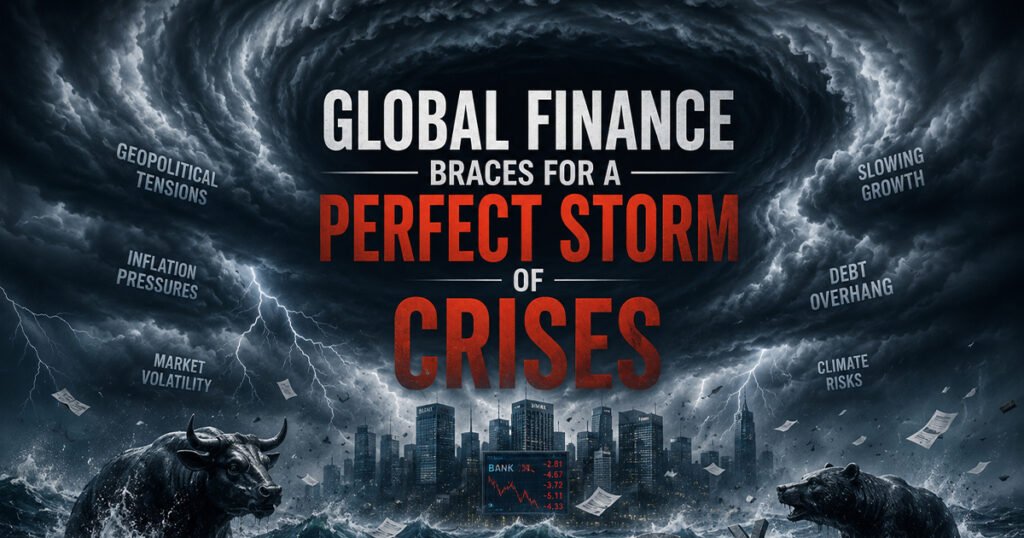
Global financial markets and economies are confronting an unusually broad set of overlapping risks in 2026. Geopolitical tensions in the Middle East, monetary policy shifts in major economies, slowing growth forecasts, persistent inflation pressures, and structural debt vulnerabilities have converged. This has created what many analysts describe as a perfect storm scenario. While resilience built up over recent years offers some protection, downside risks dominate the outlooks of the IMF, World Bank, and other institutions.
The fragile nature of recent ceasefires in critical energy chokepoints underscores how quickly conditions can deteriorate. Energy price volatility feeds directly into inflation and growth dynamics. Central banks are wrestling with trade-offs between price stability and supporting economic activity. Meanwhile, high debt levels limit fiscal responses. Technology-driven optimism around artificial intelligence provides a counterweight but cannot fully offset near-term headwinds.
Investors, businesses, and policymakers are increasingly preparing for a period of heightened uncertainty. Capital is flowing toward safe-haven assets, corporations are reassessing supply chains, and governments are reviewing contingency plans against potential economic shocks.
The interconnected nature of today’s global economy means that disruptions in one region can rapidly ripple across financial markets, trade networks, and consumer confidence worldwide. As risks become more synchronized, the margin for policy error narrows, raising the stakes for decision-makers seeking to steer the global economy through an increasingly turbulent period.
Geopolitical Shocks And Energy Market Turmoil
The dominant near-term catalyst has been instability around the Strait of Hormuz. This waterway carries roughly one-fifth of the world’s oil supply. Repeated disruptions and the fragile implementation of agreements have kept markets on edge. Oil prices surged at various points, with Brent crude projections reaching the mid-$90s per barrel in some scenarios. This represents a significant increase that embeds higher costs into economies worldwide.
Commodity importers suffer the most. Import bills rise sharply, current account deficits widen, and currencies come under pressure. Inflation expectations reset higher, complicating central bank efforts. Even net exporters face complex dynamics as global demand responses and fiscal management challenges emerge. Trade flows face rerouting costs and delays that ripple through supply chains.
Broader geopolitical fragmentation compounds these effects. Trade tensions, sanctions, and regional conflicts reduce efficiency and increase uncertainty. Investment decisions are delayed, while capital flows become more volatile as risk sentiment shifts. The World Economic Outlook highlights how prolonged conflict or deeper fragmentation could slash global growth significantly below baseline projections.
Monetary Policy Crossroads
Major central banks are navigating a changed landscape. In the United States, new Federal Reserve Chair, Kevin Warsh, presided over a decision to hold rates at 3.50 to 3.75 percent in mid-June. The accompanying projections revealed a more hawkish tilt, with several officials anticipating further hikes due to energy-driven inflation risks. Warsh shortened policy statements, reduced forward guidance, and initiated broad reviews of Federal Reserve practices. This signals a shift toward greater data dependence and less policy signalling.
Other central banks face similar dilemmas. Emerging-market policymakers must balance imported inflation against growth needs. Some have eased policy where inflation conditions permit, thereby supporting local currency assets. Yet tighter global financial conditions, driven by a stronger dollar or higher U.S. yields, can quickly reverse gains. Coordination remains imperfect, increasing spillover risks.
Bond markets have reacted with higher yields in many jurisdictions. Equity volatility has increased as sectors rotate. Currency markets have experienced safe-haven inflows alongside pressures on risk-sensitive currencies. These adjustments affect everything from mortgage rates to corporate borrowing costs.
Growth Slowdown and Diverging Regional Outlooks
Global growth forecasts have been downgraded. The World Bank projects global expansion slowing to 2.5 percent in 2026, the weakest pace outside an outright recession in nearly two decades. This follows growth of 2.9 percent in 2025. Emerging and developing economies face particularly weak per-capita income growth, with two-thirds of economies receiving downward revisions.
The IMF presents a similarly cautious outlook under assumptions of limited conflict, projecting growth of around 3.1 percent. Adverse scenarios involving prolonged disruptions could result in significantly worse outcomes, potentially reducing growth to 2 percent or lower while simultaneously increasing inflation. Recovery in 2027 and 2028 depends heavily on energy market normalization and supportive policy interventions.
Advanced economies continue to show pockets of resilience, supported by technology investment and domestic demand. However, Europe contends with rising energy and defense costs. The United States benefits from a strong labor market but faces policy uncertainties. Emerging Asia has held up relatively well in some cases due to services-sector expansion and digital transformation. Latin America and Africa continue to grapple with the intersection of commodity dependence and debt burdens. Meanwhile, the Middle East and North Africa region bears the direct costs of ongoing conflict.
Inflation, Debt, and Financial Stability Risks
Inflation has ticked upward globally, particularly among commodity-importing economies. Headline inflation measures face increasing pressure from energy and food costs, while core inflation remains sticky in the services sector. Central banks must communicate carefully to anchor expectations while avoiding excessive tightening that could trigger recessions.
Debt vulnerabilities remain at the heart of financial stability concerns. Global public debt trajectories have worsened, while rollover risks have increased due to shorter-term issuance and higher interest rates. The sovereign-bank nexus could amplify shocks if asset quality deteriorates. Non-bank financial institutions and leveraged investors add further complexity to market functioning.

Financial fragmentation is becoming increasingly visible through divergent borrowing costs and shifting capital flow patterns. Asset bubbles in certain sectors, particularly technology, raise questions about sustainability. Private credit growth is filling financing gaps but introduces transparency and liquidity risks. While stress testing and supervisory oversight have increased, gaps remain in cross-border regulation and coordination.
The AI Counter-Narrative and Structural Opportunities
Amid these challenges, investments in artificial intelligence provide a measure of optimism. Capital expenditure in technology-intensive sectors is supporting growth and productivity gains. Equity markets in leading economies have rallied on the back of these expectations. Broader AI adoption could lift potential output and create new revenue streams for governments.
However, the realization of these gains remains uneven. Emerging markets lag in infrastructure development and workforce skills, increasing the risk of widening economic divides. Concerns about asset bubbles persist if valuations become detached from underlying fundamentals. Regulatory and ethical questions surrounding AI could also slow deployment or generate new uncertainties.
Energy transition and resilience investments represent another important structural theme. Despite short-term oil market volatility, long-term shifts toward renewable energy and efficiency offer significant opportunities. Nature-positive finance and climate adaptation projects could generate attractive returns while reducing future vulnerabilities. Public-private partnerships will be essential in driving these initiatives forward.
Market Reactions and Investor Strategies
Markets have already priced in elevated volatility. Stock indices have fluctuated in response to geopolitical developments and policy announcements. Commodity markets have experienced sharp swings. Credit spreads have widened selectively for vulnerable borrowers, while stronger credits have remained relatively stable. Currency hedging costs have also risen in several markets.
Institutional investors are emphasizing diversification, quality, and flexibility. Carry trades face growing challenges in uncertain interest-rate environments. Exposure to real assets, including commodities used as strategic hedges, is attracting greater attention. Thematic investments in technology, defense, and green infrastructure continue to draw capital inflows. Nevertheless, liquidity management remains paramount given the potential for sudden market shifts.
Portfolio managers are also placing greater emphasis on risk assessment and stress testing to prepare for multiple economic scenarios. Rather than chasing short-term gains, many investors are prioritizing capital preservation and resilient income-generating assets. Demand for high-quality government bonds, defensive equities, and sectors with strong cash flows has increased as uncertainty clouds the outlook. In this environment, the ability to adapt quickly to changing market conditions may prove just as valuable as identifying the next growth opportunity.
Policy Imperatives for Navigating the Storm
Policymakers must enhance adaptability. Fiscal frameworks need strengthening through credible consolidation plans that protect vulnerable groups. Monetary authorities should prioritize credibility and maintain clear mandates. International cooperation on debt management, trade, and energy security can help mitigate cross-border spillover effects.
Reforms in labor markets, education systems, and digital infrastructure can strengthen resilience. Targeted support for small businesses and job creation initiatives can address the social dimensions of economic stress. Multilateral institutions will continue to play critical roles in providing liquidity and sharing expertise during periods of instability.
A renewed focus on productivity-enhancing investments will also be essential. Governments that channel resources into innovation, research, advanced manufacturing, and sustainable infrastructure are likely to be better positioned to withstand external shocks. Such investments not only support long-term economic growth but also help create more diversified economies that are less vulnerable to fluctuations in commodity prices or global demand cycles.
Equally important is strengthening institutional capacity and governance. Transparent policymaking, efficient public administration, and robust regulatory systems can improve investor confidence and reduce uncertainty during periods of market stress. Countries that demonstrate policy consistency and strong governance frameworks are generally better positioned to attract investment, secure favorable financing conditions, and maintain economic stability even amid challenging global circumstances.
Outlook and Scenarios
Baseline projections assume contained conflict and gradual normalization in energy markets, leading to a modest recovery in 2027. Downside scenarios involve escalation, sustained high energy prices, and tighter financial conditions, potentially pushing growth well below 2 percent while triggering renewed inflationary pressures. Upside scenarios center on faster productivity gains from AI, geopolitical de-escalation, and successful structural reforms.
Global finance enters this period with resilience that has been tested, though not without limits. Banks are generally stronger than they were during previous crises. Corporate balance sheets vary widely across sectors and regions. Household savings in some economies provide additional buffers. Nevertheless, the sheer number and complexity of risks mean that vigilance remains essential.
This perfect storm will test not only economic models but also collective decision-making. Clear communication, coordinated responses, and a sustained focus on long-term fundamentals will determine whether current turbulence results in lasting damage or serves as a catalyst for necessary adjustments. Markets and policymakers alike are bracing for continued volatility while searching for pathways toward stability and renewed growth.