


In the space of just twelve months, Ghana has rewritten its economic story in a way that has left analysts scrambling for explanations.
The country’s total public debt as a share of GDP has plummeted from 61.8 percent at the end of 2024 to 45.3 percent by December 2025. That is not a gradual improvement. It is a cliff-edge drop that has vaporized years of accumulated fiscal pressure almost overnight.
For a nation that once wore the label of “highly indebted” like a heavy chain, this shift feels less like policy tweaking and more like economic alchemy. And the supporting numbers from the fiscal books, the external payments ledger, and the currency markets tell a tale worth paying attention to.
The Numbers Behind the Miracle
At the close of 2024, Ghana’s total public debt stood at 726.7 billion Ghana cedis against a nominal GDP of 1,176.2 billion cedis, producing that worrying 61.8 percent ratio. By December 2025 the debt load had eased to 641.0 billion cedis while nominal GDP had climbed to a steady 1,400 billion cedis. The bigger economic pie, measured in local currency, combined with a modest reduction in the actual debt stock, sliced the debt burden by more than a quarter in relative terms.
The improvement shows up clearly across both external and domestic components. External debt as a share of GDP fell sharply from 35.4 percent to 21.7 percent, even as the dollar value of that debt remained fairly stable around 28 to 29 billion USD.
Domestic debt moved from 26.3 percent of GDP to 23.6 percent, with the absolute stock rising only modestly from 309.8 billion cedis to 333.8 billion cedis. Taken together, these shifts have delivered one of the most impressive debt-ratio improvements seen in any emerging market in recent years.
How the Cedi’s Strength Delivered a Helping Hand
A big part of the external debt relief came from the remarkable performance of the Ghana cedi. In February 2025 the USD/GHC exchange rate stood at 15.53. By May it had already dropped to 10.28, recording a year-to-date appreciation of 43 percent. The strength continued through the year and into early 2026, with the rate settling around 10.87 by March 2026. Similar gains appeared against other major currencies. The pound and euro both saw the cedi appreciate by more than 30 percent at peak moments.
When your currency buys more dollars, every dollar of foreign debt shrinks when converted back into cedis. This mechanical effect alone removed tens of billions of cedis from the local-currency value of external obligations.
The real effective exchange rate index also moved in a helpful direction, falling from 135.3 in early 2025 into the low 90s before stabilizing around 95. That range kept Ghana’s exports competitive while still delivering the debt-reduction benefits.
Global Currency Trends Add Complexity
The global currency environment has added another layer of complexity. The US Dollar Index fluctuated significantly, dropping from highs above 107 to below 100 before rebounding slightly. These movements have implications for emerging market currencies like the cedi, which often respond to shifts in global dollar strength.
At the same time, emerging market currency indices showed moderate improvement, rising from around 44 to above 47 during the period. This suggests that Ghana is not alone in facing currency pressures, and that broader emerging market trends may be influencing local developments.
These global factors underscore the importance of maintaining strong external buffers. In an environment where external shocks can quickly transmit to domestic markets, resilience in reserves and external accounts becomes a critical line of defense.
Fiscal Discipline Takes Center Stage
None of this happened by accident. The government’s fiscal operations show clear signs of restraint and improving balances. The primary balance on a cash basis swung from a deficit of 1.2 percent of GDP at end-2024 into positive territory for much of 2025, reaching as high as 2.2 percent before closing the year at 0.5 percent. On a commitment basis the primary balance ended even stronger at 2.6 percent of GDP.
Total revenue and grants held steady around 16 percent of GDP, with tax revenue edging up from 12.9 percent to 13.1 percent. Total expenditure remained controlled, and capital spending stayed modest at around 1.4 percent of GDP by year-end. Net domestic financing never became excessive, staying below 1.5 percent of GDP in most months. These figures point to a government that chose careful cash management and steady revenue collection over new borrowing sprees.
The overall cash balance improved from a 5.2 percent deficit to 3.1 percent, while the commitment-basis overall balance moved from a much larger 7.9 percent deficit toward balance. Year after year of widening deficits had been the old pattern. The new pattern looks far more sustainable.

Export Boom Powers the External Surplus
The real rocket fuel came from Ghana’s external sector. The trade account swung into a strong surplus, reaching a cumulative 3,689.7 million USD by February 2026. Gold exports led the charge, rising from 2,312.8 million USD in early 2025 to 4,257.4 million USD in the latest reading.
Gold exports remain the standout performer. With earnings exceeding 20.9 billion dollars in late 2025, gold continues to anchor Ghana’s export profile. The sustained global demand for gold, coupled with favourable prices, has provided a reliable source of foreign exchange inflows.
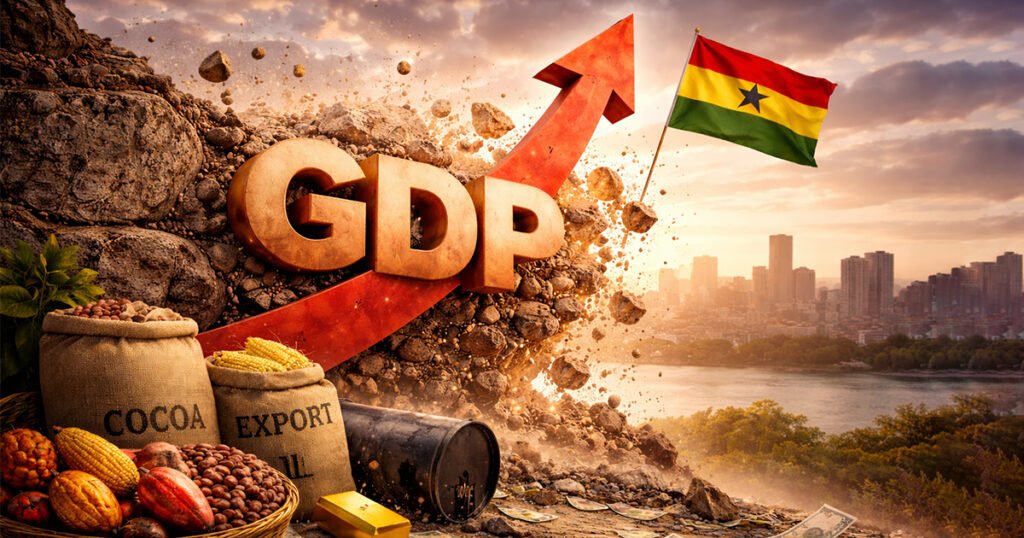
Cocoa and oil exports have also contributed, though to a lesser extent. Cocoa exports crossed 4 billion dollars by the end of 2025, while oil exports reached over 2.6 billion dollars. Together with other export categories, these sectors have helped maintain a positive trade balance.
Cocoa, meanwhile, more than doubled in several periods, while oil exports added consistent support. Total exports climbed to 6,206 million USD in the most recent cumulative figure, comfortably ahead of imports at 2,516.3 million USD.
This strong trade performance fed straight into the current account. By December 2025 Ghana recorded a current account surplus of 9,389.2 million USD, equivalent to a remarkable 8.3 percent of GDP. Private transfers, mainly remittances, continued to provide a reliable inflow as well.
The surplus did not disappear. It flowed into the country’s foreign reserves. Gross international reserves rose from 9,432.5 million USD in February 2025 to 14,469.8 million USD by February 2026. Import cover improved from around 4.2 months to 5.8 months, giving the country a much thicker cushion against future shocks. Net international reserves also strengthened significantly.
Private Transfers and Financial Inflows Support Stability
Beyond trade, private transfers have emerged as a crucial stabilizing force. Inflows reached nearly 7.8 billion dollars by the end of 2025, reflecting strong remittance activity from Ghanaians abroad. These transfers provide consistent foreign exchange inflows that help cushion the current account.
The financial account has also recorded notable improvements. Financial inflows rose to over 5.4 billion dollars by December 2025, supported largely by direct investment liabilities. This suggests renewed investor interest in the Ghanaian economy, despite global uncertainties.
Direct investment inflows alone exceeded 1.9 billion dollars, pointing to sustained confidence in key sectors of the economy. However, portfolio investment liabilities remained negative, indicating continued caution among short-term investors.
The combined effect of these inflows has contributed to a stronger balance of payments position, supporting the accumulation of reserves and enhancing external buffers.
What the Turnaround Means for Everyday Ghanaians
For ordinary citizens these big-picture numbers carry real-world consequences. A lower debt burden eventually frees up government revenue that can be redirected toward schools, hospitals, and roads instead of interest payments. Businesses borrowing in cedis face less competition from the government for local funds. Importers enjoy a more stable exchange rate, which helps keep prices in check and supports consumer confidence.
Farmers and miners who earn dollars from exports can now convert them into more cedis than before, boosting incomes in rural communities. The stronger reserves and currency also reduce the risk of sudden shortages of imported goods or medicines.
Of course, challenges remain.
The overall cash balance is still in deficit territory at 3.1 percent of GDP. Interest payments continue to consume a sizable portion of revenue. Capital expenditure has been kept tight, which could slow infrastructure development if the restraint lasts too long. And global commodity prices, which have been kind lately, can always shift.
Can Ghana Sustain the Momentum?
The early months of 2026 suggest the foundations are holding. The cedi has remained relatively firm, reserves continue to look healthy, and export flows are still positive. The debt-to-GDP ratio now sits in territory that many analysts once considered aspirational rather than realistic.
Sustaining the gains will require continued fiscal discipline, careful management of the windfall from reserves, and efforts to diversify the economy beyond gold, cocoa, and oil. If the government can maintain primary surpluses and channel some of the reserve strength into productive investments, 2025’s dramatic improvement could become the starting point for a longer period of stability and growth.
In the meantime, the story is one of genuine progress. Ghana has combined prudent budgeting, a strong export performance, and a confident currency to deliver a debt reduction that few saw coming. The fiscal tables show restraint. The external accounts show strength. The exchange-rate data show renewed market confidence.
After years of turbulence, Ghana has given itself something precious: breathing room. The decade of fiscal pain has not been completely forgotten, but it has been pushed firmly into the rear-view mirror. And for a country that has worked hard for this moment, that feels like a victory worth celebrating!