
ADVERTISEMENT

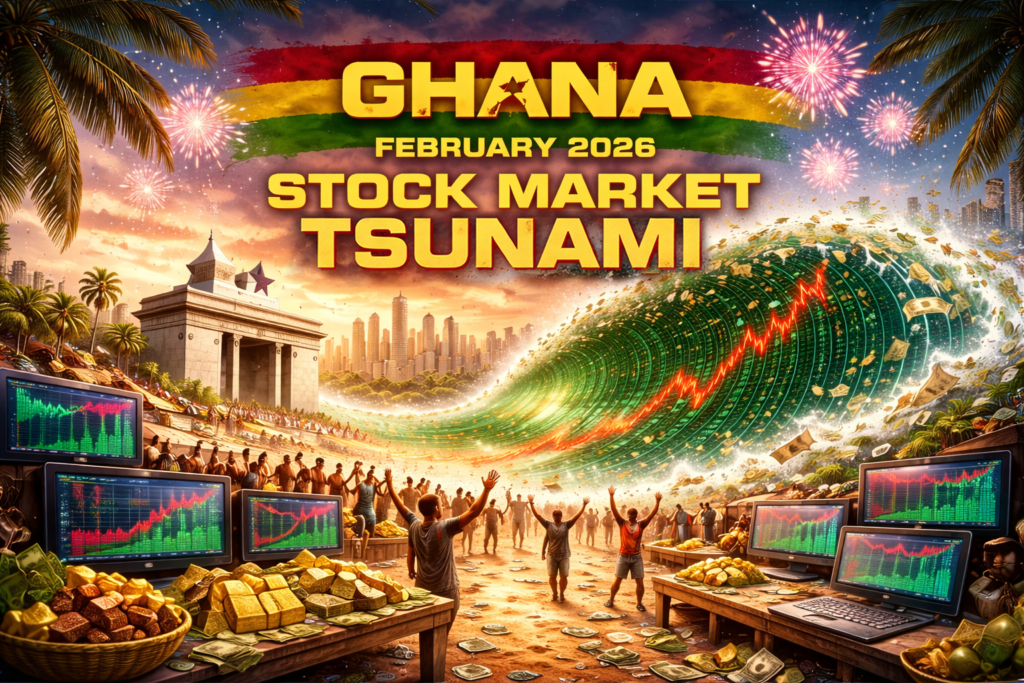
FEBRUARY 2026 STOCK MARKET TSUNAMI …GSE All-Share Index Smashes 12,000 Points Barrier in Single-Month Rocket Ride

In the busy trading floors of Accra in February 2026, screens flashed numbers so dramatic that seasoned brokers had to look twice. The Ghana Stock Exchange All-Share Index, sitting comfortably at 9,006.5 points at the end of January 2026, suddenly shot up to 12,869.2 points by the close of that month. That single month delivered a stunning gain of 3,862.7 points – roughly 42 percent in just thirty days. At the same moment, the Bank of Ghana’s Monetary Policy Rate eased down to 15.5 percent, while 91-day Treasury bill yields plunged to 8.96 percent. This was not a mild uptick. It felt like a full-blown market tsunami. A Rally Like No Other This surge was far from ordinary. The total market capitalisation of companies listed on the GSE swelled to an impressive 235.7 billion Ghana cedis in February and by March, it crossed the GHS 300 billion mark. That represents a 37 percent jump on a year-to-date basis and almost double the figure from February 2025. The GSE Financial Stock Index, which tracks the country’s key banks and insurance firms, performed even more spectacularly. It closed February at 7,692.9 points after adding a massive 2,760.5 points in the month alone. Over twelve months, this sub-index has climbed by around 173 percent. For everyday Ghanaians with money in unit trusts, pension schemes, or personal stock accounts, these gains have been life-changing on paper. Many watched their investments grow substantially in a very short time. The Twelve-Month Journey To understand the scale of what happened, it’s important to reflect on the twelve months journey. In February 2025, the All-Share Index stood at a modest 5,659.8 points, with total market capitalisation at just 127.8 billion cedis. The Monetary Policy Rate was stuck at a painful 27 percent. Many investors were still recovering from the effects of the Domestic Debt Exchange Programme, and government bond yields lingered in the high twenties. By February 2026, everything had changed. The All-Share Index had more than doubled. Market capitalisation had increased by over 107 billion cedis. And the central bank had slashed its policy rate by more than eleven percentage points. The transformation was remarkable. The Interest Rate Revolution Fueling the Fire The real driver behind this equity explosion lies in the dramatic fall in interest rates. In the primary market, Treasury bill yields collapsed across the board. The 91-day bill’s interest equivalent rate dropped from 26.93 percent in February 2025 to only 8.96 percent in February 2026. The 182-day bill fell from 27.69 percent to 10.75 percent, while the 364-day bill slid from nearly 29 percent to 11.53 percent. These moves represent one of the sharpest reductions in borrowing costs Ghana has witnessed in over a decade. The secondary market told an even more striking story. Post-DDEP bonds, once considered risky by many, saw their yields tumble across every maturity. The four-year bond yield fell from 24.38 percent to 9.10 percent. The five-year bond moved from 23.76 percent to 11.95 percent. Even the longest fifteen-year bond, which once offered 24.27 percent, now yields just 12.30 percent. Investors who held these bonds through the difficult restructuring period enjoyed significant capital gains, while new buyers had to accept much lower returns. In short, the entire fixed-income universe has been re-priced for a lower-rate environment. Reason Behind BoG’s Aggressive Rates Cut So what prompted the central bank to ease policy so forcefully? The data provides clear clues. Inflation had moderated enough to give policymakers breathing room. The interbank weighted average rate, which stood at 27.04 percent in February 2025, eased to 12.58 percent by February 2026. Average lending rates to businesses dropped from 30.12 percent to 19.17 percent, and the Ghana Reference Rate – used as a benchmark for many commercial loans – fell from 29.96 percent to 14.58 percent. For companies that had struggled with high interest costs on working capital and expansion projects, this felt like fresh oxygen after years of suffocation. Businesses could now borrow more affordably, potentially boosting investment and hiring. The Other Side of the Coin: What Happened to Savers? While borrowers celebrated, savers faced a different reality. Deposit rates remained stubbornly low. Demand deposits hovered around 1.13 percent for much of the period, savings deposits stayed at 5 percent, and both three-month and six-month time deposits held steady near 10.50 percent. With government securities now yielding below 12 percent in many cases, people holding cash had limited attractive options. This encouraged a shift of liquidity out of bank deposits and into equities and longer-term bonds. Despite the lower yields, activity in the fixed-income market stayed strong. In February 2026, the value of bonds traded reached 38.3 billion cedis, up significantly from 17.9 billion cedis a year earlier. Volume traded hit 41.6 billion cedis, and the number of trades stood at 40,600. Investors were clearly rotating out of low-yielding cash into assets that still offered reasonable returns. Financial Stocks Lead the Charge The biggest winners in this environment were financial companies. The GSE Financial Stock Index surged 65.5 percent year-to-date and nearly tripled over the full twelve months. Market capitalisation for the financial sector alone jumped from 36.9 billion cedis to 94.9 billion cedis – a 157 percent increase. Banks and insurers benefited as lower funding costs improved margins and loan demand picked up. Investors placed big bets that cheaper money would translate into stronger profits. The broader All-Share Index also delivered impressive results, posting 46.7 percent growth year-to-date. Monthly gains became consistent and then explosive once rate cuts gained momentum from mid-2025. Market capitalisation followed the same path, climbing steadily before accelerating sharply in the first two months of 2026. Real-Life Impact: Who Is Winning? On the ground, the effects are tangible. A middle-class professional in Accra who invested in a mutual fund tracking the GSE Composite in early 2025 would have seen returns exceeding 127 percent over twelve months. Pension contributors with heavy exposure to financial stocks enjoyed even better performance. Diaspora Ghanaians who had invested in local equities also benefited as their cedi holdings appreciated rapidly. Corporate leaders report a noticeable shift in mood. Companies that raised equity or listed recently have seen their valuations re-rate higher, making it easier to fund expansion or attract talent through stock-based incentives. After years of focusing on survival, many chief financial officers are now discussing growth strategies with renewed confidence. Is This Rally Sustainable? The speed of the advance has naturally raised questions among more cautious market watchers. Can such strong gains continue? The data offers mixed signals. Healthy trading volumes in the bond market suggest liquidity remains good, and broad participation indicates the rally is not overly narrow. However, the low deposit rates could eventually pressure household savings if inflation were to rise again. Interbank rates have stabilised near 12.58 percent, and longer-term bond yields have started to find a floor after their steep decline. This pause suggests the central bank believes the easing cycle has achieved much of its purpose but wants to monitor developments carefully. Outlook for Equity Investors For those invested in stocks, the focus has shifted. The key question is no longer whether the rally will happen, but how long the low-rate environment can be sustained. If inflation stays under control and the central bank maintains stability, corporate earnings should keep improving. Banks stand to gain from expanding loan books and lower non-performing loans. Insurers could see higher premium income as economic activity strengthens. Even non-financial listed companies may benefit from cheaper capital for new projects. Looking at the year-to-date figures again brings the scale into focus. The All-Share Index is up 46.7 percent, the Financial Stock Index 65.5 percent, and overall market capitalisation 37 percent. These are the kinds of moves that occur when an economy resets its cost of capital and capital flows strongly into risk assets. The Bigger Picture for Ghana No bull market continues indefinitely without corrections. Global commodity prices, exchange rate stability, and government fiscal management will all influence what happens next. Still, the structural change is undeniable. Ghana has shifted from one of the highest interest-rate environments in the region to a far more investor-friendly setting in just one year. The stock market has responded exactly as economic theory suggests: when money becomes cheaper, equities become more attractive. For ordinary citizens in cities like Kumasi or Tamale who have never bought shares, the tsunami might still seem far away. But the benefits can spread widely. Stronger company balance sheets often lead to more jobs, increased tax revenues, and improved public services over time. Larger pension funds can support better retirement payouts, while strong mutual fund returns may encourage younger Ghanaians to start saving and investing earlier. A Moment That Will Be Remembered The figures recorded in February 2026 will likely be studied for years to come: the All-Share Index reaching 12,869.2 points, the 91-day Treasury bill at 8.96 percent, market capitalisation at 235.7 billion cedis, and the Financial Index at 7,692.9 points. They represent a clear turning point when Ghana’s capital markets moved from post-crisis recovery into a phase of strong expansion. Whether this wave carries the economy even higher or eventually moderates to more sustainable levels is still uncertain. What is beyond doubt is that February 2026 will be remembered as the month when the market caught fire and interest rates finally returned closer to earth. Early investors are quietly celebrating their timing. Latecomers are rushing to get positioned. And the rest of the country watches with a mixture of excitement and cautious optimism as the GSE All-Share Index writes one of the most dramatic chapters in its history. The tsunami has landed. Now the only real question is how far this powerful wave will ultimately travel.

In the busy trading floors of Accra in February 2026, screens flashed numbers so dramatic that seasoned brokers had to look twice.

The Ghana Stock Exchange All-Share Index, sitting comfortably at 9,006.5 points at the end of January 2026, suddenly shot up to 12,869.2 points by the close of that month.

That single month delivered a stunning gain of 3,862.7 points – roughly 42 percent in just thirty days. At the same moment, the Bank of Ghana’s Monetary Policy Rate eased down to 15.5 percent, while 91-day Treasury bill yields plunged to 8.96 percent. This was not a mild uptick. It felt like a full-blown market tsunami.

A Rally Like No Other

This surge was far from ordinary. The total market capitalisation of companies listed on the GSE swelled to an impressive 235.7 billion Ghana cedis in February and by March, it crossed the GHS 300 billion mark. That represents a 37 percent jump on a year-to-date basis and almost double the figure from February 2025.

The GSE Financial Stock Index, which tracks the country’s key banks and insurance firms, performed even more spectacularly. It closed February at 7,692.9 points after adding a massive 2,760.5 points in the month alone. Over twelve months, this sub-index has climbed by around 173 percent.

For everyday Ghanaians with money in unit trusts, pension schemes, or personal stock accounts, these gains have been life-changing on paper. Many watched their investments grow substantially in a very short time.

The Twelve-Month Journey

To understand the scale of what happened, it’s important to reflect on the twelve months journey. In February 2025, the All-Share Index stood at a modest 5,659.8 points, with total market capitalisation at just 127.8 billion cedis.

The Monetary Policy Rate was stuck at a painful 27 percent. Many investors were still recovering from the effects of the Domestic Debt Exchange Programme, and government bond yields lingered in the high twenties.

By February 2026, everything had changed. The All-Share Index had more than doubled. Market capitalisation had increased by over 107 billion cedis. And the central bank had slashed its policy rate by more than eleven percentage points. The transformation was remarkable.

The Interest Rate Revolution Fueling the Fire

The real driver behind this equity explosion lies in the dramatic fall in interest rates. In the primary market, Treasury bill yields collapsed across the board. The 91-day bill’s interest equivalent rate dropped from 26.93 percent in February 2025 to only 8.96 percent in February 2026.

The 182-day bill fell from 27.69 percent to 10.75 percent, while the 364-day bill slid from nearly 29 percent to 11.53 percent. These moves represent one of the sharpest reductions in borrowing costs Ghana has witnessed in over a decade.

The secondary market told an even more striking story. Post-DDEP bonds, once considered risky by many, saw their yields tumble across every maturity. The four-year bond yield fell from 24.38 percent to 9.10 percent. The five-year bond moved from 23.76 percent to 11.95 percent.

Even the longest fifteen-year bond, which once offered 24.27 percent, now yields just 12.30 percent. Investors who held these bonds through the difficult restructuring period enjoyed significant capital gains, while new buyers had to accept much lower returns. In short, the entire fixed-income universe has been re-priced for a lower-rate environment.

Reason Behind BoG’s Aggressive Rates Cut

So what prompted the central bank to ease policy so forcefully? The data provides clear clues. Inflation had moderated enough to give policymakers breathing room.

The interbank weighted average rate, which stood at 27.04 percent in February 2025, eased to 12.58 percent by February 2026. Average lending rates to businesses dropped from 30.12 percent to 19.17 percent, and the Ghana Reference Rate – used as a benchmark for many commercial loans – fell from 29.96 percent to 14.58 percent.

For companies that had struggled with high interest costs on working capital and expansion projects, this felt like fresh oxygen after years of suffocation. Businesses could now borrow more affordably, potentially boosting investment and hiring.

The Other Side of the Coin: What Happened to Savers?

While borrowers celebrated, savers faced a different reality. Deposit rates remained stubbornly low. Demand deposits hovered around 1.13 percent for much of the period, savings deposits stayed at 5 percent, and both three-month and six-month time deposits held steady near 10.50 percent.

With government securities now yielding below 12 percent in many cases, people holding cash had limited attractive options. This encouraged a shift of liquidity out of bank deposits and into equities and longer-term bonds.

Despite the lower yields, activity in the fixed-income market stayed strong. In February 2026, the value of bonds traded reached 38.3 billion cedis, up significantly from 17.9 billion cedis a year earlier. Volume traded hit 41.6 billion cedis, and the number of trades stood at 40,600. Investors were clearly rotating out of low-yielding cash into assets that still offered reasonable returns.

Financial Stocks Lead the Charge

The biggest winners in this environment were financial companies. The GSE Financial Stock Index surged 65.5 percent year-to-date and nearly tripled over the full twelve months.

Market capitalisation for the financial sector alone jumped from 36.9 billion cedis to 94.9 billion cedis – a 157 percent increase. Banks and insurers benefited as lower funding costs improved margins and loan demand picked up. Investors placed big bets that cheaper money would translate into stronger profits.

The broader All-Share Index also delivered impressive results, posting 46.7 percent growth year-to-date. Monthly gains became consistent and then explosive once rate cuts gained momentum from mid-2025. Market capitalisation followed the same path, climbing steadily before accelerating sharply in the first two months of 2026.

Real-Life Impact: Who Is Winning?

On the ground, the effects are tangible. A middle-class professional in Accra who invested in a mutual fund tracking the GSE Composite in early 2025 would have seen returns exceeding 127 percent over twelve months.

Pension contributors with heavy exposure to financial stocks enjoyed even better performance. Diaspora Ghanaians who had invested in local equities also benefited as their cedi holdings appreciated rapidly.

Corporate leaders report a noticeable shift in mood. Companies that raised equity or listed recently have seen their valuations re-rate higher, making it easier to fund expansion or attract talent through stock-based incentives. After years of focusing on survival, many chief financial officers are now discussing growth strategies with renewed confidence.

Is This Rally Sustainable?

The speed of the advance has naturally raised questions among more cautious market watchers. Can such strong gains continue? The data offers mixed signals. Healthy trading volumes in the bond market suggest liquidity remains good, and broad participation indicates the rally is not overly narrow.

However, the low deposit rates could eventually pressure household savings if inflation were to rise again.

Interbank rates have stabilised near 12.58 percent, and longer-term bond yields have started to find a floor after their steep decline. This pause suggests the central bank believes the easing cycle has achieved much of its purpose but wants to monitor developments carefully.

Outlook for Equity Investors

For those invested in stocks, the focus has shifted. The key question is no longer whether the rally will happen, but how long the low-rate environment can be sustained. If inflation stays under control and the central bank maintains stability, corporate earnings should keep improving.

Banks stand to gain from expanding loan books and lower non-performing loans. Insurers could see higher premium income as economic activity strengthens. Even non-financial listed companies may benefit from cheaper capital for new projects.

Looking at the year-to-date figures again brings the scale into focus. The All-Share Index is up 46.7 percent, the Financial Stock Index 65.5 percent, and overall market capitalisation 37 percent. These are the kinds of moves that occur when an economy resets its cost of capital and capital flows strongly into risk assets.

The Bigger Picture for Ghana

No bull market continues indefinitely without corrections. Global commodity prices, exchange rate stability, and government fiscal management will all influence what happens next. Still, the structural change is undeniable.

Ghana has shifted from one of the highest interest-rate environments in the region to a far more investor-friendly setting in just one year. The stock market has responded exactly as economic theory suggests: when money becomes cheaper, equities become more attractive.

For ordinary citizens in cities like Kumasi or Tamale who have never bought shares, the tsunami might still seem far away. But the benefits can spread widely. Stronger company balance sheets often lead to more jobs, increased tax revenues, and improved public services over time. Larger pension funds can support better retirement payouts, while strong mutual fund returns may encourage younger Ghanaians to start saving and investing earlier.

A Moment That Will Be Remembered

The figures recorded in February 2026 will likely be studied for years to come: the All-Share Index reaching 12,869.2 points, the 91-day Treasury bill at 8.96 percent, market capitalisation at 235.7 billion cedis, and the Financial Index at 7,692.9 points. They represent a clear turning point when Ghana’s capital markets moved from post-crisis recovery into a phase of strong expansion.

Whether this wave carries the economy even higher or eventually moderates to more sustainable levels is still uncertain. What is beyond doubt is that February 2026 will be remembered as the month when the market caught fire and interest rates finally returned closer to earth.

Early investors are quietly celebrating their timing. Latecomers are rushing to get positioned. And the rest of the country watches with a mixture of excitement and cautious optimism as the GSE All-Share Index writes one of the most dramatic chapters in its history.

The tsunami has landed. Now the only real question is how far this powerful wave will ultimately travel.


Sign Up to Our Newsletter

Get notified about exclusive offers per edition!

share

ADVERTISEMENT
Scroll to Top