



“If you want to go fast, go alone. If you want to go far, go together.” This enduring African proverb captures a truth that many leaders intellectually accept but operationally struggle to practice. Going far is not simply about working alongside others; rather, it requires intentionally sharing responsibility, trusting others with meaningful work, and building the team’s collective capacity. In other words, it requires delegation. Going far, in this sense, is about ensuring that each person carries a meaningful share of the load, aligned to their strengths and empowered to contribute.
Yet many capable executives find themselves caught in what can be described as the competence trap. Their very strengths; expertise, discipline, and a relentless focus on results, make them the natural fallback for decisions both large and small. Over time, they become the hub through which everything must pass; approving, fixing, refining, and intervening. Their days fill with operational detail, and their calendars become crowded with tasks that, while important, should not require their direct involvement.
The irony is subtle but consequential. In striving to ensure excellence, the leader inadvertently becomes a constraint on progress. Decision-making slows, team capability plateaus, and organizational agility begins to erode. What once signaled high performance, gradually turns into a structural bottleneck.
Delegation is the antidote to this trap. Delegation, therefore, is not a mere managerial tactic but a strategic imperative. It is the discipline that liberates leaders from operational gravity, enables teams to grow in competence and confidence, and allows organizations to scale both performance and potential.
True delegation is the deliberate transfer of responsibility, authority, and trust to capable people who can execute, learn, and grow. It is the difference between leadership that ‘controls’ outcomes and leadership that multiplies capability.
Delegation, at its core, is about distributing responsibility so that progress is sustained, scalable, and not dependent on a single individual. Simply put, it is structuring work so others can lead parts of it. Effective delegation is a core leadership skill that involves transferring responsibility for tasks to team members, enabling them to make decisions while the leader retains ultimate accountability.
Delegation allows leaders to focus on strategy, innovation, and long-term direction while empowering teams to own execution. It boosts productivity, improves employee skills and increases efficiency amongst other benefits. Yet delegation remains one of the most misunderstood leadership skills. Some leaders delegate poorly, handing over tasks without clarity, support, or accountability.
Effective delegation requires clarity of objectives—clearly define the task, desired outcomes, and expectations; right person/circumstance—match tasks to team members’ skills, experience, and development needs; authority & responsibility—assign the necessary authority along with the responsibility to complete the task; monitoring & feedback—maintain open communication to guide; and accountability—establish accountability for results.
Levels of Leadership Delegation
The seven levels of delegation represent increasing degrees of autonomy. Leaders choose the appropriate level of control based on task complexity and team readiness, ranging from high control to full autonomy. Each level fits specific situations, and strong leaders move fluidly between levels rather than locking into one style.
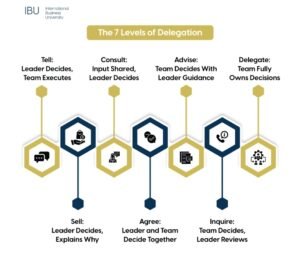
- Tell – Leader Makes Decision and Instructs: At this level, the leader decides and directs execution. The team follows instructions precisely. This level works during emergencies, compliance situations, safety issues, and early training phases.
- Sell – Leader Decides and Persuades: The leader decides and explains the reasoning. Teams gain insight into decision logic while execution remains controlled.
- Consult – Leader Seeks Input Before Deciding: The leader gathers feedback, ideas, and concerns before making the final call.
- Agree – Leader and Team Reach Consensus: At this level, decisions emerge through discussion and alignment. Authority becomes shared. Consensus works best with experienced teams, clear goals, and low urgency.
- Advise – Leader Offers Advice, Final Decision by Team: The team decides and the leader offers guidance without control. This level supports leadership development.
- Inquire – Team Decides, Leader Reviews: Teams operate independently. Leaders review outcomes and ask questions rather than directing action. This level works when competence remains high and stakes remain manageable.
- Delegate – Team Fully Autonomous: Teams own decisions, execution, and results. Oversight focuses on outcomes rather than process.
Delegation levels shift across functions and situations. Sales teams may operate at Level 6 for prospecting while using Level 2 for pricing decisions. Operations teams may run Level 7 workflows while using Level 1 during safety incidents.
Delegation also changes over time. New hires start with Level 1 or Level 2. As skills grow, leaders adjust delegation levels over time. Delegated tasks expand in scope and authority.
At its core, delegation is an act of trust. When a leader delegates, he or she says “I believe in your ability to carry responsibility.” Consider the leadership philosophy of Nelson Mandela, who famously said, “It is better to lead from behind and to put others in front.” Mandela understood that leadership influence often grows stronger when leaders empower others to step forward. This does not mean expecting perfection from the outset. It means allowing room for learning while providing guidance.
Performance Management
Without a robust performance management framework, delegation can quickly devolve into confusion, misalignment, and missed expectations.
At its core, performance management is about clarity. When leaders delegate, they must define not just the task, but the desired outcome, the standards of success, and the parameters within which decisions can be made. Ambiguity is the silent killer of performance. Teams cannot deliver what they do not fully understand. High-performing organizations counter this by ensuring that every delegated responsibility is anchored in clear objectives, measurable results, and aligned priorities.
See Also

However, clarity alone is insufficient without continuous alignment. Performance management is not an annual ritual confined to reviews; it is an ongoing dialogue. Leaders who excel at delegation establish regular check-ins that are focused, constructive, and forward-looking. These interactions are not about policing progress but about enabling it. They create space to address roadblocks, recalibrate expectations, and reinforce priorities in real time.
Equally important is monitoring progress. Leaders must remain engaged through structured check-ins, milestone reviews, and performance discussions. These interactions provide opportunities to identify obstacles early, offer strategic guidance, reinforce priorities and adjust direction if necessary.
Equally critical is the role of feedback. Effective leaders treat feedback as a strategic tool. They provide timely, specific, and actionable insights that help individuals improve performance without undermining confidence. Importantly, feedback is not one-directional. Those with delegated powers should also give feedback to their superiors.
Recognition is another powerful dimension of performance management. When leaders acknowledge achievements, they reinforce desired behaviors and motivate sustained performance. Recognition, when done authentically and consistently, signals that contributions are valued.
At the same time, leaders must be prepared to address underperformance decisively. Avoiding difficult conversations in the name of harmony can erode team effectiveness and credibility. Strong leaders approach these situations with candor and empathy, focusing on solutions rather than blame. They diagnose the root causes, whether skill gaps, resource constraints, or unclear expectations, and take corrective action that supports both the individual and the organization.
Ultimately, performance management ensures that responsibility is matched with accountability, and authority is guided by structure. For leaders, the goal is not to control outcomes, but to create the conditions where outcomes can be consistently achieved. When performance management is done well, delegation becomes a force multiplier, unlocking capacity, accelerating execution, and enabling leaders to focus on what matters most: shaping the future of the organization.
Motivating & Engaging Teams to Boost Morale and Retention
If trust is the foundation and performance management is the structure, then motivation and engagement are the energy that brings delegation to life.
Motivating teams begins with connecting the task to a larger purpose. Leaders often delegate by focusing on what needs to be done, but high-impact leaders go further; they articulate why it matters. When individuals understand how their contributions influence broader organizational goals, their work shifts from obligation to commitment. This sense of purpose transforms routine tasks into meaningful contributions and fosters intrinsic motivation.
Delegation can serve as a leadership development tool when assignments stretch people’s abilities. Leaders who are intentional about aligning tasks with individual strengths and development goals create opportunities for learning and progression. This not only builds competence but also fosters loyalty and long-term engagement.
Communication remains the thread that ties all of this together. Engaged teams are informed teams. Leaders must ensure that communication is clear and consistent.
Finally, engagement is sustained through culture. Leaders set the tone for how work feels within a team. An environment that encourages collaboration, psychological safety, and mutual respect creates the conditions for sustained motivation. Conversely, environments marked by fear, ambiguity, or indifference can quickly erode even the most well-intentioned delegation efforts.
When leaders fail to delegate, they unintentionally limit the capacity of their organizations. Delegation multiplies leadership impact in three powerful ways. First, it expands organizational capacity. More people are empowered to solve problems and drive results. Second, it develops future leaders. People learn leadership by practicing it. Delegation provides the opportunity for emerging leaders to grow. Third, it strengthens institutional resilience. Organisations are encouraged to adopt hybrid models to balance control and flexibility. Delegation distributes knowledge and authority, creating systems that can thrive even when leadership transitions occur.
Delegation requires a subtle but profound shift in leadership mindset. It requires patience to allow others to learn and grow. Expect to spend time teaching your employees how to perform certain given tasks. In the beginning, they’ll need additional guidance from you. Think of this time as an educational investment in the company’s future and the employee’s career skills.
Those who embrace delegation will find themselves not just leading teams but building legacies.