

Ghana’s fintech sector ranks among the most advanced in Africa, driven by rapid mobile money adoption, progressive regulation, and sustained investment. In 2024 alone, mobile money transactions surpassed GH¢3 trillion, underscoring a decisive shift toward a cash-lite economy. Since its introduction, mobile money has accelerated economic activity, improved payment efficiency, and expanded financial inclusion, particularly among underserved and rural communities. It has also enabled SMEs and digital commerce to thrive.
Today, fintech innovation extends beyond payments into lending, insurance, and wealth management solutions, strengthening Ghana’s financial ecosystem and advancing inclusive growth. Increasing collaboration between fintechs and traditional banks is enhancing interoperability and service delivery, although infrastructure gaps and cybersecurity risks remain key challenges.
A key player in this ascent is MobileMoney Fintech Ltd (MMFL), the newly independent powerhouse created in March 2026 when MTN Ghana spun off its iconic MoMo business. Following the statutory merger of MobileMoney LTD into the new entity, approved under the Payment Systems and Services Act, MMFL now operates as a standalone Dedicated Electronic Money Issuer. This move separates the fintech business from telecom infrastructure, unlocking dedicated capital, accelerating product innovation across payments, lending, savings, and merchant services, and creating a distinct valuation trajectory.
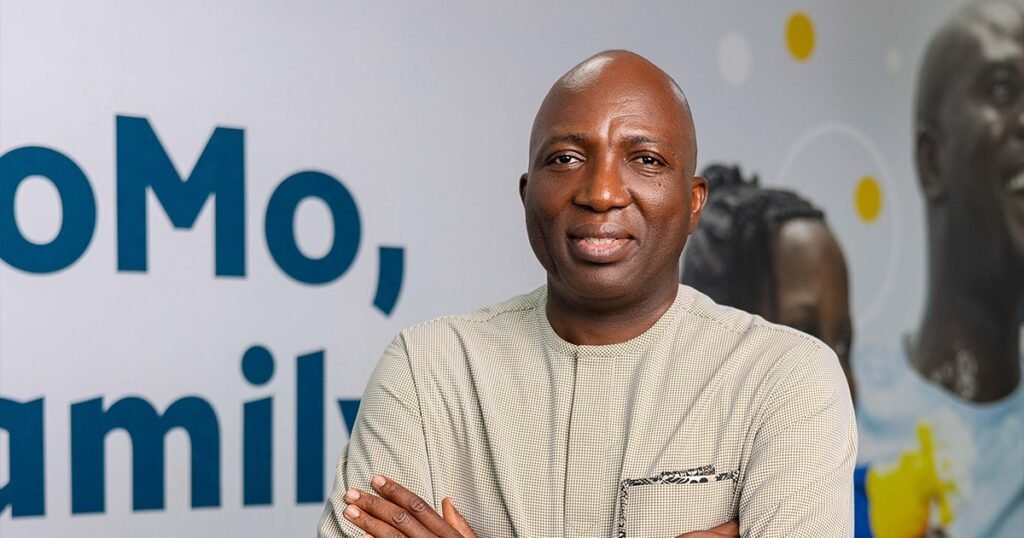
Led by CEO Shaibu Haruna, MMFL is driving the next phase of growth by championing innovation, strengthening anti-fraud systems, and enhancing the customer experience, positioning the company at the forefront of Ghana’s digital finance revolution.
TVA: Years ago, your company launched a campaign that shook the market: “Na Sika Nu Wɔ He?” Where were you when that campaign was launched?
SH: I was right here. I was with MTN at the time. I was actually working in Sales and Distribution. As you know, one of the success stories of mobile money has been the expansive sales and distribution network that we built at the time. It was a very humble beginning, and we’re excited that the business has come this far.
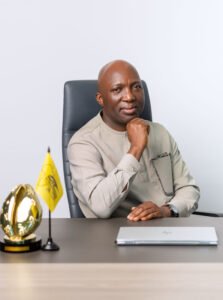
TVA: When the mobile money service was launched, it wasn’t envisaged to become this big because those in charge of voice and data still believed they were going to be the biggest thing. Did you feel the same way at the time?
SH: At the time, we were all trying to understand what kind of a beast we had on our hands, and we saw some indications of it in terms of what was happening in Kenya. We saw the signals. We spent some time in those markets to understand what it meant and, to be honest, the thought process at the time was straightforward. The question then was: How do we use mobile money to build stickiness for our telecom business?
TVA: But that was the vision at the time?
SH: Exactly! That was what it was. But we soon realized that this actually had much more value for our business in terms of the lives it could potentially change and the dignity it could bring to many people in our markets—not just in Ghana, but across the Group.
So, we remained focused on the investment, and it’s interesting to note that for the first five to six years, this was a loss-making business. However, we kept investing significant resources because adoption was slow among customers, agents, and even partners. We were fortunate to have a couple of partners who saw the vision and joined us early. Two particular partners stood out in terms of their energy and commitment to this drive.
So, it wasn’t all great at the time, but I think I have to give a lot of credit and appreciation to my predecessors and also to the CEO at the time, Brett Goschen, who believed in it and consistently committed resources, even when it wasn’t a profitable venture.

TVA: Today, when you stand in your office and look outside, you have a good view of what Accra looks like. How do you feel, considering what the mobile money space is doing in various homes?
SH: Oh, it’s humbling! And if I have to stretch that thought, what it means to me is the number of lives that we touch. Can you imagine the days when leaving your house without your wallet was unthinkable? These days, I don’t even carry a wallet because I have my mobile phone, which stores my money and enables me to do virtually everything. I can work from my mobile phone, and I can also conduct any financial transaction from it.
When you consider how we are impacting lives, it’s amazing. Two weeks ago, I travelled through the Eastern Region, crossed the Volta Lake to Afram Plains and Donkokrom, and visited the Donkokrom Market. Literally every market woman accepted mobile money.

TVA: It looks like this impact cuts across all MTN markets.
SH: Absolutely! I had the privilege of working in a few MTN markets. I spent two years in Uganda and also worked in South Africa, and the kind of impact stories you see are simply amazing. I feel we actually undersell the kind of services we have available services that can transform our economies and build wealth within our countries. Part of what we are seeking to do is not just about building new products but also driving adoption beyond wallets and app transactions.
TVA: The mobile money space is arguably the single most consequential change within the banking and fintech sectors. How has adoption been so far, particularly in ensuring that rural Ghana is not left behind?
SH: Absolutely, no one is being left behind. As a salesperson, I connect more with the grassroots, and whenever I have the opportunity, I spend time in rural communities. On weekends, I often visit rural areas, and I see how pervasive these services have become.
If someone is not connected to mobile money today, regardless of the network, it is likely because they either do not have access to a phone or have chosen not to use the service. In terms of access, I think we’ve largely cracked it. Although there are still pockets that we need to unlock, I believe the next wave of growth in our market will not come from incremental increases in new wallets, but rather from how people are using the service.
For instance, how many of our customers are using digital payments instead of cash? We still operate in a cash-heavy economy. Also, how many people are using mobile money as a gateway to wealth management services such as savings, investments, and insurance?
That is where we need to focus. If you look at the opportunities that exist, insurance penetration remains low; very few people in the country have access to pensions; and only a small fraction invest in the stock market and other assets. As such, we need rails like mobile money, along with partnerships that can unlock that kind of growth and are designed around the customer segments we serve.
I often tell people in the insurance sector and other industries that we need to reimagine the customer journey around insurance and design solutions that meet the needs of the customers we have, rather than simply using the mobile money channel as a means of delivering existing services.
The services being consumed today by a certain cohort of customers are different from the solutions we need to design for the customer segments where we seek to deepen penetration.
TVA: Thus, looking at your explanations above, it suffices to say that mobile money is an enabler of almost everything in the financial industry and, therefore, it is safe to say that mobile money is the biggest enabler?
SH: Well, I think it is. I think that is the case. Recently, during the 3i Africa Summit, I was privileged to sit on a panel with some of my colleagues from across the continent. Part of the conversation we had was whether we need to build more pipes or whether we need to build systems that connect to the pipes.
To a large extent, what we’ve done with mobile money in Ghana is build a big pipe. We are thankful for what we have achieved from an interoperability perspective. We’ve built a highly interoperable system. What we need now are supporting feeders into the main pipe that will connect many more people to different services across various sectors. So, the next wave of growth is going to be quite exciting. It won’t be about building bigger pipes; it will be about building connectors.
TVA: You recently transitioned from MobileMoney LTD to MobileMoney Fintech LTD. (MMFL). What does fintech mean, and why the transition to MMFL?
SH: Well, in its simplest form, fintech means financial technology. Recently, someone asked me about the inspiration behind moving from MobileMoney LTD to MobileMoney Fintech LTD. It was actually a very simple thought process. We felt that we had built something synonymous with the industry, which is mobile money. However, for all intents and purposes, we are a financial technology business.
Moreover, we have an ambition to work with partners to unlock even more opportunities within the financial ecosystem. We are not just about moving money—which is what mobile money is primarily known for—but about connecting people to financial services through technology. So, there was a lot of symbolism and strategic thought behind the name we chose for this forward-looking business.
TVA: Some have argued that every five years, the cost of innovation decreases while efficiency rises as fintech output increases. How are you ensuring that costs are reduced so customers continue to enjoy the services without being overburdened by additional charges?
SH: Yes, it’s a very interesting conversation. One of the things we see happening is that the cost of innovation must be aligned with the rate of adoption. In many instances, technology moves very quickly, and a great deal of obsolescence occurs.
Three years ago, AI wasn’t something we were talking about extensively. In fact, many technology businesses made significant investments in other emerging technologies. Today, for example, you hardly hear much about the metaverse anymore. It is no longer the major focus. Currently, we are pouring substantial investments into AI, and many of the AI models being developed may not necessarily deliver returns.
That is the nature of technology. However, you continue to invest in different ideas; some work and some don’t. You cannot stop innovating. Technology and innovation are expensive.
What is required is scale in adoption to bring the overall cost down. When investment levels are high but adoption rates lag behind, the benefits do not fully inure to the customer. That is why we almost have to adopt a twin-track approach, where we consistently invest in both technology and customer adoption so that we can systematically reduce costs over time.
TVA: In a previous interview I watched, Elon Musk was discussing what currency might look like in the future. He suggested that, eventually, currency or money could become energy. Currently, as a result of the proliferation of AI, there are many tokens in the system, yet you still handle cash. Do you feel threatened by the growth of AI-driven money such as Bitcoin and other emerging currencies?
SH: Well, for me, it’s an opportunity, isn’t it? We started from nowhere and built a thriving mobile money ecosystem. I don’t know exactly what the next 20 years will look like. Therefore, what we do as a technology company—and as a business focused on long-term sustainability—is constantly look at new horizons for growth.
We have never been a company that shies away from innovation. As we observe where the industry is heading, we make strategic decisions about where to invest and where to divest. We continuously evaluate these opportunities.
We are not intimidated by the stablecoin environment. In fact, we are pleased that the Bank of Ghana has taken a bold step with the Virtual Asset Service Provider framework. We are actively engaging all twelve partners participating in the sandbox, both on the Securities and Exchange Commission (SEC) side and the Bank of Ghana side, to explore what is possible.
There is significant opportunity for us to collaborate with these partners. We have already built the pipes; now we need the connectors. Stablecoins and virtual assets represent some of those connecting pieces, and we would certainly like to be part of that journey.

TVA: Looking into the future, for the benefit of young people watching this interview and studying the fintech space, could you share some insight into what you see ahead? Where should they focus their attention, and what areas should they be exploring to find their path?
SH: Based on my understanding and reading of the industry, the first thing I would say is that this industry is going to experience significant growth and acceleration. That growth will require a wide range of talented individuals to support it. In fact, one of the things we intend to pursue very boldly in the near future is finding ways to develop and attract fintech talent—not just for our business, but for the industry as a whole.
I believe there is substantial growth ahead, and emerging areas such as virtual assets will be particularly interesting because they have the potential to disrupt the status quo. If I were a long-term investor that is certainly one of the areas I would be paying close attention to. It is a space worth watching very carefully.
TVA: In 2025, MobileMoney Fintech LTD. recorded total revenue of GHS 6 billion. What contributed to this figure?
SH: As a matter of fact, if you look at the transactions processed on our platform, approximately GHS 4.1 trillion in value moved through the ecosystem. Breaking it down further, we processed around 23 million transactions per day. So, it’s quite a large-scale operation.
TVA: What is the impact of that GHS 6 billion on the economy itself?
SH: Inasmuch as GHS 6 billion is a significant figure, I believe this country needs to have multi-billion-dollar businesses that can generate in excess of a billion dollars in revenue.
However, in the broader scheme of things, our turnover is approximately $500–$550 million, depending on the exchange rate. So yes, it is a sizable business, but I think the size and potential of this market are far greater than what the current revenue profile reflects.
TVA: Can you tell us what the key drivers are?
SH: We’ve seen a significant shift in consumer behavior. Previously, the predominant services were basic transactions—person-to-person transfers and cash-outs. These services used to generate more than 60–65% of our revenue.
However, we’ve witnessed a positive transition from what we call basic services—cash-in and cash-out transactions—which have begun to decelerate in terms of their contribution to the business, to lending and P2P services, which we classify as advanced services. These are generating considerable interest and are expanding rapidly.
To put it into perspective, three years ago, the total size of our business was about GHS 2 billion. By the end of last year, it had grown to GHS 6 billion, representing a threefold increase in revenue. At that time, the advanced services portfolio was almost negligible. Today, it contributes approximately GHS 2 billion in revenue. That’s a very significant shift. For us, the future of this business lies in advanced services. This brings me back to my earlier point: investments and savings are the real avenues that will generate future growth opportunities.
Let me briefly move away from the revenue discussion and focus on what it means to process GHS 4.1 trillion in transactions and 23 million transactions daily. It means people in Ghana are actively using this service.
TVA: Twenty-three million transactions per day? What impact does that have on people’s lives?
SH: Yes! These transactions involve customers and agents exchanging value; people paying merchants in small villages in the Eastern Region to buy plantain; individuals taking loans to support their hawking businesses and pay school fees for their children, while also taking care of themselves when they fall ill. These are life-changing transactions.
What inspires me most in this role are the small impact stories. You can go to Dome-Kwabenya and ask a market woman how mobile money has benefited her, and she might tell you:
“I used to have customers travel all the way from Koforidua to Accra carrying cash to buy my products, exposing themselves to robbery risks. Today, they don’t even need to come. They simply call me because we’ve built trust over time. They place their orders, make payment, and the goods are delivered in real time.”
Mobile money removes many of the challenges associated with long-distance travel and cash handling. This is a life-transforming business, and my team and I take great pride in building solutions that impact people in such meaningful ways.
TVA: Considering your Corporate Objective 2030, there is a transition from a closed-wallet system to an open, integrated system. What does that mean?
SH: Well, we’re already operating in that space. We’re fortunate to have a regulatory framework that supports what I call “open play,” which is essentially designed to accommodate everyone.
When the pioneers of this initiative designed the ecosystem, they intentionally brought multiple banks on board from the beginning. Typically, businesses of this nature start with one partner bank and later add one or two more. However, we began with about five or six banks.
Fast forward to today, and we have all 23 partner banks connected to our ecosystem. We have embraced interoperability, and we tell our partners that we are a channel for them—a massive distribution infrastructure. Therefore, we do not pursue exclusive relationships.
What we do is open. We are a marketplace for digital orchestration, and that’s exactly where we are today. We are living the vision of open participation, inclusive growth, and being a force for good.
Some people describe us as a dominant player. However, I often disagree because the term “dominant” can carry a negative connotation. Instead, we see ourselves as a market leader—a responsive and responsible market leader that brings everyone along on the journey.
It’s a very simple mission. Because of the capabilities we have built over the years, we have an opportunity to elevate the entire industry and support others. Not every company has to do the same thing. We can all play different roles and enable one another in different ways.
There’s an interesting parallel here with the internet café era, when one successful business model emerged and everyone wanted to replicate it. But true growth requires diversification.
One company may excel at building the mobile money rails. Another may specialize in insurance solutions that connect the dots for customers. Others may develop investment products. All these solutions can plug into a common ecosystem and serve the broader population.
In that way, the ecosystem becomes a national asset—one that we can collectively strengthen and make more resilient. I believe that is what we, as Ghanaians, should aspire to: a stronger, more supportive, and resilient industry that propels growth for the mutual benefit of all.

TVA: As Africa advances the AfCFTA agenda, how easy is it for Kwame to move money from a mobile money wallet in Ghana to other networks across the continent? And how can transaction costs be reduced?
SH: The good news is that the technology already exists, and we’re actively working in that space. Today, if you’re on MTN, you can send money to Nigeria, and vice versa. This was a major topic of discussion during the 3i Summit two years ago, and there has been substantial conversation around using mobile money as a key catalyst for intra-African payments.
We have an interesting partnership through OnAfriq and PAPSS, which connects us to Nigeria. This is currently part of a Bank of Ghana’s Proof of Concept (POC). We also have another pilot initiative with BridgeX, which is exploring a currency-swap arrangement between Ghana and Nigeria.
These experiments are generating valuable insights that will help shape the final products and solutions. From my perspective, the foundational technology already exists and has been proven. There are only a few hurdles remaining.
One is the regulatory framework required to support and enable such transactions. Another is political will, which is equally important in driving continental integration. Once these elements are aligned, there are many innovators ready to seize the opportunity.
Africa is a massive market, and we have a unique opportunity to unlock it for Africans. This would be especially beneficial for small businesses seeking to trade across borders. The transaction patterns we’re observing in the Ghana–Nigeria experiments are already quite encouraging.
TVA: Does it cost more?
SH: Well, the alternatives are often far more expensive, especially if you have to travel physically, visit a bank, or rely on informal exchange arrangements at border points. The reality is that these transactions are already taking place.
One concern regulators often have is trade imbalance. If more money flows in one direction than the other, settlements become necessary, and those settlements are usually denominated in US dollars, which can create pressure on regulators.
However, these transactions are already occurring in the informal economy through mechanisms that are often more expensive, less transparent, and largely unregulated. As such, regulators have limited visibility into the scale of those flows.
By leveraging digital rails, we have an opportunity to track trade flows more effectively while also creating new revenue-generation opportunities for governments.
There are many opportunities currently being missed. Although the existing informal systems create value in some ways, I believe we can streamline them and build a much more efficient and flexible trade platform across the continent.
TVA: Mobile money fraud is on the rise. As the leading mobile money operator in the country, how are you addressing this challenge?
SH: Kindly permit me to correct what I consider a philosophical misconception. We’ve moved beyond what can simply be described as mobile money fraud. Today, we’re dealing with digital crime.
As the industry evolves, wherever money exists, there will always be people seeking to exploit it. The challenge has become increasingly sophisticated, especially as we have transitioned from USSD-based services to app-based platforms.
So, it is no longer merely mobile money fraud; it is a broader digital crime challenge. In fact, one could argue that it is evolving into a small criminal industry of its own. We take this responsibility very seriously.
Fundamentally, what we sell is trust—a promise that customers’ funds will remain safe and accessible whenever they need them. That responsibility is one we hold in the highest regard, and we are fully committed to protecting our customers and ensuring the safety of their funds.
The regulatory framework supporting this is very clear. Customer funds are securely held in partner banks, and technology enables us to provide access to those funds whenever customers need them.
Protection, however, is a shared responsibility. We have a responsibility to maintain robust platforms and deploy effective anti-fraud tools and controls. Customers also have a responsibility to practise safe financial habits. This is why education remains such an important part of our strategy.
We must remember that the ecosystem includes people with varying levels of technological understanding, and digital fraud does not discriminate based on educational background. That is why we continue to invest heavily in customer education and awareness.
One unique aspect of mobile money is that if someone knows your phone number, it’s almost as if they know your bank account.
Unlike a traditional bank account, where someone would need to know your account number and cannot simply call you through it, mobile money allows direct contact. This creates opportunities for fraudsters to exploit customers through social engineering, account takeovers, WhatsApp scams, and other deceptive tactics. For that reason, awareness and vigilance must be even higher within the mobile money ecosystem.
First and foremost, weak PIN security creates vulnerability. So, we consistently advise customers to avoid simple PINs such as “1234” or “0000.” Ironically, one of the most common reasons customers visit our service centres is to reset their PINs because they have forgotten the stronger PINs they created.
TVA: There are speculations that some of this fraud is perpetrated by syndicates that include your staff. One example often cited is the coincidence between fraudulent outreach and the receipt of funds. Has this come to your attention, and has it warranted any internal investigations given the timing of these incidents?
SH: Those are fair concerns that we receive from time to time. For all such concerns that come to our attention, we have mechanisms for validating what actually happened. Anyone who accesses a customer’s account on the backend leaves an audit trail, allowing us to identify all backend activity associated with that account.
As a result, there is a comprehensive audit log, which makes it extremely difficult for anyone to access or manipulate an account without detection.
For example, if you call our contact centre to lodge a complaint and an agent accesses your account details through the system, there is a record showing the exact time—down to the second—that the account was accessed.
Therefore, whenever such complaints arise, we trace the audit trail to determine who accessed the account and at what point in time. As a result, we conduct a significant number of backend investigations whenever these concerns are reported. That said, the best defence for customers remains simple: do not engage with suspicious calls.
There is also a foundational issue that we need to address, which relates to the SIM registration process. There are some gaps within the existing framework, and I believe this is widely acknowledged.
I am aware that the Minister for Communications has publicly committed to addressing this issue, and we are actively engaging in that process. Once those improvements are implemented, we will be able to address many of the foundational challenges surrounding SIM ownership and traceability, making it easier to link SIM cards to their rightful owners.

TVA: Beyond the measures you’ve outlined to curb the rise of digital crime, what other initiatives are you considering?
SH: The next key initiative is the establishment of a Fraud Command Centre. Recently, we held a stakeholder engagement session involving banks, fintech players, and other industry leaders. During our discussions on fraud and how to address it collectively, we agreed on the need to establish a Fraud Command Centre.
The interoperable nature of our platforms means that fraud schemes have also become increasingly sophisticated. Funds can move rapidly across different networks and mobile network operators before eventually being cashed out. Therefore, it is important to have a centralized command centre where we can quickly identify, interrupt, and break these fraud chains before funds are withdrawn.
Such a centre would require participation from all telecommunications operators. We are currently leading that conversation, and several working groups are actively collaborating to bring the initiative to life. We believe it will play a significant role in addressing the challenge.
In addition, we continue to focus on preventive measures, including both operational interventions and customer education initiatives.
TVA: What does the big-picture vision for the fintech industry look like over the next ten years?
SH: As a country, I believe we have built something truly remarkable, and I would argue that we are among the best—if not the very best—in Africa.
We have a very strong regulatory framework, and we are fortunate to have a progressive regulator that is forward-thinking and open to dialogue. This collaborative approach enables us to protect customers while simultaneously building a resilient financial ecosystem.
As a country, I believe we have established the right foundation. What we need now is the continued sustenance of that structure and progressive regulatory environment. Combined with positive macroeconomic fundamentals, these factors will serve as important catalysts for investment and the attraction of capital into Ghana.
That is what we need to sustain and accelerate fintech innovation across Africa. From a national perspective, the future is very exciting, and we can only improve through the partnerships we continue to build together.

TVA: What are your remarks to your team, and what should Ghanaians look forward to from you going forward?
SH: I am privileged to work with an amazing team—very dynamic, approachable, and grounded. At times they can be a little overexcited, but I am incredibly proud of what we are building together. That is exactly the kind of energy you need in a fintech organization, and I am proud to serve as their humble leader in driving this journey toward greatness.
Our strategic ambition is actually quite simple. It may sound broad, but for me it is deeply inspiring. At its core, our ambition is to bring dignity to Ghanaians, and everything we do revolves around that purpose.
We want to ensure that a woman in the Upper East Region can live a dignified life, support her small business, and have access to borrowing, investing, and saving opportunities—not only for herself but also for her family. That is what we are all about.