


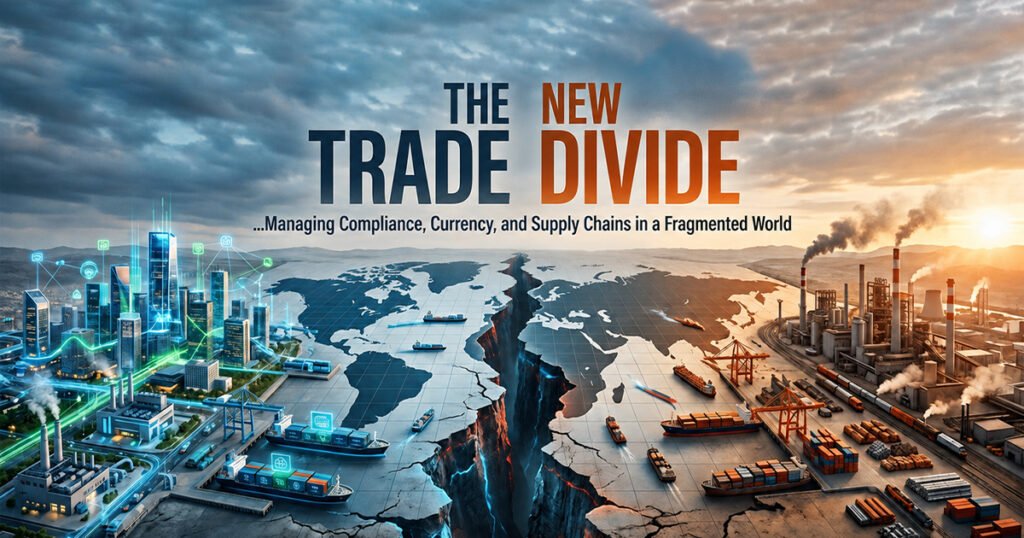
As 2026 progresses, ongoing geoeconomic strains and shifting security alliances have dragged down international trade momentum, with the International Monetary Fund warning that intensifying geopolitical divisions risk trapping global growth at a restrictive 2.5% rate.
The gridlock at the World Trade Organization’s 14th Ministerial Conference (MC14) in Yaoundé underscored this systemic breakdown, as members failed to reach a comprehensive multilateral trade declaration or extend the long-standing moratorium on digital trade customs duties.
The multilateral trading rules that governed the post-Cold War era are being abandoned. In their place stands a fractured global map split into competing regulatory and economic blocs, forcing multinational corporations to abandon hyper-optimized, single-stream supply networks in favor of fragmented operational playbooks.
Death of Universal Trade
For modern compliance officers and supply chain executives, this structural divide has transformed international trade into a complex legal landscape. Operating across deeply divided economic spheres means navigating an environment of regulatory dualism, where the legal mandates of one trading bloc can directly contradict the enforcement laws of another.
Multinational corporations no longer face the simple challenge of adjusting to tariff changes; instead, they must manage overlapping and often hostile regulatory architectures designed to weaponize trade for geopolitical leverage.
This friction is highly visible in the divergence between Western supply chain transparency frameworks and localized countermeasures. The European Union’s expanding carbon border adjustment mechanisms and strict transparency compliance rules require Western buyers to audit and verify every tier of their upstream supply chains.
Simultaneously, opposing jurisdictions have accelerated the use of sweeping counter-sanctions, data residency laws, and anti-foreign-sanctions statutes.
These laws often make it a domestic violation for local suppliers to disclose operational data or comply with foreign audit demands, leaving corporate entities caught in an operational paradox where satisfying a transparency audit in one market can risk triggering severe legal or financial penalties in another.
To keep goods moving across these fractured borders, multinational corporations are systematically dismantling their centralized compliance frameworks. Rather than maintaining a single global standard, entities are building parallel, legally insulated corporate compliance structures.
By completely isolating Western supply lines from non-aligned manufacturing operations, businesses are shifting toward a multilocal operating model, accepting structurally higher administrative and operational costs as the baseline price of continuing to trade across divided spheres.
Managing Trade, Treasury, and Multi-Currency Billing
For decades, multinational corporations operated under a unified treasury model anchored by the unchallenged centrality of the US dollar and the clearing efficiency of the Society for Worldwide Interbank Financial Telecommunication (SWIFT) network.
In that environment, trade treasury management was primarily an exercise in cash-flow optimization and straightforward interest-rate hedging. However, as the contemporary international trading system splits into distinct geographic spheres, corporate entities are witnessing a transition toward a stratified and heterogeneous multipolar currency system.
The fragmentation of physical trade lanes has triggered a parallel division within the global financial architecture, turning traditional corporate cash management into a far more complex operational challenge.
This shift is driven by geopolitical shocks and the weaponization of global financial networks, which introduce acute availability risks for traditional G7-denominated reserve assets and payment channels. The structural vulnerabilities of a unipolar financial system have prompted central banks and international trade desks to actively diversify.
Empirical data from the International Monetary Fund’s Currency Composition of Official Foreign Exchange Reserves database reveal that the US dollar’s share of global official reserves has experienced a meaningful decline, falling to approximately 57.74%. This institutional diversification is deeply linked to trade invoicing practices and the changing geography of supply chains.

When countries adjust their bilateral trade agreements to hedge against exchange-rate risks and sanctions exposure, they systematically reduce their reliance on traditional dollar-denominated invoicing.
A striking manifestation of this trend is the unprecedented realignment of official reserves. By the end of 2025, global official gold holdings had climbed to $3.909 trillion, drawing nearly level with foreign official holdings of US Treasury securities at $3.920 trillion.
This near-parity represents a broad corporate and sovereign shift toward sanctions-resistant, tangible assets designed to protect trade capital from external judicial freezes.
To keep industrial cross-border cargo moving without disruption, corporate treasury departments are implementing multi-rail payment architectures that bypass traditional clearing hubs. This operational adjustment is most visible in major trade corridors involving emerging economies.
For instance, the share of Chinese goods trade settled directly in local currency surged from 15% in 2021 to slightly more than 30% by 2025, representing annual trade exceeding $1.9 trillion. Multinational entities are no longer treating alternative transaction infrastructures, such as China’s Cross-Border Interbank Payment System, as emergency contingencies.
Instead, they are integrating them as primary rails for physical commodity pricing and invoice settlement. Managing multi-currency billing across these fragmented spaces requires corporations to maintain higher working-capital buffers and absorb the costs associated with localized liquidity shortages.
Nevertheless, the implementation of decentralized, multi-currency invoicing has become a mandatory corporate strategy to ensure that transactional liquidity cannot be unilaterally blocked by non-aligned jurisdictions.
Tariff Weaponization and The Rise of Intermediary Routing Hubs
The acceleration of protectionist policies has transformed tariffs from simple economic barriers into highly weaponized tools of national security and industrial strategy.
According to the McKinsey Global Institute’s 2026 Trade Geometry Update, average tariff rates between major economies have climbed to their highest levels since World War II, fundamentally altering the traditional landscape of cross-border commerce. This shift, spearheaded by aggressive unilateral restrictions and targeted manufacturing duties, has forced a dramatic reconfiguration of historical trade corridors.
The direct impact is most pronounced in the bilateral decoupling between the United States and China, where expanding regulatory barriers have structurally redirected more than $165 billion in nominal goods trade away from the direct Pacific corridor.
However, this decoupling, according to UNCTAD, has not entirely eliminated underlying corporate dependencies; instead, it has given rise to a network of strategically non-aligned “connector economies” that function as vital intermediary routing hubs.
To keep international trade flowing across these rising tariff barriers, multinational corporations are deliberately lengthening their supply chains, routing goods through neutral third-party territories where products can be processed, assembled, or repackaged to legally alter their country of origin.
This specific mechanism of trade redirection is extensively documented in the European Central Bank’s Economic Bulletin, published in early 2026. The Bank’s empirical analysis shows that while direct Chinese exports to the United States declined by $104 billion in 2025 due to punitive tariff exposure, Chinese shipments to the Association of Southeast Asian Nations (ASEAN) increased by 13% during the same period. This surge was heavily concentrated in upstream intermediate components, raw materials, and semi-processed electronics.
Simultaneously, ASEAN experienced a corresponding increase in its own finished-goods exports to Western markets—a parallel pattern suggesting that Southeast Asian supply chains are functioning as a major processing and assembly buffer for global commerce.
In the Western Hemisphere, Mexico has assumed a nearly identical role as a leading connector hub. Leveraging its structural protections under the United States-Mexico-Canada Agreement (USMCA), Mexico has imported growing volumes of industrial machinery and intermediate electronic inputs from East Asia to support local manufacturing ecosystems, which then export finished industrial equipment and consumer products to the North American market.
For multinational enterprises, utilizing these intermediary hubs is no longer a temporary workaround but a structural corporate strategy. While this multi-nodal rerouting approach incurs higher logistics costs, extends transit times, and introduces additional administrative layers, it provides a critical shield against sudden tariff increases and border-enforcement disruptions.
By distributing their operations across these flexible neutral corridors, global entities are successfully maintaining market access, proving that in a highly fragmented world, trade flows will continue to adapt in order to bypass political barriers.
Asset Protection and Mitigating Expropriation Risks
The final frontier of corporate trade strategy in this fragmented global economy is the preservation of physical inventory, cross-border assets, and maritime cargo located within adversarial jurisdictions.
In an era where trade policy is directly intertwined with national security, international commerce faces risks that extend far beyond fluctuating customs duties. Multinational corporations are increasingly exposed to gray-zone aggression, sudden asset seizures, export embargoes on critical raw materials, and the unilateral cancellation of trade licenses. This shift has fundamentally altered the corporate risk profile, transforming political risk management from a compliance checkbox into a core boardroom survival strategy.
According to the 2026 Political Risk Survey published by WTW, the modern threat matrix has shifted from localized, geographically isolated conflicts toward broader systemic vulnerabilities driven by government policy changes.
The survey reveals that 61% of global business executives rank economic coercion and retaliation—such as arbitrary tariffs and official or unofficial sanctions—as their primary operational concern, surpassing the threat posed by international violent conflict.
Furthermore, 39% of multinational entities report that their primary risk exposure stems directly from the regulatory and policy decisions of their own home governments, reflecting a deeply fractured global order in which domestic industrial protectionism routinely overrides international trade norms.
Faced with the rising threat of trade infrastructure disruption and inventory expropriation, corporations are structurally reorganizing their international operating models.
The WTW analysis highlights a profound shift in organizational planning, showing that more than 80% of globalized firms are either actively preparing or seriously considering strategies to make their Eastern and Western business operations completely independent corporate entities.
By legally and operationally separating regional entities, multinational enterprises are attempting to ensure that an asset seizure or trade embargo imposed by one bloc cannot destabilize or trigger a default across their broader global corporate footprint.
Simultaneously, demand for non-commercial risk mitigation has pushed the global political risk insurance market to unprecedented levels. Corporate entities are increasingly relying on multilateral institutions to provide the legal and financial backstops necessary to sustain investments in volatile trade zones.
This trend is anchored by the World Bank Group’s consolidated Guarantee Platform, managed by the Multilateral Investment Guarantee Agency (MIGA). According to its 2025 financial disclosures, the unified platform issued a record $12.3 billion in non-commercial risk guarantees, with MIGA independently accounting for $9.5 billion across 44 global projects designed to protect private investments against expropriation, breach of contract, and trade credit losses.
By layering their cross-border operations with these multilateral guarantees, global enterprises establish an essential layer of protection. Host nations are structurally discouraged from disrupting or expropriating trade pipelines when doing so could trigger a direct financial dispute with the World Bank Group.
Navigating trade in a fractured world ultimately requires corporations to accept that the globalized marketplace has permanently evolved into a map of contested systems, making structured asset insulation the definitive baseline for cross-border operations.
The New Baseline for Global Commerce
The restructuring of international trade frameworks in 2026 demonstrates that the global trading system is not entering a temporary downturn but undergoing a permanent structural transformation.
The transition away from a unipolar, frictionless model toward a highly fragmented, multi-speed global trade architecture has fundamentally altered how multinational entities evaluate operational risk and market access.
As documented by the United Nations Conference on Trade and Development in its mid-2026 global assessments, while international trade continues to expand in nominal value, the underlying momentum remains increasingly uneven, heavily influenced by geopolitical alignments, energy-corridor vulnerabilities, and localized regulatory boundaries.
In this environment, the longstanding focus on maximizing transaction speed and minimizing short-term production costs has been replaced by a corporate mandate centered on structural resilience and asset preservation.
For industry stakeholders and corporate boards, thriving in this fractured world requires abandoning any expectation of a return to a unified global trade consensus. Evidence from the frontlines of commerce shows that the companies maintaining market leadership are those actively treating fragmentation as their baseline operational reality.
By implementing parallel compliance structures, deploying multi-rail treasury frameworks, and leveraging non-aligned connector economies as intermediary routing hubs, multinational corporations are successfully insulating their supply networks from direct geopolitical shocks.
However, this decentralized strategy carries an unavoidable macroeconomic cost. Higher working-capital requirements, structural supply-chain redundancies, and increasingly complex multi-jurisdictional legal barriers inevitably compress corporate profit margins and contribute to higher consumer prices globally.
Ultimately, the divide between the world’s primary economic spheres is reshaping the metrics of corporate performance. In the decades following the establishment of modern multilateral trade frameworks, corporate success was defined by an entity’s ability to optimize global scale and integrate international labor markets.
In today’s landscape, success belongs to the organizations capable of mastering complexity across distinct, and often hostile, legal and financial jurisdictions.
As global commerce continues to splinter into separate regulatory nodes, the ability to build flexible, localized, and geopolitically insulated trade pipelines will remain the defining differentiator between corporate survival and operational failure.