


The Democratic Republic of the Congo (DR Congo) is a vast Central African nation, the second-largest in Africa by area and one of the most resource-rich countries globally, yet ranks among the world’s poorest and least developed due to prolonged political instability, conflict, corruption, and infrastructure deficits.
The nation is a prominent example of the “resource curse.” Also known as the DR Congo, Congo-Kinshasa, or simply the Congo or less often Zaire, the country is bordered by the Republic of the Congo, the Cabinda exclave of Angola, and the South Atlantic Ocean to the west; the Central African Republic and South Sudan to the north; Uganda, Rwanda, Burundi, and Tanzania (across Lake Tanganyika) to the east; and Zambia and Angola to the south. Centered on the Congo Basin, most of the DRC’s terrain is covered by dense rainforests and is crossed by many rivers. The east and southeast are mountainous.
The Democratic Republic of the Congo has been known in the past as, in chronological order, the Congo Free State, Belgian Congo, the Republic of the Congo-Léopoldville, the Democratic Republic of the Congo and the Republic of Zaire, before returning to its current name, the Democratic Republic of the Congo.
By land area, it is the eleventh-largest in the world. The Democratic Republic of the Congo is named after the Congo River, which flows through the country. The Congo River is the world’s deepest river and the world’s third-largest river by discharge. The Congo River was named by early European sailors after the Kingdom of Kongo and its Bantu inhabitants, the Kongo people, when they encountered them in the 16th century. The word Kongo comes from the Kongo language, also called Kikongo.
The DRC lies between latitudes 6°N and 14°S, and longitudes 12°E and 32°E. It straddles the Equator, with one-third to the north and two-thirds to the south. With an area of 2,345,408 square kilometres (905,567 sq mi), it is the second-largest country in Africa by area, after Algeria. As a result of its equatorial location, the DRC has high precipitation and has the highest frequency of thunderstorms in the world. The annual rainfall can total upwards of 2,000 millimetres (80 in) in some places. The DRC sustains the Congo rainforest, the second-largest rainforest in the world after the Amazon rainforest.
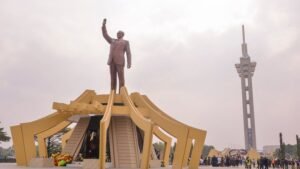
This massive expanse of lush jungle covers most of the vast, low-lying central basin of the river, which slopes toward the Atlantic Ocean in the west. This area is surrounded by plateaus merging into savannas in the south and southwest, by mountainous terraces in the west, and dense grasslands extending beyond the Congo River in the north. The glaciated Rwenzori Mountains are found in the extreme eastern region. The tropical climate produced the Congo River system which dominates the region topographically along with the rainforest it flows through. The Congo Basin occupies nearly the entire country and an area of nearly 1,000,000 km2 (390,000 sq mi). The river and its tributaries form the backbone of Congolese economics and transportation. Major tributaries include the Kasai, Sangha, Ubangi, Ruzizi, Aruwimi, and Lulonga.
The Congo River has the second-largest flow and the second-largest watershed of any river in the world, behind the Amazon in both respects. The sources of the Congo River are in the Albertine Rift Mountains that flank the western branch of the East African Rift, as well as Lake Tanganyika and Lake Mweru. The river flows generally west from Kisangani just below Boyoma Falls, then gradually bends southwest, passing by Mbandaka, joining with the Ubangi River, and running into the Pool Malebo (Stanley Pool). Kinshasa and Brazzaville are on opposite sides of the river at the Pool. Then the river narrows and falls through a number of cataracts in deep canyons, collectively known as the Livingstone Falls, and runs past Boma into the Atlantic Ocean. The river and a 37-kilometre-wide (23 mi) strip of coastline on its north bank provide the country’s only outlet to the Atlantic.
The territory of the Congo was first inhabited by Central African foragers around 90,000 years ago and was settled in the Bantu expansion about 2,000 to 3,000 years ago. In the west, the Kingdom of Kongo ruled around the mouth of the Congo River from the 14th to the 19th century. In the center and east, the empires of Mwene Muji, Luba, and Lunda ruled between the 15th and 19th centuries. These kingdoms were broken up by Europeans during the colonization of the Congo Basin. King Leopold II of Belgium acquired rights to the Congo territory in 1885 and called it the Congo Free State. In 1908, Leopold ceded the territory after international pressure in response to widespread atrocities, and it became a Belgian colony. Congo achieved independence from Belgium in 1960 and was immediately confronted by secessionist movements, the assassination of Prime Minister Patrice Lumumba, and the seizure of power by Mobutu Sese Seko in 1965. Mobutu renamed the country Zaire in 1971 and imposed a personalist dictatorship.
Instability caused by the influx of refugees from the Rwandan Civil War into the east of the country led to the First Congo War between 1996 and 1997, ending in Mobutu’s overthrow. Its name was changed, and it was confronted by the Second Congo War from 1998 to 2003, which resulted in an estimated several million deaths and the assassination of President Laurent-Désiré Kabila. The war ended under President Joseph Kabila, who restored relative stability, though fighting continued in the east. Human rights remained poor, and there were frequent abuses, such as forced disappearances, torture, arbitrary imprisonment and restrictions on civil liberties.
Kabila stepped down in 2019, the country’s first peaceful transition of power since independence, after Félix Tshisekedi won the contentious 2018 election. Over 120 armed groups remain active, concentrated in the east. One of the region’s largest cities, Goma, was occupied by the M23 rebels in 2012 and since 2025. The M23 uprising escalated in early 2025, with military support from Rwanda, which has caused a conflict between the two countries.
With a population of around 124 million people, the Democratic Republic of the Congo is the fourth-most populous country in Africa and the most populous Francophone country in the world. French is the official and most widely spoken language. There are over 200 indigenous languages, of which Lingala is the most widely spoken. The capital, largest city, and economic center is Kinshasa.
The DRC is one of the most vulnerable nations to climate change and the least prepared to deal with its impacts. Climate change in the DRC is predicted to cause more frequent and intense floods, droughts and exacerbated disease epidemics. Sectors vulnerable to climate change include agriculture, forestry and energy. The DRC faces persistent healthcare challenges, including outbreaks of Ebola, measles, and malaria, and its healthcare system is under-resourced. The DRC is a member of the UN, Non-Aligned Movement, African Union, COMESA, Southern African Development Community, Organisation Internationale de la Francophonie, and Economic Community of Central African States.
GOVERNANCE
The DR Congo operates as a decentralized unitary semi-presidential republic under the 2006 Constitution (promulgated 18 February 2006), establishing the Third Republic. It features separation of powers among executive, legislative, and judicial branches, with some devolution to 25 provinces plus the city-province of Kinshasa. Multi-party democracy exists. The DRC’s political system is considered to be authoritarian and scores low on rankings of democracy, political rights, and civil liberties. Despite the constitution providing for the separation of executive, legislative, and judicial powers, in practice the President and his associates have dominated the political system. Freedom House rated the country as “not free” in 2025, citing endemic corruption, the manipulation of the political system, and human rights abuses, including by security forces. The Economist Democracy Index described the DRC as an “authoritarian regime” in 2024, ranking it 156 out of the 167 countries that it evaluated. The DRC was ranked 163 out of 180 countries in the Corruption Perceptions Index for 2024. Administrative institutions remain weak, especially in rural areas, undermining the ability of government to provide basic services to the population. The state has also struggled to extend its administration over the country’s entire territory. The Fragile States Index ranked the DRC the 5th most fragile country in the world, out of 179 countries, as of 2024.
Executive branch
See Also
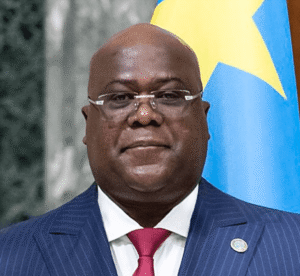
The President serves as Head of state and Commander-in-chief of the armed forces, elected by universal suffrage for a five-year term (renewable once). Félix Tshisekedi has held the office since January 2019, marking the first peaceful transfer of power since independence in the 2018 election (re-elected in 2023 amid fraud allegations). The President appoints the Prime Minister (Head of government) and cabinet, typically from the parliamentary majority, though with significant influence. The current Prime Minister is Judith Suminwa (since 2024). The executive manages foreign policy, defense, and can influence legislation, but the government (cabinet) is responsible to the legislature.
Legislative branch
The Palace of the People in Kinshasa houses Parliament. Parliament is bicameral, consisting of the National Assembly (lower house) and the Senate (upper house). The National Assembly comprises 500 members directly elected (mix of first-past-the-post and proportional representation) for five-year terms. It holds primary legislative power, approves the budget, and can pass a motion of no confidence in the government. Senate members are indirectly elected by provincial assemblies for five-year terms. The Senate represents provinces and has roles in constitutional matters and oversight.
Judicial branch
The judiciary is constitutionally independent, comprising the Constitutional Court, the highest for constitutional issues with Chief Judge Dieudonné Kamuleta; the Court of Cassation, highest for ordinary civil/criminal matters; the Council of State, administrative jurisdiction; as well as lower courts and tribunals.
Administrative divisions
The country has 26 administrative divisions: 25 provinces and Kinshasa (capital and city-province). Provinces have Governors and assemblies with some fiscal and administrative autonomy under decentralization. The provinces are subdivided into 145 territories and 33 cities. Key provinces include Katanga, Kivu and Équateur. This structure aims to address ethnic/regional diversity but faces implementation hurdles due to weak institutions and conflict.
ECONOMY
The DR Congo has a developing, resource-dependent economy transitioning from conflict. Its largest trade partner by a significant margin is China, which represented 41% of its exports in 2024, followed by Zambia, South Africa, Singapore, and the United Arab Emirates. Agriculture employs most of the population (~66% historically), while minerals dominate exports (80%+ of export value, led by cobalt and copper to China). The economy suffered from colonial exploitation, Mobutu-era mismanagement, nationalizations, and wars (First and Second Congo Wars, which caused millions of deaths and economic collapse). Recovery since 2003 has been uneven; informal sector activity is substantial and undercounted in official statistics. Major constraints to the economy are poor infrastructure, corruption, conflict minerals, and “resource curse.”
AGRICULTURE
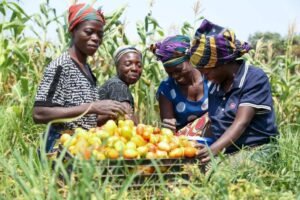
Agriculture is the mainstay of the economy, supporting around two-thirds of the population and historically accounting for a large GDP share, though output has stagnated since independence due to conflict, poor transport, and limited commercialization. It is mostly subsistence-based on small plots, with four million families involved. Only around 3.5% of land is cultivated. Principal food crops are cassava (29.9 million tons in 2018, 3rd globally), plantains (4.7 million tons, largest producer), maize (2 million tons), rice, yams, sweet potatoes, beans, peanuts, bananas, pineapples, and mangoes. Cash crops are coffee (major export), palm oil, rubber, cocoa, cotton, sugar, tea.
INDUSTRY
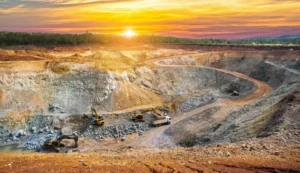
Industry (including manufacturing, mining, construction) contributes around 22.6% to GDP (2012 est.). At independence (1960), DR Congo was Africa’s second-most industrialized after South Africa, with strong mining and some processing. Decline followed due to instability. Key areas include mineral processing, consumer goods, lumber, cement, and ship repair. Much activity is informal.
Manufacturing
Sector Manufacturing is limited and underdeveloped, focused on basic consumer products (textiles, plastics, footwear, cigarettes, processed foods/beverages), metal products, and some agro-processing. Post-independence nationalizations and wars caused collapse; revival is slow due to power shortages, poor infrastructure, high costs, and import competition. Special economic zones, e.g., agro-industrial in N’Sele, have been planned to attract investment. Cement production and basic assembly exist, but scale is small compared to potential. Bracongo, Bralima (brewing), and cement firms like Ciments du Katanga are notable.
Extractives
The extractives sector, especially mining, dominates the economy, supplying over 95% of export revenues and driving growth. The DRC is the world’s top cobalt producer (over 60-70% global supply), a major copper producer (Katanga Copper Belt), and significant for diamonds, gold, coltan (tantalum), tin, tungsten, zinc, and others. Diamonds come from Kasaï Province in the central DRC. By far the largest mines are located in southern Katanga Province and are highly mechanized, with a capacity of several million tons per year of copper and cobalt ore, and refining capability for metal ore.
The DRC is the second-largest diamond-producing nation in the world. Industrial mining coexists with widespread artisanal/small-scale mining. Aside from Kinshasa, the next largest cities, Lubumbashi and Mbuji-Mayi, are mining communities. Major firms include Gécamines (state-owned) and international players. Conflict minerals (e.g., coltan, tin) have fueled eastern wars; traceability initiatives aim to improve governance. Environmental and social issues (child labor, pollution) are prominent. Oil is minor but present. The sector suffers from smuggling, corruption, and uncertain legal frameworks.
Construction
Construction is modest, tied to infrastructure projects, mining developments, and urban growth (e.g., Kinshasa). It faces severe constraints from poor roads/rail (vast distances, terrain), electricity shortages, and conflict. Chinese investment has supported some road/bridge projects. Cement production supports local needs; post-war rebuilding and mining-related infrastructure offer potential, but corruption and funding limit scale. Urban rehabilitation programs exist with World Bank/IDA support.
SERVICES
Services contribute around 33% to GDP. They include trade, transport, telecommunications, public administration, and emerging sectors. Kinshasa is the economic hub. Informal services dominate employment. Transport relies heavily on rivers (Congo River system) due to limited paved roads/rail. Air and river transportation have an important role due to the terrain and the poor state of the road and rail networks. Air and limited rail serve mining areas. There are eight airlines in the country, including the flag carrier Congo Airways, and several international airlines service Kinshasa’s international airport.
Besides Kinshasa there are three other international airports in the DRC, which are at Lubumbashi, Kisangani, and Goma. The DRC has about 15,000 kilometres (9,300 mi) of navigable waterways, with the Congo River serving as the spine. Water transport has traditionally been the dominant means of moving around in the DRC and is also used to fill gaps between roads. Around two million tons of cargo pass through the port of Kinshasa on the Congo River every year, more than triple the volume moved by the national railroad company, the SNCC.
River transports are owned by many private operators. The DRC’s three economic hubs; Kinshasa in the west, Lubumbashi in the south, and Kinsangani in the northeast, are not connected by roads or rail. The rail system is concentrated in the southeast. Kinshasa is connected by river ferry to Ilebo, where the rail line to Lubumbashi begins. This line is also critical for the movement of metal and minerals from the southern DRC to ports in Angola or South Africa (via Zambia) to be exported overseas. There is an electrified line between Kinshasa and the Atlantic seaport of Matadi. The track and rolling stock of the SNCC system is in poor condition, though the more recently built Matadi–Kinshasa line has better track. Telecom has grown with mobile penetration.
Banking
The banking sector is small, underdeveloped, and concentrated in urban areas. The Central Bank of the Congo (BCC) oversees monetary policy and the Congolese franc (CDF). Challenges include dollarization, low financial inclusion, corruption, and weak regulation. Reforms aim to improve access and stability. Microfinance and mobile money are growing for the unbanked majority. Foreign banks and partnerships exist, but trust and infrastructure limit depth.
Tourism
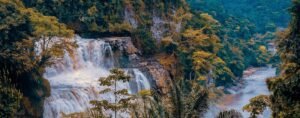
Tourism is underdeveloped but growing, hindered by security concerns (eastern conflicts), poor infrastructure, and limited facilities. The country has a wide range of tourist attractions throughout its provinces, including wildlife and dense vegetation; numerous national parks, nature reserves, and hunting zones; a wide variety of natural landscapes such as waterfalls, lakes, islands, and mountains; and cultural sites like monuments, religious structures, museums, and art markets.
The country is home to seven national parks and 57 reserves and hunting areas. Tourist attractions include Virunga National Park, Kahuzi-Biéga National Park, Garamba National Park, Lola ya Bonobo Sanctuary, Okapi Wildlife Reserve, Idjwi Island, Zongo Falls and Inkisi Falls, Congo River, and Kinshasa’s vibrancy.
CULTURE
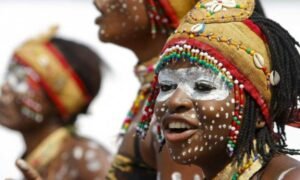
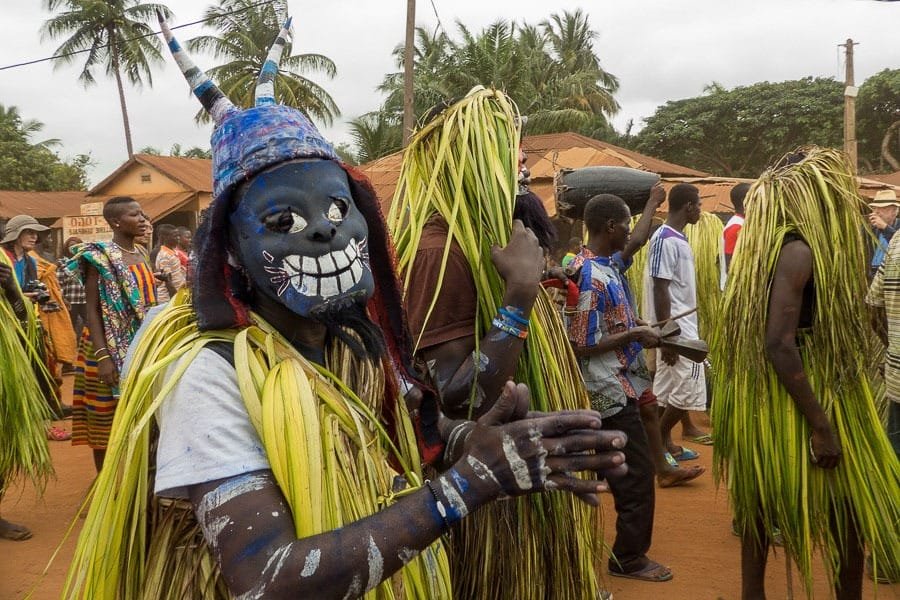
The culture of the Democratic Republic of the Congo reflects the diversity of its numerous ethnic groups and their differing ways of life throughout the country; from the mouth of the River Congo on the coast, upriver through the rainforest and savanna in its centre, to the more densely populated mountains in the Far East. The country has over 250 ethnic groups and 450 tribes (ethnic subgroups). They are in the Bantu, Sudanic, Nilotic, Ubangian and Pygmy linguistic groups. Because of this diversity, there is no dominant ethnic group. However, these ethnic groups account for 51.5% of the population: Luba-Kasaï, Kongo, Mongo, Lubakat, Lulua, Tetela, Nande, Ngbandi, Ngombe, Yaka and Ngbaka. Traditional arts include sculpture (Hemba, Kuba masks), music (soukous/rumba influence across Africa), dance, and oral traditions.
Colonial and post-independence history shape modern expressions. Christianity is the predominant religion of the DRC. The cuisine varies widely, representing the food of indigenous people. Cassava, fufu, rice, plantain and potatoes are generally the staple foods. Congolese meals often consist of a starchy ingredient, along with vegetables and meat in the form of a stew. The starch can come in the form of a paste or mash made of cassava or corn flour, called fufu or ugali. A type of fermented bread, kwanga or chikwangue, made from cassava, is commercially produced throughout the country. Lituma is a popular plantain dish made from mashed plantains, which are formed into balls and baked. Sweet potatoes are prepared similarly and mixed with roasted peanuts in some parts of the country. To accompany these starchy ingredients, green vegetables such as cassava leaves (pondu), bitterleaf, and okra are often added. Mushrooms, especially prized among the Luba people, are often seen as a substitute for meat in times of shortage. Most meals are eaten without meat due to its high price. Fish are plentiful along the Congo River, its tributaries, and various lakes, and are baked, boiled or fried for immediate consumption, or smoked or salted when preserved. Markets often sell ready-to-eat peppered fish baked in banana leaves. Goat is the most widely consumed meat. Mwambe is a common way of cooking chicken with peanut sauce. Edible insects such as grasshoppers and caterpillars are eaten.
SPORTS
Football (soccer) is by far the most popular, with around 35 million fans. The national team (Léopards) won AFCON in 1968 and 1974. The country recently qualified to the 2026 FIFA World Cup. Domestic league and clubs exist amid challenges. Other sports include basketball, rugby, volleyball, athletics. DR Congo’s women’s national volleyball team lastly qualified for the 2021 Women’s African Nations Volleyball Championship. The country featured a national team in beach volleyball that competed at the 2018–2020 CAVB Beach Volleyball Continental Cup in both the women’s and the men’s section. Infrastructure is limited; talent often develops informally or migrates. International participation occurs despite constraints.