

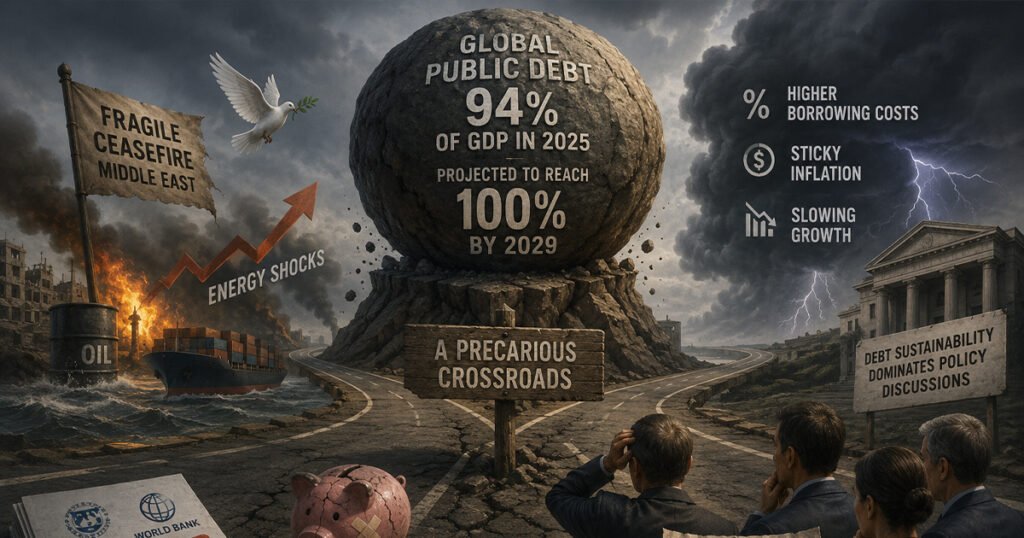
The world economy stands at a precarious crossroads in mid-2026. Global public debt climbed to nearly 94 percent of Gross Domestic Product in 2025 and is projected to reach 100 percent by 2029. This marks levels last seen only in the aftermath of World War II.
A fragile ceasefire in the Middle East offers little comfort as energy shocks ripple through vulnerable balance sheets. Higher borrowing costs, sticky inflation, and slowing growth have combined to create conditions in which debt sustainability concerns dominate policy discussions at the highest levels.
Economists and policymakers warn that the combination of elevated debt stocks and external shocks could trigger widespread distress. The International Monetary Fund and the World Bank have repeatedly highlighted these risks in recent reports. With fiscal buffers eroded after years of pandemic spending, defence buildups, and now energy price spikes, many nations find themselves with limited room to manoeuvre.
The Scale of The Global Debt Challenge
Public debt accumulation has accelerated dramatically in recent years. Advanced economies carry heavy debt burdens, but emerging markets and developing economies face the sharpest pressures. Global gross government debt has risen amid resilient yet uneven growth. Projections now show it reaching dangerous thresholds faster than previously anticipated.
In emerging and developing economies, debt ratios are forecast to breach 60 percent of GDP by 2028 in aggregate. This masks significant variation. Some countries, such as Argentina and India, show potential for stabilisation through reforms. Others face widening disparities and rising rollover risks. Low-income countries and fragile states are particularly exposed. Many already spend large portions of government revenue on debt servicing. African nations, for example, allocate approximately 31 percent of government revenue to external debt payments.
Interest payments have surged to nearly 3 percent of global GDP, up from 2 percent just four years ago. This crowds out essential spending on healthcare, education, and infrastructure. For many governments, the cost of servicing debt now exceeds investment in long-term development. This dynamic creates a vicious cycle in which slower growth further strains fiscal positions.
The conflict in the Middle East has added fresh pressure. Disruptions in the Strait of Hormuz drove oil prices sharply higher at various points in 2026. This increased import bills for net oil-importing countries by potentially tens of billions of dollars annually. A sustained price surge could cost vulnerable economies more than 5 percent of GDP in some cases through higher energy and transport costs alone. These shocks widen current account deficits, weaken currencies, and push up borrowing costs precisely when countries can least afford it.
Why Debt Has Become So Dangerous
Several structural factors have amplified vulnerabilities. First, the era of ultra-low interest rates ended abruptly. Central banks raised rates to combat post-pandemic inflation. Even as some easing occurs, real interest rates remain elevated in many economies. This increases the cost of rolling over existing debt, particularly short-term debt issuance that many governments relied upon during more accommodative periods.
Second, geopolitical fragmentation has reduced policy space. Trade tensions, supply-chain shifts, and regional conflicts limit export revenues and foreign investment flows. Third, demographic pressures and ageing populations in advanced economies are increasing demands on pension and healthcare systems while tax bases grow more slowly.
The sovereign-bank nexus presents another channel of risk. In several emerging markets, banks have increased their holdings of government debt, in some cases accounting for as much as 20 percent of assets in weaker economies. A debt restructuring or sharp rise in yields could impair bank capital, leading to credit contractions that harm the real economy. Leveraged investors in sovereign bond markets add further fragility.
Private debt has also risen in tandem. Corporations in some sectors, particularly outside high-growth technology industries, face mounting interest coverage challenges. Small and medium-sized enterprises in emerging markets exhibit elevated levels of debt alongside thin coverage ratios. This creates the conditions for broader corporate distress should financial conditions tighten further.
Regional Hotspots and Diverging Fortunes
Asia presents a mixed picture. South Asia has demonstrated relative resilience, supported by strong domestic demand and growth in the services sector. India benefits from reform momentum and favourable demographics. However, commodity importers across the region continue to feel the pressure of rising energy costs. China is managing high local government debt through policy support, although weaknesses in the property sector persist.
Latin America faces familiar debt challenges amid political cycles and dependence on commodity exports. Countries such as Brazil and Mexico are pursuing fiscal adjustments that could strengthen credit profiles if sustained. However, social spending pressures remain elevated. Argentina has made progress in its stabilisation efforts, attracting renewed investor attention.
Africa and the Middle East and North Africa (MENA) region face the most difficult outlook. Conflict-affected countries are suffering direct blows to growth and government revenues. Many low-income nations entered 2026 with exhausted fiscal buffers following previous shocks, including COVID-19, food-price spikes, and climate-related events. Debt distress risks remain elevated, and calls for faster restructuring mechanisms are growing louder.
Europe continues to grapple with rising defence expenditures and the costs of the energy transition. While some economies maintain strong fundamentals, others face worsening debt trajectories amid slower growth. The United States, despite benefiting from its reserve-currency status, confronts rising deficits and long-term entitlement pressures that contribute to elevated global interest-rate expectations.

Policy Responses and the Search for Solutions
Central Banks find themselves in a difficult position. The US Federal Reserve, under its new Chair, Kevin Warsh, held rates steady at 3.50 to 3.75 percent during its mid-June 2026 meeting. Projections indicated that several officials anticipated additional rate increases due to persistent inflationary risks stemming from energy shocks. Warsh emphasised the importance of price stability and launched reviews of Federal Reserve operations and communications. This hawkish stance supports higher global borrowing costs.
Fiscal policy must now prioritise sustainability. The IMF recommends rebuilding fiscal buffers, diversifying revenue sources, and strengthening debt-management frameworks. Fiscal rules and expenditure restraint are becoming increasingly important. Yet political realities often favour short-term relief over long-term consolidation.
Debt restructuring frameworks have seen incremental improvements through initiatives such as the Global Sovereign Debt Roundtable. However, faster and more transparent processes remain necessary. Creditors—including bilateral partners, multilateral institutions, and private investors—must improve coordination. Some analysts advocate for greater use of state-contingent debt instruments that link repayment obligations to economic performance or commodity prices.
On a more positive note, artificial intelligence and technology investments offer significant productivity gains. If these gains materialise more rapidly than expected, they could boost economic growth and government revenues, thereby easing debt burdens. Wider adoption across emerging markets could narrow income gaps and strengthen fiscal positions. However, uneven access to these technologies risks widening existing disparities.
Human and Market Implications
The world’s debt burden is no longer merely an economic statistic discussed in policy circles. It has become a growing threat with far-reaching consequences for households, businesses, and governments alike. As global debt levels continue to rise to record highs, countries are increasingly diverting scarce resources toward debt servicing instead of investing in critical sectors such as healthcare, education, infrastructure, and social protection. For millions of people, this translates into higher living costs, reduced public services, and greater economic uncertainty.
The pressure is particularly severe in developing and emerging economies, where high borrowing costs and external shocks have strained public finances. Families are being forced to make difficult choices as inflation and economic instability erode purchasing power. In many countries, households are cutting back on essential spending, while governments struggle to maintain support programmes designed to protect vulnerable populations. The result is a growing risk of poverty, inequality, and social unrest at a time when many economies are still recovering from recent global disruptions.
Financial markets are also feeling the impact of the mounting debt challenge. Investors have become increasingly selective, rewarding countries that demonstrate strong fiscal discipline and credible economic reforms while penalising those perceived as high-risk borrowers. Bond yields have risen, borrowing costs have increased, and weaker economies are finding it more difficult to access affordable financing. This widening gap between stronger and more vulnerable nations threatens to deepen global economic divisions, creating a world in which access to capital and opportunity becomes increasingly unequal.
The Path Forward
Defusing the debt time bomb requires coordinated action. Advanced economies must lead by example through fiscal responsibility while supporting multilateral initiatives. Emerging markets should focus on domestic revenue mobilisation, efficient public spending, and structural reforms that enhance growth potential. International financial institutions can facilitate this process by providing targeted support and catalysing private investment.
Climate resilience and green investments represent dual opportunities. Well-designed projects can generate economic returns while addressing environmental vulnerabilities that would otherwise exacerbate debt through costly disaster-recovery efforts. Nature-based solutions and energy-transition financing deserve greater attention.
The coming years will test the strength of global cooperation. A prolonged energy shock or a new geopolitical flare-up could push more countries into distress. Conversely, successful de-escalation in key regions, combined with productivity gains from technological innovation, could create valuable breathing space for fiscal consolidation.
Policymakers face a narrow window of opportunity. Delaying difficult decisions only increases the eventual costs. With debt levels continuing to rise, the stakes extend beyond financial stability to encompass the social fabric of nations and the prospects for shared prosperity. The world must act decisively to prevent this debt time bomb from detonating.
Another critical priority is strengthening global debt transparency and improving sovereign debt restructuring mechanisms. Many countries face complex debt obligations involving multiple creditors, making negotiations lengthy and costly during periods of distress. Greater transparency in borrowing practices, coupled with faster and more predictable restructuring frameworks, would help restore investor confidence and reduce the risk of prolonged economic crises.
Without such reforms, vulnerable nations could remain trapped in cycles of borrowing and repayment that undermine long-term development and economic stability.