
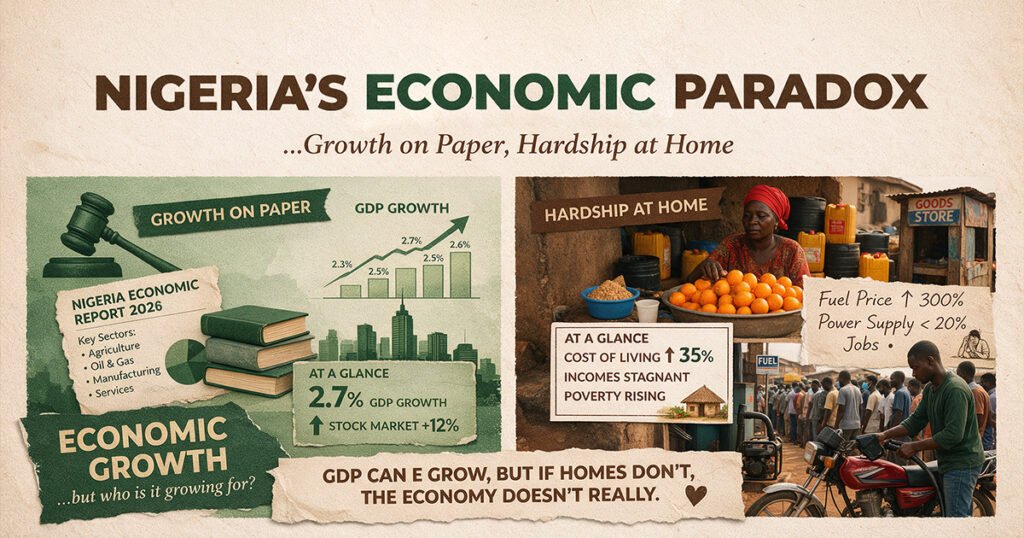
As economic reforms restore investor confidence and improve growth prospects, millions of Nigerians continue to struggle with rising living costs, insecurity and shrinking purchasing power.
Nigeria’s economic recovery is unfolding against a troubling contradiction. While official indicators suggest that the country is gradually regaining its economic footing, millions of households remain trapped in a daily struggle against rising prices, declining purchasing power and diminishing living standards. The result is an increasingly visible divide between the progress recorded in economic statistics and the hardship experienced across the country.
By late 2026, the International Monetary Fund had raised its growth forecast for Nigeria to 4.2 per cent, signalling renewed confidence in the country’s economic outlook. World Bank assessments have also pointed to continued economic expansion and indications that some poverty indicators may be stabilising after years of deterioration.
Policymakers in Abuja describe these developments as evidence that the difficult decisions taken since 2023 are beginning to bear fruit. Currency reforms, the removal of the long-standing petrol subsidy and tighter fiscal management have helped restore some external buffers and reopen access to international capital markets.
Yet the benefits remain unevenly distributed. High petrol prices, expensive food, rising transport fares and limited employment opportunities continue to strain household finances. For millions of Nigerians, the promise of economic recovery remains distant, overshadowed by the immediate demands of survival.
The central question is no longer simply whether Nigeria is growing, but whether that growth is improving the lives of its people.
The Promise of Macroeconomic Recovery
Supporters of the government’s economic direction argue that the previous system was unsustainable. The fuel subsidy consumed vast sums of public money that could otherwise have funded infrastructure, education and healthcare. Multiple exchange rates created distortions and opportunities for arbitrage that benefited a few while undermining the broader economy. By allowing the naira to float more freely and ending the blanket fuel subsidy, the authorities argue that they have established clearer price signals and reduced fiscal leakages.
Early results appear encouraging on paper. Economic growth has strengthened, external reserves have improved during certain periods, and private capital inflows worth billions of dollars have been reported.
The Dangote Refinery has recorded strong revenue and profit figures, offering a domestic source of refined petroleum products that could eventually reduce dependence on imports. Shell’s decision to sell its Nigerian gas distribution business to a local company has also been cited by some observers as evidence of continued private-sector activity amid the economic transition.
Government officials frequently point to these developments when responding to criticism. They highlight increased revenues at the state level and argue that the foundations for longer-term economic expansion are being laid.
The Central Bank of Nigeria has maintained a relatively tight monetary policy stance in an effort to bring inflation down from the elevated levels recorded in previous years. Although inflation has moderated from earlier peaks, it continues to impose a heavy burden on wage earners.
These arguments carry weight in boardrooms and among international partners. They help explain why growth forecasts have been revised upwards and why some investors continue to view the Nigerian market with interest. The narrative of reforms delivering results is not without foundation; it rests on measurable changes in fiscal and monetary indicators.
The Weight of Everyday Costs
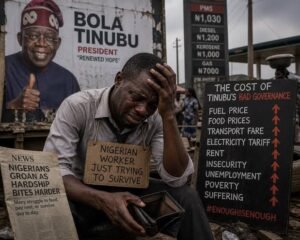
The same reforms that have improved some official economic indicators have also increased the cost of many goods and services consumed by ordinary Nigerians. Transport costs rose sharply following the removal of the fuel subsidy. Food prices subsequently came under additional pressure because petrol and diesel power the trucks, mills and agricultural machinery needed to produce and distribute food.
Market traders, commercial motorcyclists, ride-hailing drivers and salaried workers all report that their incomes have failed to keep pace with rising expenses.
The national minimum wage, which many workers already consider inadequate, now buys considerably less than it did three years ago. Organised labour has issued ultimatums demanding lower fuel prices and renewed wage negotiations. Public-sector unions and the Nigeria Labour Congress have maintained pressure on the government, warning of industrial action if relief measures prove insufficient. Ride-hailing drivers have also protested that rising fuel costs have outstripped the payments they receive for individual trips.
In both urban and rural communities, families have reduced their consumption of protein, withdrawn children from private schools or postponed medical treatment. Meanwhile, the phenomenon known as Japa—the large-scale emigration of Nigerians seeking better opportunities abroad—continues. Doctors, nurses, engineers and academics are leaving in significant numbers in search of better remuneration and living conditions.
This loss of human capital compounds the challenges of building a more productive economy, particularly when the country needs skilled professionals to strengthen its healthcare system, education sector and industrial base.
Debt servicing presents another, less visible source of pressure. During the first half of 2026, interest payments alone reportedly exceeded total federal revenue, according to figures attributed to the World Bank. When such a large proportion of public funds is committed to debt servicing, less remains available for social spending, infrastructure maintenance and targeted assistance for vulnerable households. The result is a fiscal squeeze that limits the government’s ability to cushion the effects of its own reforms.
Insecurity Multiplies the Hardship
Economic hardship does not exist in isolation. Persistent insecurity across several regions has deepened the crisis facing ordinary Nigerians. Banditry and kidnapping in the North-West and North-Central regions disrupt farming and trade, while the activities of groups linked to Boko Haram and the Islamic State West Africa Province continue in parts of the North-East. Communal clashes and other forms of criminal violence affect additional areas.
These threats increase the cost of doing business, discourage investment in agriculture and mining, and force communities to divert scarce resources towards protecting themselves. In Zamfara and other affected states, insecurity has weakened healthcare delivery, leaving communities more vulnerable to cholera and other preventable diseases.
Lassa fever has also claimed hundreds of lives in 2026, with case-fatality rates reportedly higher than those recorded in the previous year. Meanwhile, flooding along major river systems has displaced tens of thousands of people and damaged homes and farms already struggling with high production costs.
When farmers cannot safely access their fields, traders cannot reach markets and patients cannot obtain medical care, headline growth figures become a poor reflection of everyday realities. The estimated annual economic losses resulting from insecurity in the North-Central region alone have been placed in the billions of dollars.
Such losses represent more than foregone revenue. They translate into food that is never produced, jobs that are never created and businesses that cannot operate at full capacity. They also help explain why many households feel that the economic recovery has passed them by.
Political Stakes Rise Ahead of 2027 Elections
The contrast between economic growth figures and household hardship is already shaping the political contest ahead of Nigeria’s 2027 general elections. The ruling All Progressives Congress has expanded its presidential campaign structures to include governors and ministers from diverse backgrounds. Opposition figures have characterised the move as an attempt to consolidate power through political absorption rather than persuasion.
Legal disputes over candidate lists, questions about eligibility and concerns regarding the credibility of electoral institutions have added further layers of tension to the political environment.
Voters will ultimately determine whether the sacrifices associated with the reforms have been worthwhile. The government’s argument is that short-term hardship will eventually give way to lasting stability and shared prosperity. Critics, however, contend that the benefits remain concentrated while the costs are borne by the wider population.
Labour unrest, rising petitions to human rights bodies and continued emigration all point to public dissatisfaction that cannot be dismissed simply by citing percentage-point increases in gross domestic product.
Transparency surrounding major infrastructure projects has also become a contentious issue. The Lagos-Calabar Coastal Highway, a multitrillion-naira undertaking, has faced questions concerning route changes, contractor selection and overall project costs. Calls for full disclosure reflect a broader demand for accountability at a time when many citizens feel they have already paid a substantial price for economic policy changes.
Searching for a Balance Between Economic Indicators and Human Welfare
Nigeria’s predicament is not unique. Other developing economies that have implemented ambitious stabilisation programmes have faced similar tensions between economic adjustment and social welfare. Historical experience suggests that successful reform programmes must eventually be complemented by targeted social protection, investment in productive capacity and credible improvements in public security.
The International Monetary Fund has cautioned against a return to blanket fuel subsidies while emphasising the importance of measures that protect the most vulnerable members of society.
Some steps in this direction have been attempted. Temporary discounts at selected filling stations, discussions about a possible ceiling on fuel landing costs and announcements of fiscal reforms intended to attract investment form part of the government’s response. However, whether these initiatives can be expanded sufficiently and reach the households that need assistance most remains an open question.
The private sector presents a mixed picture. Strong performance by major industrial enterprises demonstrates that large-scale businesses can thrive under the new pricing environment. At the same time, smaller businesses and informal-sector operators, who account for a substantial proportion of employment, report shrinking margins and greater uncertainty.
The sale of Shell’s gas distribution interests to a Nigerian company could create opportunities for greater local ownership. Nevertheless, persistent insecurity and high operating costs continue to weigh on investment decisions across the wider economy.
Education and healthcare face their own challenges. Millions of children remain out of school, while healthcare facilities in conflict-affected areas struggle with staff shortages and disruptions to essential supplies. These longstanding structural weaknesses limit the extent to which economic growth can translate into broad-based improvements in living standards.
Looking Beyond the Immediate Horizon
As 2026 draws towards its close, Nigeria’s economic story is one of measurable progress accompanied by profound social strain. Growth of 4.2 per cent would represent a meaningful achievement after years of weaker performance. Signs that some poverty indicators are stabilising offer a limited basis for hope, while renewed access to capital markets and rising private investment inflows suggest that international confidence may be returning.
Yet the crushing burden experienced by ordinary Nigerians cannot be dismissed by pointing to aggregate economic indicators. When petrol remains expensive, food consumes an ever-larger share of household income, insecurity prevents farmers from accessing their fields and skilled professionals continue to leave the country, the reforms risk being judged incomplete.
The political contest of 2027 will test whether Nigeria’s leaders can narrow the gap between official economic success and the everyday experiences of citizens.
Growth without inclusion has a limited political lifespan. Inclusion without growth is equally unsustainable. Nigeria’s current economic experiment will ultimately be judged by how successfully it manages both sides of that equation.
In homes across Lagos, Kano, Port Harcourt and countless smaller towns, families continue to weigh transport fares against food prices, school fees against medical expenses, and immediate survival against longer-term aspirations. Their daily calculations provide the most tangible measure of economic policy.
Until that arithmetic becomes less punishing, the headline figures will remain only part of the story—and, for millions of Nigerians, perhaps the less important part.