

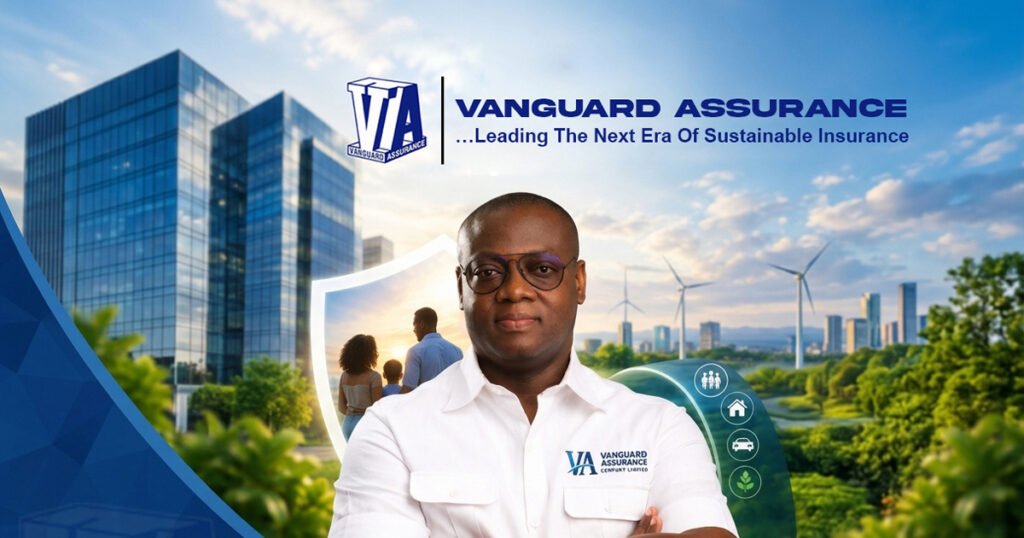
Climate change is no longer a distant risk for insurers. Floods, extreme weather events and changing environmental patterns are already disrupting communities, businesses and economies, forcing the insurance industry to rethink how risks are identified, assessed and priced.
Traditionally, insurance has focused on compensating customers after losses occur. But as risks become more complex and interconnected, insurers are increasingly expected to anticipate emerging threats, encourage prevention and help businesses and communities build resilience.
This is where sustainable insurance is reshaping the industry.
For Vanguard Assurance, sustainability goes beyond environmental initiatives or corporate social responsibility. It is increasingly being integrated into underwriting, product development, risk management, technology, operations and investment.
In an exclusive interview with The Vaultz Africa, Mr Frederick Adotey Saka, the Chief Executive Officer of Vanguard Assurance, discusses the company’s sustainability strategy, its transition towards climate-informed underwriting, the growing role of artificial intelligence and data, and its ambition to position insurance as a strategic partner in building resilience in Ghana.
Embedding Sustainability into the Business
Vanguard Assurance’s decision to become Ghana’s first insurer to sign the UNEP Principles for Sustainable Insurance (PSI) marked an important milestone in its sustainability journey. The company has since focused on translating that commitment into practical changes across its operations.
According to Mr Saka, the value of the “sustainability commitment is not the signature — it is what changes because of it. Signing the Principles was not the destination; it was a strategic commitment to a different way of doing insurance.”
To support this objective, Vanguard has established a cross-departmental Sustainability Leadership Team to embed “sustainability into strategic decision-making, with oversight retained at Board level.” Its Sustainability Policy covers operational emissions, employee wellbeing, health and safety, fair customer treatment and green insurance products, while extending sustainability considerations across risk selection, underwriting, claims, procurement and customer engagement.
“Over the next three to five years, stakeholders should expect movement from commitment to integration, and from integration to measurable impact: stronger climate-informed underwriting, relevant sustainable insurance solutions, deeper use of data and technology, and stronger partnerships that support resilience.”
Reimagining the Role of Insurance
For Vanguard, sustainability is also changing the traditional role of the insurer. Therefore, the CEO sees the future of insurance as a combination of “risk transfer, prevention, better intelligence and resilience.”
Meanwhile, rather than simply paying claims after losses, insurers can help customers understand emerging risks and take preventive measures.
“Sustainability gives us an opportunity to rethink how we underwrite, innovate and engage customers. This can differentiate Vanguard, because we are not treating sustainability as an environmental add-on sitting alongside the business — we see it as a business strategy that can improve risk quality, deepen customer relevance and open new markets.”
This supports Vanguard’s ambition to “evolve from being viewed simply as a risk carrier to becoming a strategic partner in resilience.”
Besides, Ghana’s evolving regulatory environment is also reinforcing this direction, with the National Insurance Commission’s 2025 ESG Guidelines encouraging insurers and reinsurers to integrate ESG considerations into areas including operations, underwriting, investment and stakeholder engagement.

Towards Climate-Informed Underwriting
One of the clearest expressions of Vanguard’s sustainability strategy is its shift towards more predictive and climate-informed underwriting. Moreover, regardless of historical claims data remaining important, it may not adequately capture future exposure as environmental and climate risks evolve.

“The principle is simple: if the risk is changing, the way we understand and price it must change too. The objective is not to replace underwriting judgement with technology, but to give our underwriters better intelligence with which to make commercially sound decisions.”
Vanguard is therefore complementing historical data with forward-looking indicators such as climate trends, weather patterns, geographic and flood exposure, construction characteristics, business continuity arrangements and customers’ own resilience measures.
ESG as Part of Risk Assessment
The shift towards more forward-looking underwriting also extends to the integration of environmental, social and governance (ESG) considerations into traditional risk assessments.
Hence, Vanguard is also incorporating ESG considerations into its assessment of risk, using a materiality-driven approach rather than treating ESG as a compliance exercise.
“Our approach to ESG is risk-based and materiality-driven, not a box-ticking exercise.”
For commercial properties, this may include assessing flood exposure, energy efficiency, emissions and water risks alongside employee and customer safety, working conditions and community impact. Governance factors may include Board oversight, internal controls and regulatory compliance.
The central question is therefore whether an ESG factor could affect “the quality, frequency or severity of the risk we are underwriting.”
And this the CEO emphasizes, “Good ESG underwriting is ultimately good risk management.”
Harnessing AI and Data Intelligence
Technology is becoming increasingly important to Vanguard’s approach to emerging risks. Thus, the company is exploring artificial intelligence, predictive analytics and data intelligence to strengthen underwriting, improve claims management and support sustainable pricing.
“We are currently piloting AI tools to support underwriting and risk assessment, as well as claims processing of motor policies at both the pre-loss and post-loss stages through our incremental approach.”
The use of advanced data is particularly relevant to emerging areas such as electric mobility and renewable energy, where limited local claims histories can make conventional risk assessment difficult.
Vanguard is therefore exploring satellite and geographic data, predictive analytics and other sources of intelligence to develop a more granular understanding of risk.
However, technology is intended to enhance rather than replace professional expertise. Hence, Vanguard’s approach is to combine technology with actuarial knowledge and underwriting experience to support better decisions on coverage and pricing.
Developing Green Insurance Products
Vanguard’s sustainability strategy also extends to product development. The company is exploring insurance solutions that connect environmental responsibility with sound risk management while remaining relevant to Ghana’s market.
“Our approach is deliberately disciplined. We do not believe in putting a green label on a conventional product simply because it sounds attractive. A sustainable insurance solution should have a demonstrable environmental, social or resilience benefit and, ideally, a corresponding risk management rationale.”
Green products are already identified as a priority in Vanguard’s Sustainability Policy. Potential solutions include incentives for environmentally friendly behaviour, eco-friendly vehicle discounts and green home insurance that recognises features such as solar energy, energy-efficient equipment, water-efficiency systems and fire-prevention measures.
Beyond motor and property insurance, the company sees opportunities in renewable energy, energy-efficient infrastructure and climate-resilient agriculture.
However, Mr Saka stresses that “sustainability itself should not automatically translate into a lower premium; pricing must remain actuarially and technically defensible.”
Therefore, the principle is to reward sustainable practices where there is evidence that they improve risk quality or reduce the likelihood and severity of losses.

Impact Underwriting: Profit with Purpose
Vanguard’s approach also reflects the emerging concept of impact underwriting, through which insurers can influence risk behaviour and contribute to broader economic resilience.
Better fire protection, flood preparedness and safer working environments are examples of measures that can reduce exposure to loss.
The CEO describes such philosophy as “profit with purpose and discipline.”
“The strongest underwriting decisions should protect the insurer’s balance sheet while supporting a more resilient and sustainable economy.”
Expanding Access to Climate Protection
For sustainable insurance to have a meaningful impact, protection must reach those most exposed to climate risks, including farmers, small businesses and vulnerable communities.
Hence, Vanguard is exploring technology, partnerships and innovative insurance models to reduce the cost of distributing smaller-ticket policies. Digital onboarding, mobile distribution and data analytics could help extend insurance to underserved segments.
Parametric insurance is another area of opportunity, particularly in agriculture. Instead of relying on traditional loss assessment, parametric policies are triggered by predefined conditions, such as specified rainfall or temperature levels, potentially allowing policyholders to receive funds more quickly after extreme weather events.
Besides, partnerships will be critical to scaling these solutions.
“No insurer can solve this alone. We are working with — and need to keep deepening our work with — Ghana Agricultural Insurance Pool (GAIP) and Impact Life Insurance, to build distribution models that reach vulnerable communities at a cost they can sustain.”
Looking Beyond Environmental Risk
Vanguard’s sustainability agenda extends beyond climate and environmental issues. Social considerations such as employee safety, customer treatment and data protection, alongside governance issues such as internal controls, regulatory compliance and Board oversight, are increasingly relevant to risk assessment.
“The discipline is the same as with climate risk: we ask whether the factor can plausibly change the quality, frequency or severity of the risk we are underwriting. Where it can, it belongs in the assessment.”
Overcoming the Barriers
Despite the opportunities, sustainable insurance in Ghana faces challenges including data gaps, affordability, limited consumer awareness, technology requirements and shortages of specialised skills.
According to the CEO, reliable data remains one of the most significant constraints.
“Climate-informed underwriting depends on good-quality, accessible and sufficiently granular data, and that remains a real constraint in the Ghanaian market.”
The challenge for insurers is therefore to develop technically sound solutions that remain accessible and commercially viable.
Meanwhile, Ghana’s regulatory progress provides an important foundation, but greater collaboration among insurers, regulators, businesses, technology providers and other stakeholders will be necessary to scale sustainable insurance.

The Future of Insurance
The Chief Executive Officer of Vanguard Assurance believes the distinction between traditional and sustainable underwriting could eventually disappear as climate and ESG considerations become standard elements of risk assessment.
By 2030, he expects insurance policies to become increasingly “intelligent, personalised and proactive.”
“A motor policy could increasingly reflect driving behaviour and vehicle technology; a property policy could incorporate building characteristics and climate exposure; agricultural cover could draw on weather and satellite information; commercial insurance could reflect a company’s own resilience and risk-management practices.”
Hence, greater use of technology and near-real-time data could enable insurers to monitor changing risks, provide preventive guidance and maintain more continuous relationships with customers.
Sustainable Finance and Ghana’s Economic Future
For Vanguard, the opportunity extends beyond “creating ‘green’ insurance products.” The industry can potentially contribute to sustainable finance through its “capital, expertise and risk transfer mechanisms,” supporting renewable energy, resilient infrastructure, sustainable agriculture, technology and other emerging sectors.
This positions insurance as more than a mechanism for protecting existing assets. It can also help unlock investment in Ghana’s future economic capacity.
This, Mr Saka discloses, “That opportunity, ultimately, is where we see the future of sustainable insurance: protecting what matters today while helping build the economy of tomorrow.”
Building the Next Era of Insurance
Vanguard Assurance’s sustainability journey reflects a broader transformation in the insurance industry. Sustainability is increasingly moving from the margins of corporate strategy into the core of how insurers assess, price, manage and prevent risk.
As Ghana’s risk landscape evolves, insurers will be expected to do more than compensate customers after losses. They will need to anticipate emerging threats, encourage stronger risk management, expand access to protection and contribute to economic resilience.
For Vanguard Assurance, that future is already taking shape—one in which insurance is not simply a mechanism for transferring risk, but a strategic partner in building a more resilient Ghanaian economy.