
Ghana’s energy economy faces a defining challenge: transforming petroleum resources and electricity infrastructure into sustainable economic growth. While petroleum generates foreign exchange and public revenue, reliable electricity remains essential to industrial development, business competitiveness and household welfare. Yet declining oil production, persistent power-sector debts, distribution losses and fuel-supply constraints continue to limit the economic benefits of these resources.
Renewed investor interest in Ghana’s offshore petroleum industry offers an opportunity to reverse declining production. During Africa Oil Week in Accra in September 2026, the Ghana National Petroleum Corporation (GNPC) reported a memorandum of understanding involving Shell and Chevron for the South Deepwater Tano Block. Afterwards, Eni and Vitol also announced memoranda covering offshore blocks GH WB 3 and GH WB 8. Although these developments signal investor interest, their eventual contribution will depend on successful exploration, financing, regulatory approvals and commercial viability.
The priority is to translate these opportunities into lasting economic value. Hence, Ghana must revitalise petroleum production, strengthen electricity distribution, restore financial discipline in the power sector and direct energy-sector gains towards productive industries. The objective is not simply to extract more oil or generate more electricity, but to build an economy in which energy supports competitiveness, employment and long-term resilience.
Revitalising Petroleum Production and Protecting Public Finances
Ghana’s petroleum industry remains an important contributor to national revenue, but its declining production trajectory presents a growing economic concern.
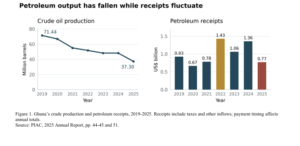
According to the Public Interest and Accountability Committee (PIAC), crude oil production fell from 71.44 million barrels in 2019 to 37.30 million barrels in 2025, representing a decline of almost 48 per cent. The Energy Commission attributes the downward trend to maturing fields, operational shutdowns and limited investment.
Reversing the decline requires sustained investment in existing fields, improved recovery techniques and commercially viable exploration. However, new discoveries cannot immediately replace declining output because exploration, appraisal and development take time. Investment decisions must therefore distinguish estimated petroleum resources from commercially recoverable reserves and assess projects against realistic costs, prices and production prospects.
The implications extend directly to public finances. Petroleum Holding Fund receipts reached US$1.43 billion in 2022, declined in 2023, recovered to US$1.36 billion in 2024 and fell to US$770.3 million in 2025. These receipts (Fig, 1) reflect more than production alone: realised prices, taxation, payment schedules and other factors influence when and how much revenue reaches the state. PIAC records, for example, that payment for Ghana’s October 2025 crude shipment from the TEN oilfield was received in January 2026. This volatility reinforces the need for conservative revenue forecasts and prudent management of the Ghana Stabilisation Fund.
Petroleum revenues should be converted into durable economic assets through investment in infrastructure, education, technical skills and productive industries. Spending and borrowing decisions must remain sustainable even when oil receipts fall. Ultimately, Ghana must maximise the net economic benefit of petroleum production rather than judge success by export earnings alone.
Reforming the Power Sector
Meanwhile, persistent financial and operational weaknesses in electricity supply continue to place pressure on public finances. In January 2026, the Ministry of Finance reported approximately US$1.47 billion in energy-related payments during 2025. These included US$597.15 million, including interest, to repay drawdowns under the World Bank gas-payment guarantee; approximately US$480 million in gas invoices owed to Eni and Vitol; and US$393 million in legacy debt owed to independent power producers.
Although clearing arrears can restore supplier confidence, lasting reform requires preventing new liabilities from accumulating. Better revenue collection, efficient operations, transparent subsidies and disciplined expenditure are essential to restoring the sector’s financial sustainability.
Distribution losses remain a major concern. The Energy Commission’s 2026 statistical bulletin reports that the Electricity Company of Ghana (ECG) recorded distribution losses of 26.9 per cent in 2025. ECG purchased 17,961 gigawatt-hours of electricity, while recorded sales amounted to 13,134 gigawatt-hours. Technical losses, inadequate metering and unrecorded consumption weaken the system, while poor collection further limits the revenue available to pay suppliers.
Therefore, reducing losses requires targeted network repairs, accurate metering, improved billing and effective collection. ECG must also reconcile electricity purchases, recorded consumption, customer bills and actual payments to identify inefficiencies and strengthen accountability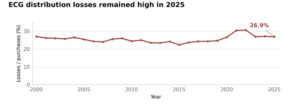
Fuel security presents another challenge. The Energy Commission’s 2026 outlook projected thermal generation to account for 73.0 per cent of electricity supply, hydropower 25.8 per cent and non-hydro renewables 1.2 per cent, highlighting the importance of reliable gas supplies and sustainable fuel-payment arrangements. Installed capacity alone cannot guarantee dependable electricity without adequate fuel, functioning infrastructure and timely payments.
Ghana must therefore approach electricity reform as both an operational and financial priority. Tariffs should support the recovery of efficiently incurred costs, while targeted and transparent assistance protects vulnerable consumers. Government institutions must also meet their electricity obligations to prevent arrears from accumulating elsewhere in the public sector.

Strategic Investment and Energy Diversification
A sustainable energy strategy must combine immediate operational improvements with carefully planned long-term investment. In petroleum, priority should be given to commercially attractive opportunities in existing fields and areas near established infrastructure, alongside credible exploration prospects. Transparent licensing, enforceable contracts and sound regulation can encourage investment while protecting national interests.
In electricity distribution, stronger metering, targeted network rehabilitation and improved revenue collection can deliver practical benefits without waiting for major new generation projects. Cash waterfall arrangements can improve payment discipline by allocating available revenue among generators and fuel suppliers. However, regular audits and public reporting are necessary to establish whether outstanding obligations are genuinely declining.
Domestic gas development can reduce exposure to imported liquid fuels, provided that processing facilities, pipelines, power plants and supply contracts are properly coordinated. Renewable energy, particularly solar, can further diversify supply and reduce daytime fuel consumption. Its contribution will depend on appropriate grid connections, flexible generation and energy storage where economically justified.
Investment decisions should consider the full cost of delivering dependable electricity, including financing, infrastructure, maintenance and system balancing. Energy efficiency must complement new investment: efficient industrial machinery, improved refrigeration and better energy management can lower operating costs and reduce pressure on existing infrastructure.
Turning Electricity Access into Productive Growth
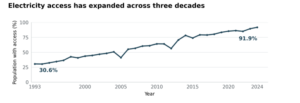
Ghana has made significant progress in expanding electricity access. World Bank data indicate that access increased from 30.6 per cent of the population in 1993 to 91.9 per cent in 2024. This expansion (Fig. 3) represents a major infrastructure achievement, but access alone is not a sufficient measure of energy security.
A connection does not guarantee continuous supply, affordable bills or adequate voltage. Outage frequency, outage duration and service quality must therefore be assessed alongside access rates.
Unreliable electricity increases business costs through backup generators, fuel purchases, production delays and damaged goods. Meanwhile, dependable power can improve productivity in manufacturing, agro-processing, cold storage and other commercial activities. However, infrastructure delivers its greatest value when businesses also have access to finance, equipment, skilled labour and viable markets.
Energy investment should therefore be aligned with realistic demand and commercially sustainable industrial opportunities. Petroleum-funded infrastructure must have transparent procurement, adequate maintenance budgets and clear accountability to ensure that it continues delivering value after oil revenues decline.
Local participation is equally important. Technical training, apprenticeships, supplier development and engineering partnerships can help Ghanaian firms compete in maintenance, fabrication and specialist services. Building domestic expertise will retain more value locally and reduce dependence on external capabilities as petroleum production matures and energy technologies evolve.
Households and small enterprises must also benefit from the transition. Affordable clean-cooking equipment, accessible fuels and dependable electricity can improve welfare, reduce exposure to cooking smoke and support economic activity. Energy security should ultimately be measured by its contribution to productivity, livelihoods and opportunity, not infrastructure expansion alone.
Building a Sustainable Energy Future
Ghana must move beyond short-term revenue generation and repeated financial rescues towards coordinated, accountable and long-term energy reform.
The immediate priorities are to revitalise commercially viable petroleum production, manage public revenues prudently, reduce electricity distribution losses, improve revenue collection and prevent fresh arrears. Utilities and regulators must demonstrate progress through transparent reporting, regular audits and measurable performance targets.
At the same time, investment must support reliable electricity, cost-effective renewable energy, domestic industrial capacity and improved energy efficiency. Addressing existing operational weaknesses while new petroleum projects progress through exploration and development will reduce dependence on uncertain future revenues to solve present challenges.
Ultimately, Ghana’s energy future will not be secured by petroleum agreements signed, infrastructure announced or public money spent alone. Success must be measured by reliable electricity, competitive businesses, productive employment and sustainable public finances.
The real transformation will occur when petroleum wealth becomes a foundation for economic resilience, electricity drives productivity, and investments made today continue creating prosperity long after the country’s oil fields begin to decline.