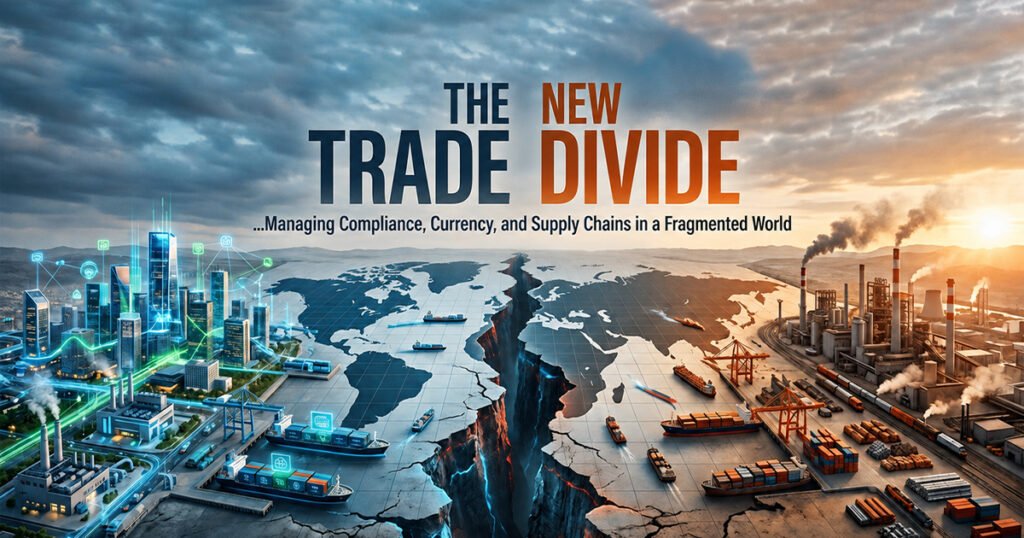


The global business environment is undergoing a fundamental transformation as geopolitical tensions reshape the movement of goods, capital, energy and technology across borders. Conflicts in the Middle East, intensifying competition between major powers and the growing use of trade and technology as instruments of economic statecraft are challenging assumptions that have governed international commerce for decades.
As of mid-October 2026, the consequences are increasingly evident across energy markets, international trade, inflation, technology investment and corporate strategy. A global economic system once driven primarily by market access, cost efficiency and integrated supply chains is becoming more fragmented, politically sensitive and exposed to uncertainty.
For businesses, geopolitics is no longer an external consideration reserved for periods of crisis. It has become a central factor influencing procurement, investment, financing, market access and long-term competitiveness. Companies must anticipate how military conflicts, sanctions, tariffs and regulatory restrictions could affect their operations. This shift is rewarding organisations that diversify supply chains, strengthen regional production networks and reduce dependence on individual markets or strategic chokepoints.
Energy Markets Face Persistent Volatility
Energy remains one of the clearest channels through which geopolitical instability affects the global economy. Disruptions around the Strait of Hormuz and wider Middle Eastern tensions have heightened concerns about oil supplies, with Brent crude reportedly trading near or above US$106 per barrel. Attacks on shipping and energy infrastructure have added pressure to crude and refined-product markets, particularly diesel.
The International Energy Agency’s reported warning that diesel supply constraints could persist into 2027 underscores the possibility of prolonged disruption. Higher energy prices increase transportation, manufacturing and distribution costs, squeeze household budgets and complicate efforts to control inflation.
The impact varies across economies. Oil-exporting countries outside major conflict zones may benefit from stronger demand and higher prices, provided they can maintain reliable production and delivery. Import-dependent economies, however, face rising fuel bills, pressure on foreign exchange reserves and difficult monetary policy decisions.
Strategic petroleum reserve releases and additional production from alternative suppliers can offer temporary relief, but may not fully offset sustained disruptions to major shipping routes or refining capacity. Businesses exposed to energy-price fluctuations are therefore reviewing forecasts, improving efficiency and diversifying fuel sources.
Energy security has consequently become a corporate priority as well as a government responsibility. Reliable infrastructure, transport routes and distribution systems are as important as the availability of energy resources. For businesses, the challenge is to balance competitive pricing with supply reliability. Governments must similarly diversify import routes, strengthen strategic reserves and encourage investment in domestic production and alternative energy sources.
Global Trade Realigns Along Political Lines
International trade remains an important driver of economic growth, but its direction is increasingly influenced by geopolitical alignment, industrial policy and national security considerations. China’s reported export surge in September 2026, supported by products such as semiconductors, electric vehicles and green technologies, illustrates the continued strength of its manufacturing base despite mounting trade tensions.
This performance has intensified concerns among trading partners about trade imbalances, industrial competition and concentrated manufacturing capacity. European and American policymakers continue to press for fairer market access and more balanced trade relationships, while Chinese officials have signalled interest in stabilising relations with the European Union.
The broader trend is a reorganisation of global commerce around strategic trust, political relationships and supply-chain security. Companies are evaluating not only supplier prices and product quality but also political stability, exposure to sanctions, export controls and diplomatic disputes.
Globalisation is not disappearing; it is becoming more selective. Businesses are diversifying production locations, establishing regional manufacturing hubs and developing alternative suppliers to reduce dependence on individual countries and transport corridors.
Artificial intelligence-related trade adds another dimension to this transformation. Semiconductors, data-centre equipment and advanced computing technologies have become essential to commercial growth and national competitiveness. Their concentration in specialised production networks creates opportunities for leading suppliers while exposing dependent economies to disruption.
Governments are increasingly deploying tariffs, export restrictions, industrial subsidies and national security reviews to influence commercial outcomes. Regional trade agreements are becoming more significant, while multinational corporations are adopting differentiated supply-chain strategies to satisfy varying market requirements.
The traditional model of globalisation, based primarily on comparative advantage and cost efficiency, is evolving into one that balances cost with resilience, security and political acceptability. International trade continues to generate value, but the channels through which that value is created and distributed are changing.

Inflation and Monetary Policy Face External Pressures
Geopolitical instability is complicating efforts to control inflation. Higher energy prices, rising freight charges and disruptions to essential commodities increase production and distribution costs, potentially pushing consumer prices higher.
US consumer inflation reportedly rose by 3.7 per cent in the year to September 2026, exceeding forecasts and reflecting, in part, higher energy costs. If confirmed by official data, this would reinforce concerns that inflationary pressures remain more persistent than policymakers anticipated.
Changing inflation expectations influence financial markets. The prospect of additional Federal Reserve rate increases can strengthen the US dollar, push bond yields higher and tighten global financing conditions. Other central banks face similar challenges as imported fuel, fertiliser and shipping costs threaten to reverse progress towards price stability.
These pressures are difficult to manage because they often originate beyond domestic policymakers’ control. Higher interest rates can restrain demand but cannot reopen disrupted shipping routes or restore damaged energy infrastructure.
Elevated public debt further constrains governments’ responses. Rising debt-servicing costs leave fewer resources available to support households, subsidise essential imports or stimulate economic activity during downturns.
Developing economies are particularly vulnerable. A stronger US dollar increases the domestic cost of dollar-denominated debt and essential imports, while higher global interest rates make refinancing more expensive and can discourage investment.
Governments and central banks must therefore balance inflation control with economic growth while preserving sufficient financial capacity to respond to future crises. Their central challenge is to prevent external shocks from developing into prolonged domestic economic difficulties.
Technology Investment Faces Greater Scrutiny
Artificial intelligence continues to attract substantial investment in data centres, semiconductors and digital infrastructure. Companies such as ASML have highlighted sustained demand associated with advanced computing and semiconductor manufacturing. However, this investment boom is accompanied by increasing scrutiny of valuations, financing costs and expected commercial returns.
Weakness in technology equities has renewed questions about whether future earnings and productivity improvements will justify the capital being committed. Data centres require substantial upfront investment, reliable electricity, specialised equipment and advanced chips. Projects financed heavily through borrowing are particularly vulnerable to higher interest rates and refinancing pressures.
Investors are assessing whether enterprise adoption, productivity gains and revenue growth will develop quickly enough to support current spending levels. A significant correction in artificial intelligence-related valuations could weaken investor confidence, corporate investment and broader financial conditions, especially where exposure is concentrated among highly leveraged businesses or interconnected financial institutions.
Geopolitics is also shaping technology investment. Governments increasingly regard artificial intelligence and semiconductor manufacturing as strategic assets, deploying subsidies, production incentives, export controls and restrictions on technology transfers to protect national interests.
Businesses must therefore navigate technological uncertainty alongside commercial and political risks. Access to advanced chips, skilled workers, research partnerships and international markets may depend as much on government policy as on financial resources.
The strategic priority is to capture artificial intelligence’s productivity benefits without excessive exposure to speculative valuations, concentrated suppliers or politically sensitive technology dependencies.
Corporate Strategies Shift Towards Resilience
As geopolitical uncertainty becomes a persistent feature of the business environment, companies are redesigning their operating models to withstand disruption. Supply-chain resilience is gaining importance alongside cost efficiency, encouraging dual sourcing, nearshoring and regional manufacturing arrangements.
Inventory management is also changing. Rather than relying exclusively on lean systems and minimal stock levels, companies are maintaining strategic reserves of critical components and essential inputs. Risk-management teams are incorporating geopolitical scenarios into routine planning, while boards are paying greater attention to sanctions exposure, trade restrictions and regulatory changes.
Investment decisions increasingly favour jurisdictions considered politically stable, commercially attractive or strategically aligned. Private investors and asset managers are similarly examining political and regulatory risks when evaluating cross-border opportunities.
Geopolitical due diligence is becoming increasingly important in mergers and acquisitions involving sensitive technologies, critical infrastructure and international supply networks. Some companies are pursuing vertical integration and long-term supply agreements to secure essential inputs, while others are investing in automation and digital systems to offset higher labour, logistics and compliance costs.
These adjustments involve trade-offs. Maintaining alternative suppliers, additional inventory and geographically dispersed production facilities can increase operating expenses. Nevertheless, the financial consequences of prolonged shutdowns, sudden tariff increases or interrupted supplies of critical components may be substantially greater.
The objective is not to eliminate risk but to identify vulnerabilities and determine how much exposure a business can reasonably tolerate. Talent management is also becoming more complex as restrictions on cross-border mobility and competition for advanced technical skills force multinational companies to rethink recruitment, knowledge transfer and workforce development.
Resilience is consequently becoming a source of competitive advantage rather than merely an additional cost of doing business.
Debt Dynamics Amplify Global Stability Risks
High levels of public and private debt are magnifying the effects of geopolitical shocks. Governments with limited fiscal flexibility have fewer resources to cushion households, support businesses or finance emergency responses. Bond markets may react sharply to renewed inflation, deteriorating fiscal outlooks and uncertainty over economic policy.
Emerging markets remain particularly exposed to shifts in global risk appetite and movements in the US dollar. When international investors become more cautious, capital may flow towards perceived safe havens, leaving vulnerable economies facing currency depreciation, higher borrowing costs and reduced access to financing.
This creates a difficult feedback loop. Higher financing costs constrain public investment and private-sector expansion, while weaker economic activity reduces tax revenues and makes existing debt burdens harder to manage.
Corporate balance sheets face similar pressures. Rising interest expenses reduce available cash flow, while businesses that accumulated substantial debt during periods of low interest rates may encounter difficulties when refinancing becomes necessary.
The consequences vary across sectors. Energy and commodity producers may benefit from higher prices, while import-dependent manufacturers, transport operators and consumer-facing businesses face rising costs and squeezed margins. These uneven outcomes can deepen disparities between countries, industries and households.
They may also intensify political pressure for subsidies and protectionist measures, further complicating international economic cooperation. Maintaining financial stability therefore requires prudent borrowing, credible fiscal policies and stronger risk management across public and private institutions.
A More Contested Global Business System
The cumulative effect of geopolitical conflict, trade realignment, inflation, technological competition and mounting debt is a global business environment that is increasingly fragmented, politically sensitive and costly to navigate.
Trade continues, but commercial relationships are increasingly shaped by security considerations and political alignment. Technology advances rapidly, yet access to its most valuable components has become a source of strategic rivalry. Energy resources remain substantial, but regional disruptions can trigger price spikes, shortages and wider economic instability.
For businesses, long-term competitiveness will depend not only on efficiency and innovation but also on the ability to anticipate disruption and adapt quickly. Companies must diversify critical supply chains, evaluate geopolitical exposure with the same rigour applied to financial performance and allocate capital with a clear understanding of alternative scenarios.
Governments face an equally difficult balancing act. Protecting national security and strategic industries is legitimate, but excessive protectionism and poorly coordinated interventions can increase costs, restrict competition and undermine the international cooperation required to address shared challenges.
The future of global commerce will depend on how effectively governments and businesses reconcile resilience with efficiency, national interests with international interdependence, and technological ambition with financial discipline.
The shocks of recent years have already transformed significant elements of the global business rulebook. Further adjustments are likely as conflicts evolve, strategic competition intensifies and debt burdens constrain policy choices.
Geopolitical awareness must therefore become integral to everyday decisions concerning sourcing, investment, technology, financing and market expansion. Organisations that build adaptability into their strategies will be better positioned to navigate the next phase of international commerce. Those that continue to depend on assumptions of political stability, frictionless trade and uninterrupted supply chains risk discovering that resilience is no longer optional, but essential to survival and sustainable growth.