

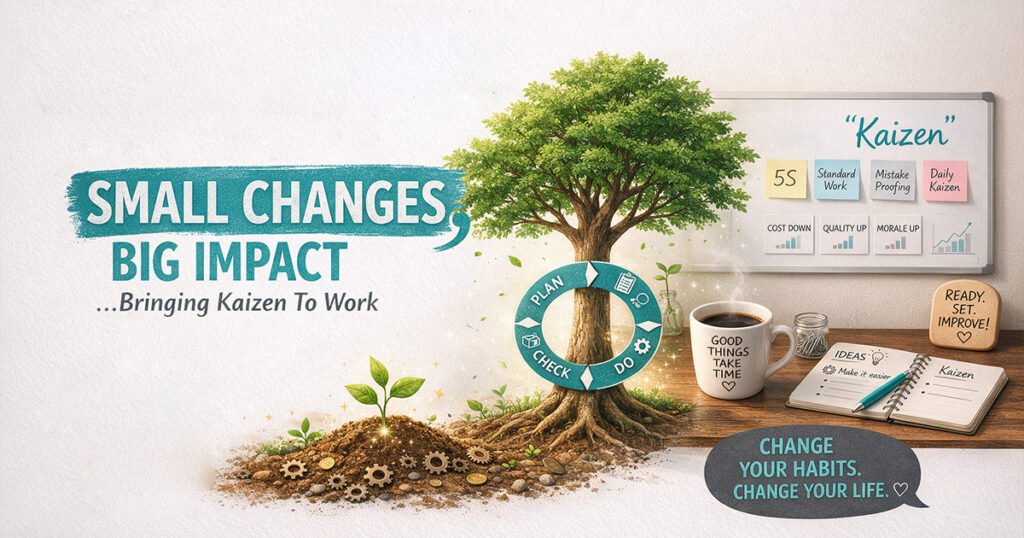
What if meaningful change did not require a dramatic overhaul, but simply the disciplined pursuit of small improvements—made consistently, measured carefully and sustained over time? A tiny adjustment to a morning routine, a smarter way of completing a familiar task, or a quiet decision to learn from yesterday rather than settle for it. Over time, these seemingly insignificant changes can gather momentum, transforming not only how we work, but how we live. That is the thinking at the heart of Kaizen, the Japanese philosophy of continuous improvement.
Rather than waiting for a major overhaul, Kaizen asks a deceptively simple question: “What could we make a little better today?” For organisations facing constant pressure to improve productivity, customer experience, quality and agility, that mindset has considerable appeal. Yet Kaizen is more than a collection of efficiency techniques. At its best, it is a way of working that encourages people at every level to identify problems, test improvements, learn from the results and incorporate successful changes into everyday operations.
Importantly, Kaizen is not a promise that every small change will produce a dramatic result. Research suggests that its value depends heavily on how it is implemented, particularly on leadership commitment, employee involvement, organisational culture and the ability to sustain improvements over time.
The word Kaizen is commonly translated as “change for the better” or “continuous improvement.” It is a Japanese business philosophy centred on making small, ongoing improvements. In business, it became closely associated with Japanese manufacturing and the development of the Toyota Production System before spreading into industries ranging from healthcare and services to logistics and knowledge work.
A traditional improvement effort might involve a large project team, significant investment and a target date several months away. Kaizen can certainly coexist with major transformation, but it operates at a different level. It encourages employees to identify small sources of waste, delay, duplication, error or frustration and address them systematically.
A 2024 systematic literature review examining 98 research articles on the development and application of Kaizen found that the approach has been adopted across multiple industries, while also highlighting that its effectiveness and sustainability depend on context and implementation.
In other words, Kaizen is not simply about “making lots of small changes.” It is a disciplined cycle of observing, improving, testing, learning and standardising.
Why Kaizen Matters to Modern Organisations
The business case begins with an uncomfortable reality: organisations can lose enormous amounts of time not necessarily through spectacular failures, but through repeated small inefficiencies. One unnecessary approval may take three minutes. One duplicated spreadsheet may take ten. One confusing customer handoff may generate another email, another call and another delay. Repeated hundreds or thousands of times, these small sources of friction become significant.
Kaizen gives organisations a mechanism for bringing that friction into view. It also changes who is expected to solve problems. The people closest to a process often understand its practical difficulties better than someone observing it from a distance. A frontline employee may know exactly why a particular form causes errors, why customers abandon a particular step or why a supposedly efficient procedure requires an unofficial workaround. That makes employee participation central to Kaizen rather than optional.
A 2024 systematic review of continuous-improvement initiatives found that senior-management involvement and organisational culture were among the important factors affecting team effectiveness. The authors also highlighted the importance of resources, appropriate recognition and employee empowerment.
Benefits of Kaizen
Kaizen can contribute to several organisational benefits, although results vary according to the sector, process and quality of implementation.
- Less waste: Waste does not only mean unused materials. In an office, it can include unnecessary meetings, repeated data entry, excessive handoffs, waiting for approvals or time spent searching for information. A team that discovers that three people are independently maintaining similar reports has identified a potential Kaizen opportunity.
- Better quality: Small process improvements can reduce opportunities for mistakes. Standardising a reliable procedure, clarifying responsibilities or introducing a simple quality check can help prevent recurring problems.
- Greater operational efficiency: When organisations remove bottlenecks and unnecessary steps, work can flow more smoothly. Recent reviews of Kaizen applications across industries continue to identify productivity, efficiency and waste reduction among the principal objectives of implementation.
- More engaged problem-solving: Kaizen can give employees a more active role in improving the systems within which they work. It means people should have a credible channel through which problems and ideas can be raised, tested and discussed.
This distinction matters. A suggestion box that nobody reads is not Kaizen.

Kaizen Starts With Seeing the Work
One of the most practical principles of Kaizen is to understand what actually happens rather than relying exclusively on what a process map or policy says should happen.
Consider a finance team whose expense-reimbursement policy appears perfectly logical on paper. Employees submit a form, a manager approves it, Finance checks it and payment is made. However, when someone observes the process closely, they may discover that forms are frequently returned because a required field is unclear, managers receive approval requests without enough context, and Finance manually re-enters information into another system.

The problem is not necessarily employee performance. The process itself may be creating avoidable friction. A Kaizen approach might involve identifying the causes, redesigning the form, clarifying the instructions and testing the revised process for several weeks. The improvement may appear modest. But if it eliminates thousands of unnecessary corrections each year, that modest change becomes meaningful.
Practical Kaizen Habits for Individuals
Kaizen is not reserved for factories or corporate improvement teams. Professionals can apply the philosophy to their own working lives.
- Keep a “friction list”: For one week, note recurring frustrations―the report you always have to reformat, the file you can never find or the meeting that consistently lacks an agenda. Do not try to fix everything. Look for one recurring problem.
- Improve one routine at a time: If preparing for the weekly management meeting takes an hour, experiment with a standard template. If you repeatedly forget follow-ups, create a consistent end-of-meeting action-capture process. Small experiments are easier to evaluate than sweeping productivity systems.
- Ask “why?” before treating symptoms: If a task is repeatedly late, ask why. Then ask why again. A deadline problem may actually be caused by an unclear dependency, an approval bottleneck or incomplete information at the beginning of the process.
- Standardise what works: Once an improvement proves useful, turn it into a repeatable practice. An improvement that depends entirely on someone’s memory is unlikely to remain an improvement for long.
- Review, do not obsess: Kaizen is about continuous improvement, not continuous self-criticism. The objective is to learn, refine systems and make progress.
What Kaizen Looks Like in the Workplace
For leaders, the challenge is to create conditions in which improvement becomes normal rather than exceptional. Start with regular, focused improvement conversations. A team might spend ten minutes at the end of each week asking:
- What created unnecessary friction this week?
- What did we learn?
- What small change should we test?
- How will we know whether it helped?
The questions are deliberately practical. Leaders should also make experimentation safe. If employees believe that identifying a problem will result in blame, they have a strong incentive to hide problems. Research on organisational culture increasingly points to the importance of psychological safety and participation in enabling constructive employee behaviour and improvement. This shifts the conversation from blame to learning.
However, there is a trap in adopting Kaizen: turning it into another corporate ritual. Teams can hold improvement meetings, generate dozens of ideas and fill dashboards with activity while achieving very little. More suggestions do not automatically translate into better performance.
A 2024 review of process-improvement failures examined 49 studies and identified 39 factors associated with unsuccessful initiatives. The findings reinforce an important warning: improvement programmes can fail because of organisational and implementation problems, not necessarily because the underlying idea of continuous improvement is flawed.
The antidote is discipline. Choose meaningful problems. Define the current situation. Make a small change. Measure what happens. Keep it, adapt it or abandon it based on evidence. Resist the temptation to launch ten initiatives when one well-executed improvement would be more valuable.
The Leader’s Role: Create the Conditions
Kaizen ultimately says something important about leadership: leaders do not have to personally identify every improvement. Their role is to create an environment in which improvement can happen consistently.
That means giving teams time to solve problems, providing access to relevant information, removing barriers, recognising useful contributions and following through when employees raise legitimate concerns. It also means accepting that some experiments will not work. A failed small experiment can still be valuable if it teaches the organisation something and prevents a larger mistake later.
The goal is not perfection. It is a workplace that gets better at getting better.
For an organisation considering Kaizen, the first step does not need to be a company-wide transformation. Choose one team and one recurring problem. Map what actually happens. Ask the people doing the work where the friction lies. Identify a small change, agree on a simple measure, test it and review the result. If it works, standardise it. If it does not, understand why and try again. Then repeat. Over time, these cycles can accumulate into an organisational habit of learning.
That may be the most useful lesson of Kaizen for today’s corporate world. At a time when leaders are constantly being asked to transform, disrupt and reinvent, improvement does not always need to arrive as a grand strategy. Sometimes it begins with noticing an unnecessary step, asking a better question and recognising that the most consequential change in an organisation can start with a very small one.