

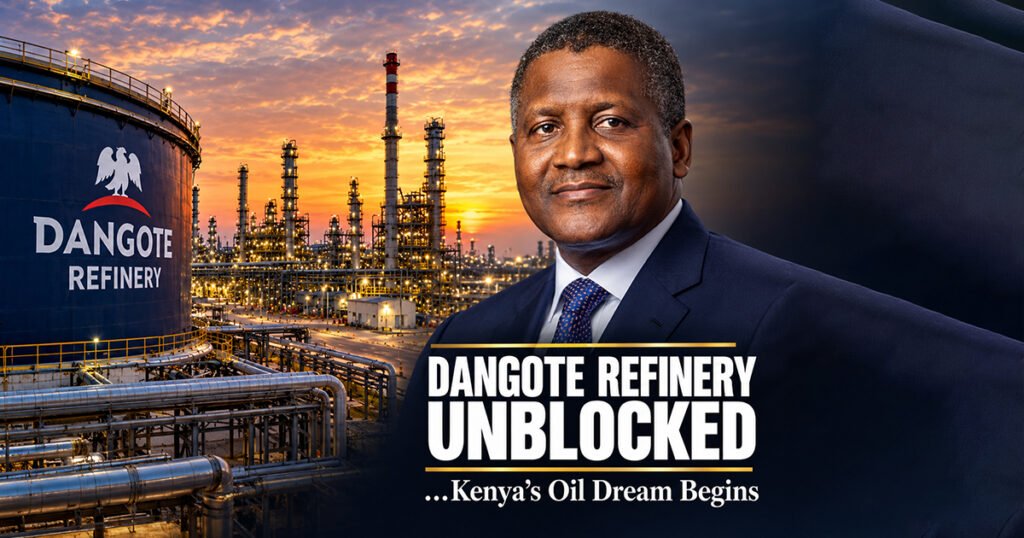
Kenya took a decisive step towards energy self-reliance when the Malindi High Court lifted a restraining order on the ambitious Dangote oil refinery project in Lamu. The ruling clears the way for the construction of a facility valued at approximately KSh 2.2 trillion, making it one of the largest industrial investments in the country’s recent history.
President William Ruto and Nigerian billionaire Aliko Dangote have remained firmly committed to the venture, which is projected to begin operations around 2030. For a nation that has long depended on imported refined petroleum products, the decision represents more than a legal victory. It signals the possible beginning of a new chapter in Kenya’s economic development.
The court’s decision removes a significant legal obstacle that had stalled progress amid an ongoing land dispute. Officials and project backers now describe the development as a practical step towards realising Kenya’s long-standing ambition to establish domestic oil-refining capacity. Although challenges remain, the ruling has injected fresh momentum into plans that could reshape the energy landscape along the coast and beyond.
Historic Court Ruling Clears Major Obstacle
The Malindi High Court’s decision followed consideration of competing claims over the land earmarked for the refinery. Opponents had previously secured an order that effectively halted preparatory work. By lifting that restriction, the court has cleared the way for developers to proceed with site preparation, environmental compliance procedures and eventual construction.
Government statements have emphasised that the project must still satisfy outstanding legal and administrative requirements. Nevertheless, the removal of the restriction is widely regarded by supporters as a significant breakthrough.
Local and national leaders reacted swiftly. Supporters hailed the judgment as evidence of Kenya’s ability to attract and protect large-scale foreign investment, while critics continued to raise concerns about land rights and community consultation. The court’s decision does not resolve these issues, but it shifts the focus from a complete halt to the management of the project’s remaining challenges.
Project timelines point towards a possible groundbreaking in the near term, with full commercial operations targeted for around 2030.
Massive Scale of the Planned Facility
The proposed Dangote Lamu refinery is envisioned as a modern industrial complex capable of processing substantial volumes of crude oil into fuels and related products. With an estimated cost running into trillions of shillings, it ranks among the most capital-intensive projects proposed in Kenya.
Proponents argue that domestic refining could reduce the country’s dependence on imported petrol, diesel and kerosene. Recent increases in pump prices, which reportedly saw petrol rise by more than KSh 12 per litre in Nairobi alone, have intensified public interest in initiatives that could eventually ease energy costs.
Aliko Dangote’s track record of developing large industrial facilities across Africa lends credibility to the project’s ambitions. The Nigerian industrialist has successfully established cement and other manufacturing operations in several countries. His involvement brings significant financial resources and industrial experience to the proposed venture.
Kenyan authorities have presented the partnership as a model of African-led development, in which more economic value is retained within the continent rather than being lost through the export of raw resources and the subsequent importation of finished products.
Economic Promise for Jobs and Growth
If completed as planned, the refinery is expected to generate thousands of direct and indirect jobs during construction and subsequent operations. Coastal communities in Lamu and neighbouring counties could benefit from employment opportunities, supplier contracts and improved infrastructure.
Associated investments in roads, electricity connections and port facilities could stimulate wider economic activity. National planners also anticipate potential foreign-exchange savings as the country reduces its expenditure on imported refined petroleum products.
Kenya’s broader economic circumstances make the project particularly significant. Multidimensional poverty continues to affect a substantial proportion of the population, while high living costs, partly driven by energy expenses, remain a burden on households and businesses.
A successful domestic refinery could contribute to more reliable fuel supplies and, over time, more competitive pricing. Government officials have also highlighted the potential growth of related industries, including logistics, maintenance services and petrochemical manufacturing, which often develop around major refining facilities.

Land Concerns Persist Despite Ruling
The court’s decision does not resolve every grievance surrounding the project. An ongoing land dispute continues to cast a shadow over the development, with local residents and advocacy groups raising questions about land ownership, compensation and the potential effects on traditional livelihoods.
Lamu’s distinctive cultural heritage and ecological significance add further complexity. The area is home to historic communities and fragile coastal ecosystems that require careful protection.
Project developers and government agencies have pledged to engage transparently with affected communities and comply with environmental standards. Previous large-scale infrastructure projects in Kenya have sometimes encountered difficulties over community relations, and the Dangote refinery will face close scrutiny on this front.
Resolving outstanding land issues fairly and transparently will be essential to ensuring that construction proceeds smoothly and that the project’s benefits are shared equitably. Independent monitoring and effective grievance-resolution mechanisms will also be important in maintaining public confidence.

Strong Political Support at the Highest Levels
President Ruto has consistently championed the refinery as a strategic national asset. His administration views greater energy self-reliance as a cornerstone of long-term economic prosperity.
Senior officials have repeatedly indicated that the government intends to remove unnecessary obstacles to investment while upholding the rule of law. The timing of the court ruling also coincides with heightened political activity ahead of Kenya’s 2027 general election. Projects of this magnitude are likely to feature prominently in national discussions about economic progress and the government’s development record.
Opposition figures have questioned aspects of the proposed deal and the pace of community consultation. Nevertheless, the underlying objective of expanding domestic refining capacity has the potential to attract support across the political spectrum.
The debate is likely to centre less on the principle of reducing dependence on imported petroleum products and more on the project’s implementation, environmental safeguards and the equitable distribution of its benefits. As political campaigns intensify, the refinery could become a prominent feature of discussions about industrialisation and coastal development.
Environmental and Social Safeguards Under Review
Lamu is a region of considerable biodiversity and cultural significance. Any major industrial facility must address its potential effects on marine life, air quality, water resources and community health.
Environmental impact assessments are an essential part of the approval process. Authorities have indicated that the project will incorporate modern technologies designed to minimise emissions, waste and other forms of pollution. International best practices in refinery safety and environmental management are expected to inform the facility’s design and operation.
Social impact planning will be equally important. Training programmes for local workers, fair recruitment practices and investments in community infrastructure could help transform the industrial site into a source of shared prosperity.
Experience from other African megaprojects suggests that early and continuous engagement with residents can reduce conflict and improve project outcomes. The coming months will test how effectively these principles are translated into practice.
Regional Ambitions and Continental Context
The Lamu refinery fits into a broader trend of African countries seeking to capture more value from their natural resources. Across the continent, governments have pursued similar ambitions, with varying degrees of success.
Kenya’s strategic location, port infrastructure and expanding industrial base could provide advantages. If successful, the refinery could serve not only the domestic market but also parts of the wider East African region, strengthening regional trade and energy security.
Partnering with an experienced industrialist such as Dangote could help mitigate some of the technical and financial risks that have undermined previous industrial ventures. However, the project must also account for changes in global energy markets.
As the world gradually transitions towards cleaner energy sources, long-term demand for some refined petroleum products may decline. Project planners will therefore need to consider how the facility can remain commercially viable as market conditions evolve. Potential opportunities could include greater flexibility in production and the development of petrochemical products that retain economic value as transport systems become less dependent on conventional fuels.
What Ordinary Kenyans Stand to Gain or Lose
For the average Kenyan, the most immediate hope is that the refinery will eventually contribute to more affordable and reliable fuel supplies. Transport costs influence food prices, public transport fares and the operating expenses of small businesses. Any sustained reduction or greater stability in energy costs could ease pressure on household budgets.
Construction would also generate temporary employment and create demand for local goods and services. Over the longer term, a stronger industrial base could support higher-skilled employment, expand the tax base and generate additional revenue for public services.
However, significant risks remain. Large-scale projects can displace communities or place pressure on local resources if they are poorly managed. Cost overruns and construction delays could also undermine public expectations.
Furthermore, global crude oil prices, exchange-rate movements, taxes, refining costs and distribution expenses will continue to influence domestic pump prices, regardless of whether Kenya establishes its own refining capacity.
The refinery is therefore not a complete solution to the country’s energy challenges. Rather, it could become one component of a broader strategy encompassing renewable energy, energy efficiency, industrial development and regional cooperation.
2030 and Beyond
The journey from a favourable court ruling to an operational refinery remains long. Financing arrangements must be secured, contracts finalised, skilled labour mobilised and the necessary regulatory approvals obtained. Constructing a facility of this scale would typically require several years of coordinated planning and execution.
If the 2030 target is achieved, Kenya could enter the next decade with a major new industrial asset on its coast.
Success would mark a significant milestone in the country’s pursuit of industrial transformation. It would demonstrate that ambitious projects can overcome legal and logistical challenges when political commitment, private capital and effective governance work together. Conversely, failure or substantial delays could reinforce public scepticism about the country’s ability to deliver complex development projects.
The coming years will determine which outcome prevails.
For now, the Malindi High Court’s decision has removed a significant obstacle. Kenya’s long-discussed ambition to establish domestic oil-refining capacity has taken a potential step closer to reality.
The proposed Dangote refinery represents both an opportunity and a test. How the country addresses the remaining legal, financial, environmental and social challenges will determine whether the project delivers lasting benefits for the economy, the environment and the communities closest to the site.
The work of turning a legal development into steel, concrete, industrial capacity and sustainable employment has only just begun.