
For four decades, Ghana’s petroleum story has evolved from exploration and resource discovery to the broader challenge of translating hydrocarbons into lasting national value. As the Ghana National Petroleum Corporation (GNPC) reflects on four decades of operations, its next chapter is increasingly defined by a critical question: can renewed exploration help secure Ghana’s future energy needs?
Established in 1983 to explore and develop Ghana’s hydrocarbon resources, GNPC has become a strategic institution in the country’s energy security and economic development. However, declining production, volatile global energy markets and the accelerating transition to cleaner energy are reshaping the sector.
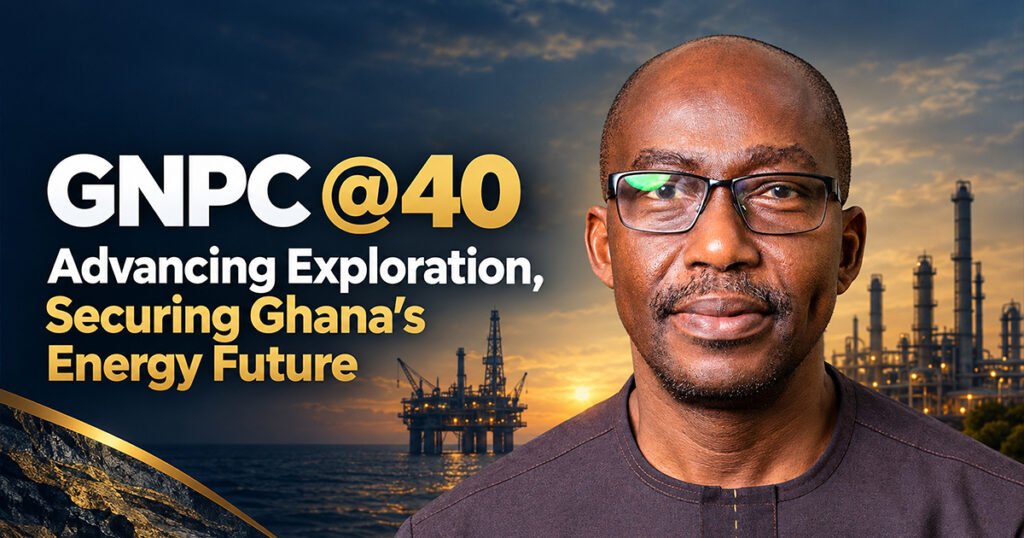
In an exclusive interview with The Vaultz Africa, Mr. Kwame Ntow Amoah, Chief Executive of Ghana National Petroleum Corporation, highlights renewed exploration—from the onshore Voltaian Basin to Ghana’s offshore acreage—as a key pathway to replenishing the country’s petroleum resources and strengthening energy security.
His core argument is that energy security begins with understanding what resources Ghana has and developing them where commercially sensible. As such, exploration creates the opportunity; sustained production, commercialised gas and disciplined execution will determine its impact.
From Petroleum Potential to a Producing Nation
Ghana’s petroleum story has evolved from geological potential into a functioning upstream industry, with the Ghana National Petroleum Corporation (GNPC) playing a central role in building the foundations of that transformation.
According to Mr. Amoah, GNPC’s journey is “very much the story of Ghana moving from petroleum potential to a producing country with a functioning upstream industry.”
The Corporation’s early work was foundational—acquiring geological data, promoting Ghana’s sedimentary basins, developing technical expertise and creating the conditions necessary to attract investment. That groundwork ultimately contributed to the discovery and development of the Jubilee, TEN and Sankofa Gye Nyame fields.
The defining lesson, according to Mr. Amoah, is that discovery is only the beginning.
“The important lesson is that resources in the ground do not automatically become national value. You need good data, patient investment, strong institutions, credible partners, commercial discipline and local capability. You also have to keep exploring.”
That lesson has become particularly relevant amid declining production. Success in one period, he says, cannot become a reason to slow down. For GNPC, the next phase is therefore about applying four decades of experience to sustain production, commercialise more gas, open new exploration frontiers and progressively build greater operatorship capability.

Four Decades of Milestones and National Capability
GNPC’s contribution to Ghana’s petroleum sector extends beyond production volumes and financial returns.
Mr. Amoah identifies four broad areas of impact: building the foundations of the petroleum industry, supporting production, developing Ghana’s gas resources and strengthening national capability.
The Corporation helped build and promote the geological knowledge that attracted exploration investment into Ghana, which was “central to the country’s journey to the Jubilee discovery and first oil.” It has since represented the State’s commercial interests across the country’s three producing fields.
By the end of 2025, the Greater Jubilee Field had produced a cumulative 454.84 million barrels of crude oil and 840.60 billion standard cubic feet of associated gas.
Gas has also become an increasingly important pillar of Ghana’s energy system. Domestic gas supplies support electricity generation and industry, while gas exports for domestic use reached approximately 336 million standard cubic feet per day in 2025.

Beyond its producing assets, GNPC has invested approximately US$160 million in geological, geophysical and seismic work in the Voltaian Basin as it prepares to move towards drilling.
But perhaps the Corporation’s most enduring contribution is less tangible: the development of national capability. This includes Ghanaian professionals, indigenous service companies, technical institutions and the growing expertise within GNPC itself. “Those are assets that remain with the country beyond any single field or project.”
An Evolving Mandate for a Changing Industry
GNPC’s statutory mandate remains centred on the exploration, development, production and disposal of Ghana’s petroleum resources. However, the operating environment surrounding that mandate has changed significantly.
In the industry’s early years, the priority of the Corporation was to attract exploration investment and establish a functioning petroleum sector. Today, GNPC must contend with mature fields, declining production, growing domestic gas demand, stronger expectations around local participation and environmental performance, and increasing competition for global capital.
These realities are pushing the Corporation beyond the role of a passive interest holder and towards a more active commercial and strategic position.
“We must be a commercially disciplined partner, a stronger steward of national assets, an aggregator and marketer of gas, an active explorer and, progressively, a capable operator where that makes commercial and strategic sense. That evolution is not a departure from our mandate; it is what delivering the mandate responsibly now requires.”

From Petroleum Revenues to Long-Term National Value
For Mr. Amoah, the value of GNPC cannot be captured by financial returns alone. In his response, he cautioned against “reducing GNPC’s contribution to one revenue number.” Hence, the Corporation’s broader contribution, he argues, lies in helping Ghana establish a domestic petroleum industry capable of generating revenue, energy security and technical expertise.
Nevertheless, the financial scale is substantial. GNPC Group recorded revenue of US$1.64 billion in 2025, while gas revenue reached US$952.38 million, representing 65.6 per cent of the Corporation’s standalone revenue.
“But the real measure is whether petroleum resources are converted into durable national value.”
That means replenishing the resource base and creating the conditions for future production. Over the coming decade, GNPC plans to sustain output from existing producing fields while advancing discoveries including Pecan, Eban-Akoma, Afina, Almond and Beech, using cluster-based approaches for smaller finds.
Additional domestic gas availability could reduce exposure to imported fuels while supporting industry and potential downstream opportunities, including petrochemicals.
Frontier exploration—particularly in the Voltaian Basin and across more than 25,000 square kilometres of open offshore acreage—forms another part of the strategy.
Across all these areas, Mr. Amoah identifies capability as “the multiplier.” A GNPC that can make stronger investment decisions, manage data and assets effectively and progressively operate projects can retain more value for Ghana.
From Resilience to Renewal
As Ghana’s petroleum sector confronts declining production and a changing global energy landscape, the question is no longer simply how to preserve what exists. It is how to create the next phase of growth.
The Minister for Energy and Green Transition has called for a shift from resilience to renewal and long-term sustainability. For GNPC, Mr. Amoah defines renewal as “moving beyond managing decline and deliberately creating the next phase of growth.” But, as he puts it, “Resilience cannot be the destination.”
Operationally, the shift rests on disciplined execution around a few priorities: arresting production decline, progressing new wells and field developments, commercialising more gas, advancing the Voltaian Basin and improving the commercial performance of GNPC itself.
At the same time, the Corporation must build the competence required to operate petroleum assets.
“Sustainability is part of the same equation. We have to produce more efficiently, manage environmental and social impacts responsibly, strengthen governance and ensure that projects remain commercially viable in a world where capital is increasingly selective.”
Renewal, therefore, is not simply about producing more barrels. It is about building a stronger Corporation and a more competitive petroleum sector.
Confronting Production Decline
The decline in Ghana’s crude oil production has become one of the most immediate challenges facing the upstream sector. Mr. Amoah, therefore, acknowledges that “the decline is real and has to be confronted directly.”
National crude oil production fell from 71.4 million barrels in 2019 to approximately 37.3 million barrels in 2025. Reversing that trend requires both immediate interventions on existing assets and longer-term investment in new production.
In view of this, GNPC is working with operators and Government to sustain field performance and support additional drilling. The extension of the West Cape Three Points and Deepwater Tano Petroleum Agreements to December 2040 underpins a US$2 billion framework for Jubilee and TEN that provides for up to 20 new wells. Additional investment is also being advanced in the Offshore Cape Three Points area, including Eban-Akoma.
More recently, there are early indications of improved production performance.
Speaking at a Technical Consultative Workshop on Ghana’s gas sector in Accra, Deputy Chief Executive for Finance, Commercial and Administration, Mr. Hamis Ussif, said GNPC and its partners have “arrested production decline” and are experiencing “steady production from the three fields.”
Moreover, during the recently concluded ‘Africa Oil Week’, Mr Amoah disclosed that investment commitments will ultimately be judged by their execution. He described “the approximately US$3.5 billion investment programme now moving towards execution as important,” but its real impact will depend on “converting those commitments into wells, projects and production. That is where the focus must remain.”

Voltaian Basin: Testing Ghana’s Next Petroleum Frontier
While existing fields remain central to near-term production, Ghana’s longer-term petroleum prospects depend on finding and developing new resources.
The Voltaian Basin represents the country’s major onshore exploration frontier and, according to Mr. Amoah, provides “an opportunity to test a petroleum system outside our established offshore producing basins.”
Following approximately US$160 million in geological, geochemical and seismic work, GNPC is working towards drilling an exploratory well in the final quarter of 2026.
However, Mr. Amoah emphasizes that what Ghanaians should expect is a disciplined programme rather than a promise of discovery.
“Frontier exploration carries uncertainty; that is the nature of the business. The purpose of the well is to test our technical interpretation and give us information that only drilling can provide. A successful result could open an entirely new petroleum province for Ghana.”
Even if an initial well does not result in a commercial discovery, the information generated could improve understanding of the Basin and inform future investment decisions. The project also provides an opportunity for GNPC and GNPC Explorco to build practical operating experience.
The risk-management philosophy is therefore data-driven: “reduce uncertainty before committing capital and then make each investment decision on the quality of the evidence.”
This is supported by stronger subsurface interpretation, well planning, engineering, project assurance and data governance, with specialist technical partners engaged where necessary.
“There is no method that removes geological risk altogether.”
Rebuilding Ghana’s Exploration Pipeline
The Voltaian Basin is only one component of GNPC’s broader exploration strategy. Mr. Amoah therefore believes Ghana needs “a broader exploration pipeline.”
More than 25,000 square kilometres of open offshore acreage extend from the ultra-deepwater Tano area through Saltpond to parts of the Keta Basin. Reviving exploration will require both a stronger technical proposition through better seismic imaging and accessible data and a competitive commercial environment.
On the investment side, his message to potential partners at ‘Ghana Day’ during the ‘Africa Oil Week’ was straightforward: “Ghana understands that capital has choices.”
The country therefore needs predictable regulation, competitive project economics, timely decision-making and partnerships capable of creating value for both investors and Ghana.
Technology will also play an increasing role. GNPC is expanding its use of 3D and 4D seismic, Ocean Bottom Node technology, machine learning and artificial intelligence to improve subsurface understanding and decision-making.
Mr. Amoah, however, stresses that technology must serve a purpose and not be used “because it is fashionable.”
“It is to extract more insight from the data we already have, identify patterns that may be difficult to see through conventional workflows, improve reservoir understanding and make better decisions about where to deploy capital.”
This is because human expertise remains central and advanced tools help geoscientists and engineers test interpretations across larger datasets, with the objective of securing better data and lowering exploration risk.
Exploration as a Pillar of Energy Security
For GNPC, the case for exploration extends beyond the search for additional petroleum reserves. It is closely connected to Ghana’s broader energy security.
“Energy security begins with understanding what resources we have and developing them where it is commercially sensible,” Mr. Amoah says.
This means sustaining existing oil production, replenishing reserves and placing particular emphasis on gas because of its direct connection to Ghana’s power and industrial systems.
Natural Gas: Powering Ghana’s Energy Security
Mr. Ussif notes that gas contributes more than 90 per cent of thermal power generation, while the three producing fields were exporting just over 409 million standard cubic feet per day as of 21 September.
The next phase of Ghana’s gas infrastructure includes the planned OCTP upgrade, GPP2, the proposed 1,200-megawatt state-led thermal power plant and the Tema LNG terminal, targeted for start-up by the end of 2027. Together, these projects form part of a wider ecosystem intended to strengthen the reliability of domestic energy supply.
Hence, and as Mr. Ussif puts it: “It’s important to remember that where natural gas flows, the lights will glow, industries will follow, and the economy will grow.”
Mr. Amoah prefers the concept of “energy security rather than absolute energy independence,” recognising that modern energy systems are interconnected.
The strategic objective, he says, is to “reduce avoidable vulnerability.”
“Every additional unit of commercially viable domestic energy that can displace a more expensive imported fuel improves Ghana’s resilience to external price shocks and foreign-exchange pressures. Exploration is therefore not separate from energy security; it is one of the long-term foundations of it.”
Yet discoveries alone are insufficient. They must be commercially developable, making exploration, infrastructure, fiscal competitiveness and institutional strength mutually reinforcing.

Balancing Petroleum Development with the Energy Transition
The evolution of Ghana’s petroleum sector is taking place alongside a broader shift in the global energy system. For GNPC, this creates the need to balance continued petroleum development with longer-term energy transition objectives.
Mr. Amoah does not view petroleum development and Ghana’s energy transition as mutually exclusive. “We still have work to do, and I would rather be measured about that than suggest the transition is complete.”
Ghana continues to require reliable and affordable energy, with gas playing an important role in electricity generation and industry. At the same time, the financing and production of oil and gas are changing, while environmental performance is increasingly relevant to investment decisions and competitiveness.
Gas can support the transition where it displaces more carbon-intensive liquid fuels in thermal generation. Alignment with the National Energy Transition Plan towards 2030, Mr. Amoah says, requires “sequencing, not slogans.”
For GNPC, this means embedding ESG considerations into project design, evaluation and management rather than treating sustainability as a “separate communications exercise.”
The emphasis is on greater operational efficiency, responsible gas utilisation, stronger environmental monitoring, early community engagement as onshore exploration advances and transparent governance.
Competitiveness is equally important. The acquisition of the FPSO John Evans Atta Mills for US$205 million, rather than maintaining a more expensive leasing arrangement, illustrates the type of structural efficiency the Corporation is seeking.
“We cannot rely indefinitely on the fact that we are the National Oil Company.”
Building the Capability to Operate
The ambition to assume greater operatorship responsibility requires more than strategic intent. It requires the systematic development of technical, managerial and commercial capability.
For GNPC, transformation begins with strengthening the fundamentals: drilling, reservoir management, subsurface interpretation, project execution, data governance and commercial discipline.
“We know that operatorship is not achieved by declaration. It is built through systems, people, experience and repeated execution.”
The Voltaian Basin provides a practical platform for developing this capability, while GNPC’s Research and Technology Centre and partnerships with universities help connect research with operational needs.
Partnerships with international oil companies, independent producers, other national oil companies, local service companies and African petroleum institutions will remain important. But partnership does not mean dependency.
“GNPC does not need to own every capability,” Mr. Amoah says. Instead, the Corporation needs to leverage external capital, technology and experience while deliberately building Ghanaian expertise.
At the Presidential Dinner hosted with ExxonMobil during ‘AOW: Energy 2026’, he described Ghana’s strength as lying not only in its resources but also in “the relationships we build above [them].”
The test for each new business area, he says, is whether it strengthens GNPC’s commercial position and creates durable value for Ghana.
Mr. Amoah envisions “a Corporation that is technically competent, commercially strong and trusted to take on a greater share of responsibility for Ghana’s petroleum resources.”