
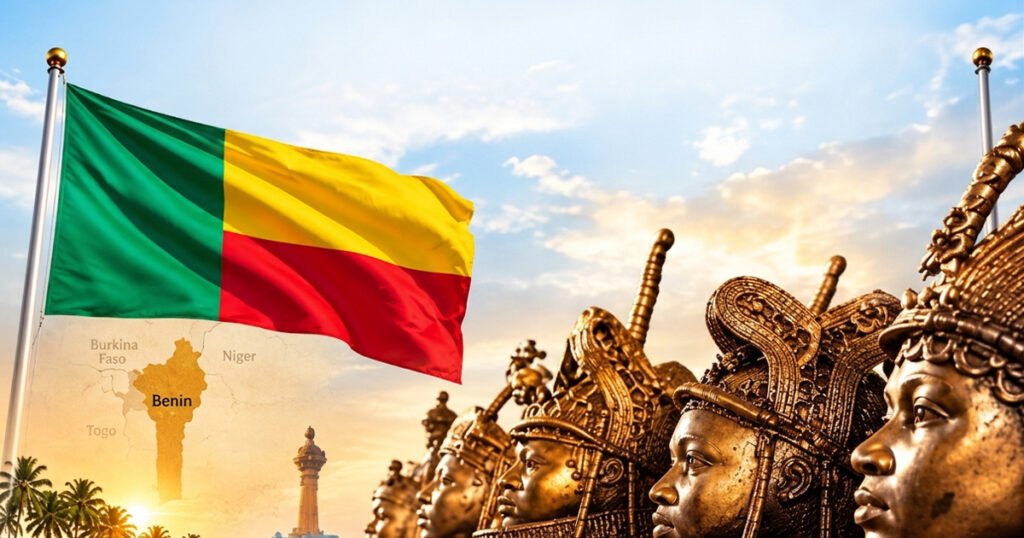
Benin, officially the Republic of Benin, is a narrow, north–south-oriented West African country situated on the Gulf of Guinea. It is bordered by Togo to the west, Nigeria to the east, Burkina Faso and Niger to the north, and the Atlantic Ocean to the south.
Formerly known as Dahomey, the country adopted the name Benin in 1975, drawing inspiration from the historic Bight of Benin, which takes its name from the ancient Benin Kingdom centred primarily in present-day Nigeria.
Although relatively small geographically, Benin’s location gives it considerable regional importance. Its southern coastline and the Port of Cotonou provide an important gateway for trade with neighbouring landlocked countries, particularly Niger and Burkina Faso, while its eastern border connects it closely to Nigeria, Africa’s almost populous country.
Geography Features of Benin
Benin stretches from the humid coastal plains of the Gulf of Guinea to the drier Sudanian and Sahelian zones in the north.
Southern Benin is generally low-lying, characterised by lagoons, lakes, wetlands and sandy coastal areas. Moving northward, the landscape rises into plateaus and savannah, while the Atakora mountain range in the northwest contains some of the country’s highest elevations.
The Ouémé River, Benin’s longest river, is a major geographical feature and supports agriculture and settlement. Other important waterways include the Mono, Niger and Pendjari river systems. Lake Nokoué and the extensive lagoon network around Cotonou and Porto-Novo are also important for transport, fishing and local livelihoods.
Benin’s climate varies considerably from south to north. The southern region generally has a tropical climate with two rainy seasons, while central and northern areas typically experience a single, more pronounced rainy season followed by a longer dry period.
Rainfall is generally heavier along the coast and decreases towards the north. Climate change has increased concerns about irregular rainfall, flooding, coastal erosion and drought, particularly because agriculture remains highly dependent on rainfall. Coastal communities are especially vulnerable to rising sea levels and erosion, while farming areas in the north face growing pressure from land degradation and changing weather patterns.
History of Benin
The territory of modern-day Benin was historically home to several powerful African kingdoms, most notably Dahomey in the south, as well as the kingdoms of Porto-Novo and other political entities.
The Kingdom of Dahomey emerged as a major regional power between the seventeenth and nineteenth centuries. It developed a centralised political system and became deeply involved in regional commerce. Its history is also closely associated with the transatlantic slave trade, particularly through the coastal town of Ouidah, which became one of West Africa’s important slave-trading centres.
France gradually established control over the territory during the late nineteenth century, incorporating it into French West Africa as Dahomey. The country gained independence on 1 August 1960 as the Republic of Dahomey.
The early post-independence period was marked by political instability and repeated changes of government. In 1972, Major Mathieu Kérékou seized power in a military coup and later introduced a Marxist-Leninist political system. The country was renamed the People’s Republic of Benin in 1975.
Economic difficulties and political pressure contributed to the National Conference of 1990, which helped usher in a democratic transition and a new constitutional order. The country subsequently became one of West Africa’s notable examples of a transition from military rule to multiparty democracy.
Population and Cities
Benin has a population of more than 14 million people, with the largest concentration in the south.
Porto-Novo is the official capital, while Cotonou is the country’s largest city and principal economic and commercial centre. Other important urban centres include Parakou, Abomey-Calavi, Ouidah and Natitingou.
French is the official language, while Fon, Yoruba, Bariba, Dendi and numerous other indigenous languages are widely spoken.
Benin is a member of the United Nations, African Union, Economic Community of West African States, West African Economic and Monetary Union, Organisation Internationale de la Francophonie and other regional and international organisations.
Its geographical position and economic links make the country’s stability important to regional trade, security and development.
GOVERNANCE

Benin is a unitary presidential republic operating under the Constitution of 1990, as subsequently amended. A major constitutional revision adopted in 2025 changed the structure of Parliament from a unicameral system to a bicameral one, created a Senate and extended several elected terms to seven years.
Executive Branch
The President serves as both Head of State and Head of Government and exercises significant executive authority. The President also serves as Commander-in-Chief of the armed forces. Following the 2025 constitutional revision, the presidential term is seven years and may be renewed once, with a lifetime limit of two presidential terms.
Romuald Wadagni became President of Benin on 24 May 2026, succeeding Patrice Talon. He had previously served as Minister of Economy and Finance. The Cabinet operates under the authority of the President and supports the formulation and implementation of government policy through the various ministries and public institutions.
Legislative Branch
Benin’s Parliament is now bicameral, comprising the National Assembly and the newly established Senate, following the 2025 constitutional revision. The National Assembly exercises legislative powers and oversees government action. The constitutional changes extended the parliamentary mandate to seven years for the legislature elected under the new framework.
The creation of the Senate represents a significant change from the previous unicameral parliamentary structure.
Judicial Branch
Benin’s judicial system includes the Constitutional Court and the Supreme Court, alongside other courts established under national law. The Constitutional Court is the highest authority on matters of constitutional interpretation and review. It also plays an important role in electoral and constitutional matters.
The Supreme Court is the highest court for matters within the ordinary judicial hierarchy and performs both judicial and advisory functions. The constitutional framework also provides for a High Court of Justice with jurisdiction over specified high-level constitutional and political offences.
Administrative Divisions
Benin is divided into 12 departments: Alibori, Atakora, Atlantique, Borgou, Collines, Couffo, Donga, Littoral, Mono, Ouémé, Plateau, and Zou. These departments are further divided into communes and smaller administrative units.
The decentralisation process seeks to bring government closer to local communities and improve service delivery. However, local authorities continue to face financial, administrative and institutional constraints.
Differences between the relatively urbanised south and the more rural north also influence development outcomes and access to infrastructure.
ECONOMY
Benin has a developing, trade-oriented economy in which agriculture, commerce, transport and services play central roles. Its strategic location between Nigeria and the landlocked countries of the Sahel has made trade and logistics particularly important. The Port of Cotonou serves the domestic economy while also providing access to regional markets.
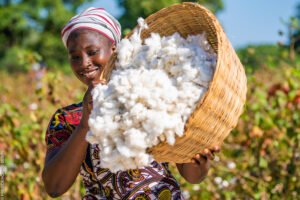
Agriculture remains a major source of employment, with cotton serving as the country’s leading agricultural export. Other important sectors include food production, transport, telecommunications, construction, financial services and, increasingly, industrial processing.
The government has sought to diversify the economy through investment in industrial zones, tourism, infrastructure and value addition.
Benin uses the West African CFA franc, which is shared by members of the West African Economic and Monetary Union and managed regionally through the Central Bank of West African States.
Cotton and cotton-related products are among the country’s important exports, while cashew nuts and other agricultural commodities also contribute to export earnings. Benin imports petroleum products, machinery, food products and manufactured goods.
Nigeria remains a particularly important economic partner because of its proximity, large consumer market and extensive formal and informal trade links. Benin’s economic strengths include its coastal location, access to regional markets, the strategic importance of Cotonou as a logistics centre and a policy focus on industrialisation and value addition.
Its challenges include dependence on commodity exports, exposure to developments in Nigeria, widespread informal employment, poverty, infrastructure gaps, security pressures in the north and climate-related risks.
AGRICULTURE
Agriculture remains one of the foundations of Benin’s economy and provides livelihoods for a substantial share of the population, particularly in rural areas. Production is dominated by smallholder farmers, with the sector combining subsistence farming and commercial agriculture.
Cotton is the country’s most important cash crop and has historically accounted for a significant share of agricultural export earnings. Major food crops include maize, cassava, yams, rice, sorghum, millet, beans and vegetables.
Livestock production is also important, particularly in northern areas, where cattle, sheep and goats contribute to household incomes and food security. Fishing supports many coastal and lakeside communities.
Cotton production is concentrated largely in the northern and central parts of the country. Benin has emerged as one of Africa’s leading cotton producers, and the crop remains central to efforts to expand agro-industrial processing.
Cashew nuts have also become increasingly important as an export commodity, while pineapple, palm products and other horticultural goods contribute to agricultural activity.
Despite its importance, agriculture faces significant challenges. Production remains vulnerable to rainfall variability, drought, flooding and land degradation. Farmers often have limited access to irrigation, modern equipment, credit, storage facilities and reliable transport.
Developing local processing is therefore central to efforts to increase agricultural value, create employment and reduce dependence on exports of raw commodities.
INDUSTRY
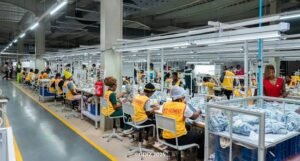
Benin’s industrial sector is relatively small compared with its agricultural and services sectors but has become an increasingly important focus of government policy.
Industrial activity includes agro-processing, cement production, food and beverage manufacturing, textiles, petroleum-related activities and construction materials.
The government’s industrial strategy has increasingly focused on processing agricultural products domestically rather than exporting them in raw form. The objective is to create employment, increase export earnings and strengthen domestic value chains.
The development of industrial infrastructure around Glo-Djigbé, near Cotonou, has become a central component of this strategy. Benin’s industrial development benefits from its access to the Port of Cotonou and regional markets. However, electricity costs, access to finance, competition from imported goods and the limited scale of domestic manufacturing remain challenges.
The large informal sector also continues to play an important role in employment and commerce, although informal businesses often operate outside formal regulatory and tax systems.
Manufacturing
Manufacturing in Benin is centred primarily on food processing, cotton and textile production, beverages, cement, pharmaceuticals, plastics and other consumer goods.
Agro-processing offers significant potential because of the country’s agricultural base. The Glo-Djigbé Industrial Zone has been developed to promote large-scale processing and manufacturing, including cotton transformation, textile production, cashew processing, food processing and other export-oriented activities.
The broader objective is to retain a greater share of the value generated by Benin’s agricultural products and create industrial employment.
Cotton provides one of the clearest examples of this strategy. Rather than relying almost entirely on raw cotton exports, Benin has sought to expand spinning, textile and garment production. Cashew processing has similarly been targeted for expansion, reducing the need to export raw nuts for processing abroad.
Manufacturing remains constrained by infrastructure gaps, skills shortages, energy requirements and the relatively limited size of the domestic market. However, investment in industrial zones and regional trade opportunities could support further expansion.
Extractive Industries
Benin is not a major mining economy, and extractive industries contribute far less to national output than agriculture, trade and services. Nevertheless, the country possesses deposits of limestone, marble, clay, gold and other minerals. Limestone is particularly important because of its use in cement production.
Small-scale and artisanal gold mining occurs in parts of the country, particularly in northern regions. The sector remains limited and faces challenges relating to regulation, environmental management and informal activity.
Benin has also explored offshore petroleum resources, although oil production has historically been limited compared with the petroleum industries of larger West African producers.
The relatively limited role of extractives means that Benin’s economy is less dependent on mining revenues than many resource-rich African countries. However, future development of natural resources will require effective regulation to address environmental risks, illegal extraction and the equitable distribution of benefits.
Construction
Construction has become increasingly important as a result of public investment in roads, housing, urban development, tourism infrastructure and industrial facilities.
Government programmes have prioritised the modernisation of major urban centres and transport routes. Road development has improved connections between Cotonou, Porto-Novo, Abomey-Calavi, Parakou and northern parts of the country.
The expansion of industrial zones has created additional demand for factories, warehouses and logistics infrastructure. Construction benefits from continued urbanisation and public investment but faces challenges related to financing, the cost of building materials and infrastructure maintenance.
Rapid urban growth, particularly around Cotonou and Abomey-Calavi, has also increased pressure on housing, drainage, sanitation and transport systems.
SERVICES
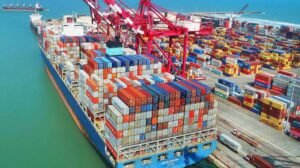
Services constitute a major component of Benin’s economy and include trade, transport, telecommunications, financial services, public administration and tourism. Commerce is particularly important because Benin functions as a trading hub between coastal West Africa and neighbouring landlocked states.
The Port of Cotonou is the country’s most important transport and commercial asset. It handles imports and exports for Benin and serves as a gateway for goods moving to and from Niger, Burkina Faso and other parts of the region.
Its proximity to Nigeria also supports extensive cross-border commerce.
Port operations, trucking, warehousing and related logistics activities therefore generate significant economic activity. Road transport remains the dominant mode of internal transportation. The country has developed major north–south and east–west corridors, although road quality varies. Rail infrastructure remains limited, making road and maritime transport particularly important.
Cotonou’s international airport provides air connections to regional and international destinations.
Telecommunications have also expanded significantly through mobile phone services and digital connectivity. Mobile technology has supported financial inclusion and commercial activity, while digital services are becoming increasingly important to government and private-sector operations.
Banking and Financial Services
Benin’s banking sector operates within the regional framework of the West African Economic and Monetary Union. The Central Bank of West African States is responsible for monetary policy and currency issuance for member countries, including Benin. Commercial banks provide services to businesses and households, although access to formal financial services remains uneven, particularly in rural areas.
Microfinance institutions have therefore played an important role in extending financial services to smaller businesses and lower-income populations. Mobile money has further expanded access to payments and transfers, allowing people outside the traditional banking system to conduct financial transactions through mobile phones.
Digital financial services and fintech are likely to become increasingly important as mobile connectivity expands and efforts to promote financial inclusion continue.
Challenges include limited access to credit for small businesses, the dominance of informal economic activity and disparities in financial access between urban and rural areas.
TOURISM
Tourism is an important area of potential growth for Benin because the country combines historical, cultural and natural attractions. The government has invested in tourism infrastructure and sought to develop Benin as a destination for cultural heritage, coastal tourism and wildlife.
Ouidah is among the country’s best-known historical destinations. It is closely associated with the history of the transatlantic slave trade and contains monuments, museums and sites connected to that history, including the Route of the Slaves. Ouidah is also an important centre of Vodun culture and hosts the annual Vodun Festival.
Ganvié, located on Lake Nokoué, is another major attraction. Often described as a lake village, it is characterised by houses and community life built around the water. Its distinctive cultural and physical environment has made it one of Benin’s most recognisable tourist destinations.
The country also has significant wildlife resources. Pendjari National Park and W National Park form part of an important transboundary conservation landscape in West Africa and contain elephants, lions, buffaloes, antelope and other wildlife.
Other attractions include the Royal Palaces of Abomey, the coastal town of Grand-Popo, Porto-Novo’s Afro-Brazilian heritage and the Atakora region’s natural landscapes.
Tourism growth depends on improved infrastructure, accommodation, marketing and security. Insecurity in northern areas has created challenges for wildlife tourism, while coastal erosion and environmental pressures threaten some tourism assets.
CULTURE
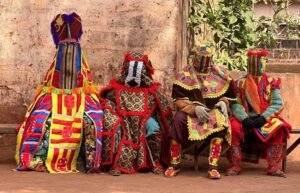
Benin’s culture reflects the diversity of its ethnic groups, historical kingdoms and interactions with West Africa, Europe and the wider African diaspora. Major ethnic communities include the Fon, Adja, Yoruba, Bariba, Dendi and numerous other groups. Cultural traditions vary between the southern coastal regions and the northern savannah areas.
French is the official language, but indigenous languages remain central to everyday communication and cultural identity. Fon and Yoruba are widely spoken in the south, while Bariba and other languages are prominent in northern regions.
Religion is similarly diverse. Christianity and Islam are widely practised, while Vodun remains an important indigenous religious tradition.
Vodun originated in the region and has influenced religious and cultural traditions across the Atlantic world, particularly in parts of the Caribbean and the Americas. In Benin, Vodun practices coexist with Christianity and Islam and remain an important element of cultural identity.
Traditional music, dance, storytelling, sculpture and textile production are significant forms of cultural expression. The history of the Kingdom of Dahomey continues to influence art, historical memory and national heritage.
The annual Vodun Festival in Ouidah is among the country’s most prominent cultural events.
Cuisine
Beninese cuisine reflects the country’s agricultural resources and regional diversity. Common staples include maize, cassava, yams, rice and beans. Dishes are frequently served with sauces made from tomatoes, peanuts, vegetables or palm products.
Fish is particularly important in coastal and lakeside communities, while meat dishes and grilled foods are common throughout the country. Fruits such as mangoes are also widely consumed.
Street food forms an important part of urban life, particularly in Cotonou and Porto-Novo.
SPORTS
Football is the most popular sport in Benin and attracts widespread public interest. It is also the country’s principal international sporting activity.
The men’s national football team, known as the Cheetahs, has participated in several Africa Cup of Nations tournaments. Football clubs provide opportunities for domestic competition and player development.
Other popular sports include athletics, basketball, handball, volleyball and traditional sporting activities.
The development of sports is constrained by infrastructure gaps, limited financing and the need for stronger grassroots programmes. Investment in stadiums, training facilities and youth development could strengthen the country’s ability to identify and develop sporting talent.
Benin’s sporting sector therefore remains an important area of cultural identity and youth engagement, with potential for further development alongside broader investment in infrastructure and talent development.